Appearance
Genogram Symbols
Genogram symbols are standardized shapes and lines that represent the people in a family and how they relate to each other.
This page covers the full symbol set available in EasyGenogram, organized by what each type does.
Person Shapes
Every person on a genogram is represented by a shape. The shape indicates gender identity.
Standard shapes:
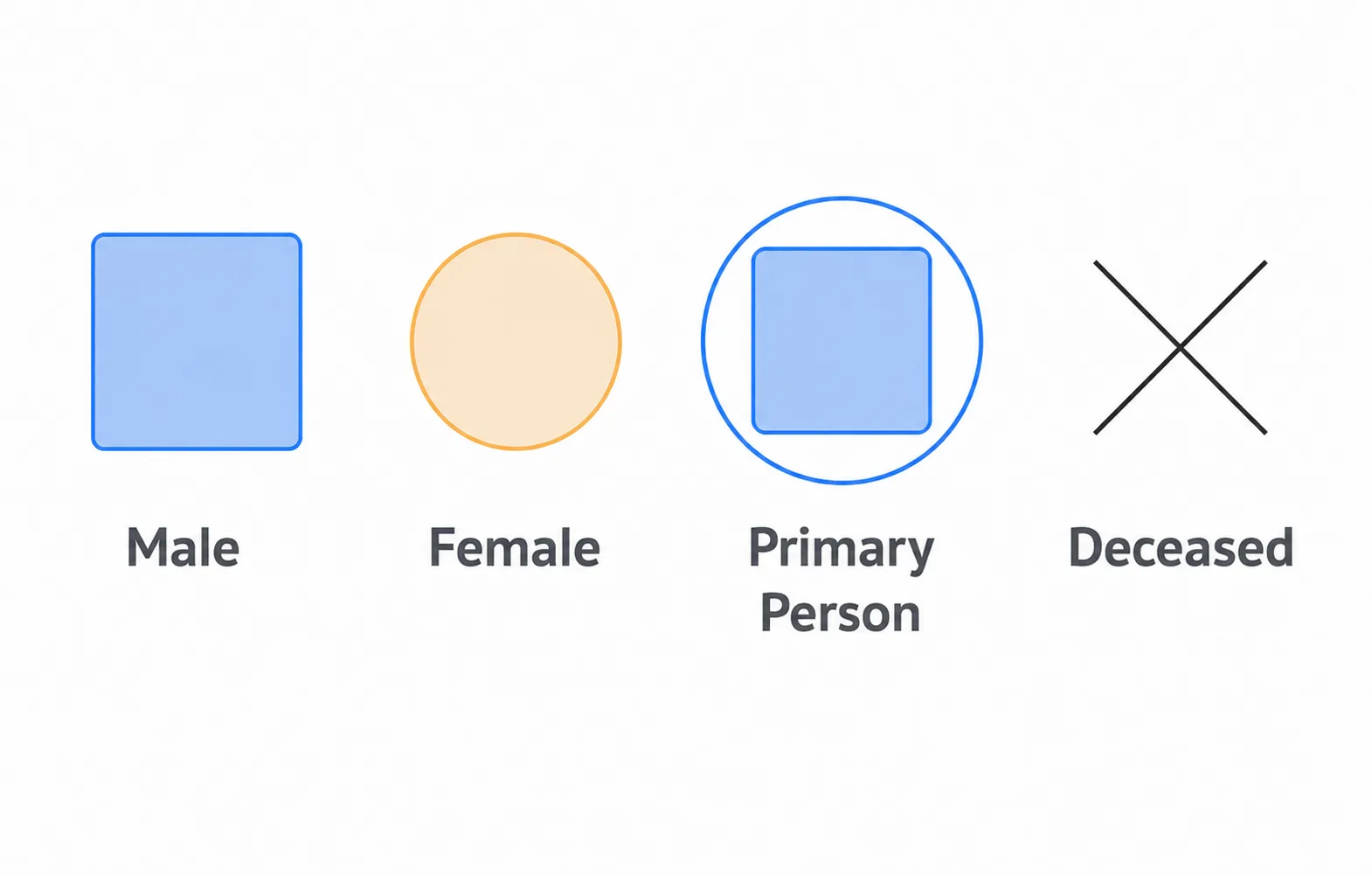
- Male - solid square.
- Female - solid circle.
- Primary person - any shape with a double border, marking the individual the genogram is built around.
- Deceased - any shape with an X through it. See the deceased genogram symbol guide for death details and pregnancy loss notation.
Extended gender identity shapes:
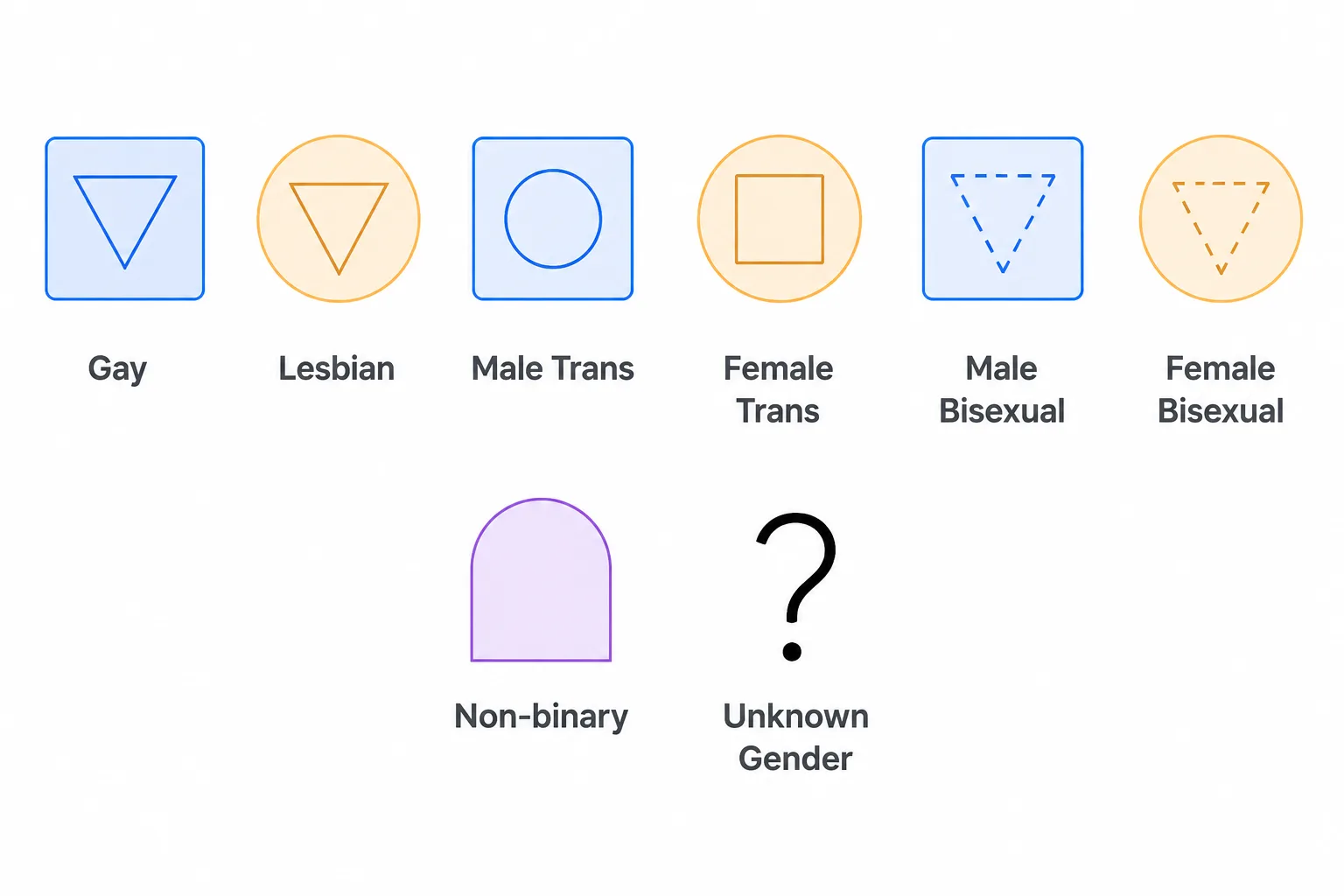
- Gay - square with an inverted triangle.
- Lesbian - circle with an inverted triangle.
- Male Trans - square with a circle inside.
- Female Trans - circle with a square inside.
- Male Bisexual - square with a dashed inverted triangle.
- Female Bisexual - circle with a dashed inverted triangle.
- Non-binary - arch or dome shape.
- Unknown gender - question mark symbol.
Other shapes:
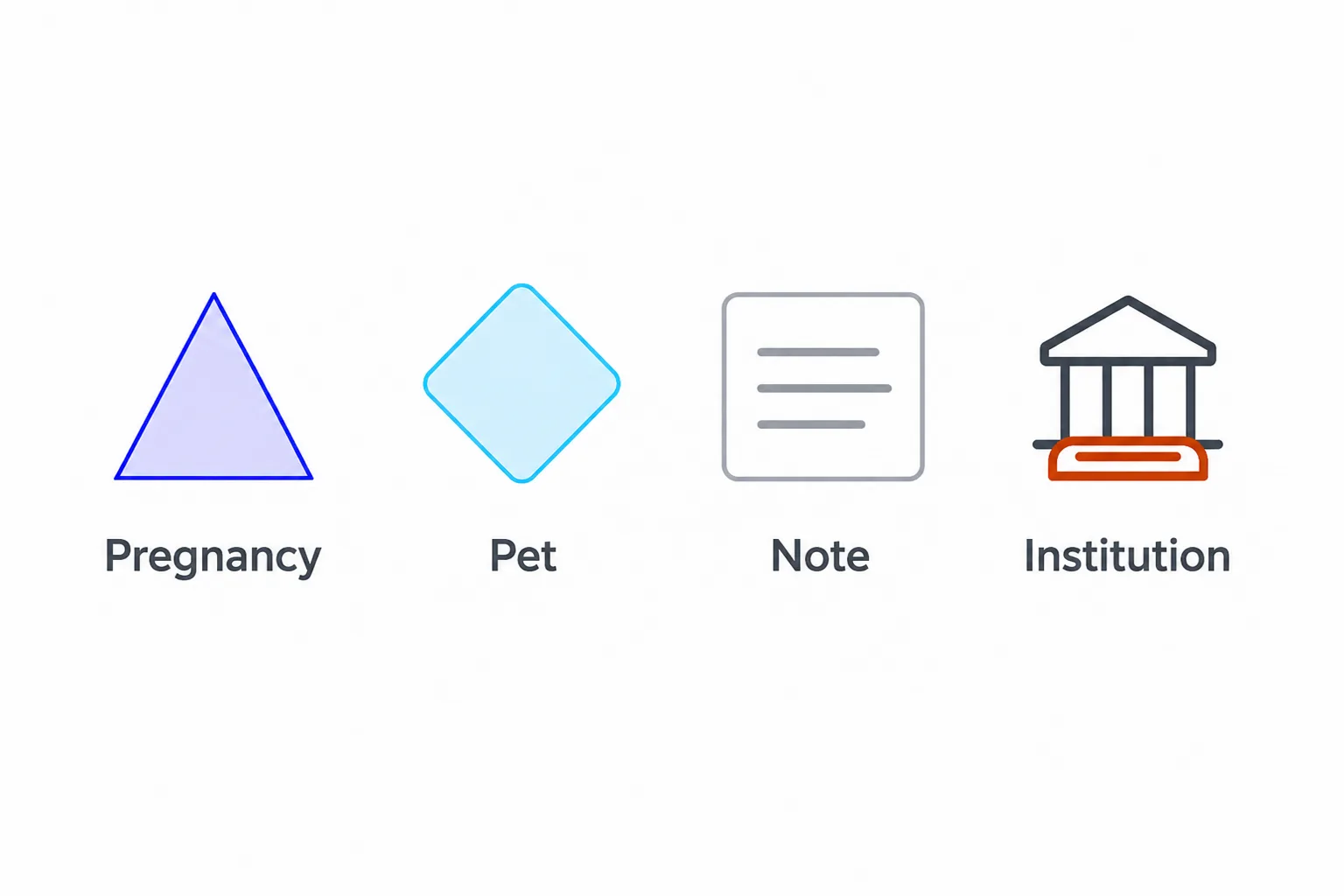
- Pregnancy - triangle pointing upward. See the pregnancy genogram symbol guide for placement and pregnancy loss distinctions.
- Pet - diamond.
- Note - document icon, used to attach text annotations to a person or connection.
- Institution - building icon, used to represent organizations or care facilities rather than individuals.
Family Relationship Lines
Family relationship lines connect couples and show the nature of their relationship.
The lines most genograms use:
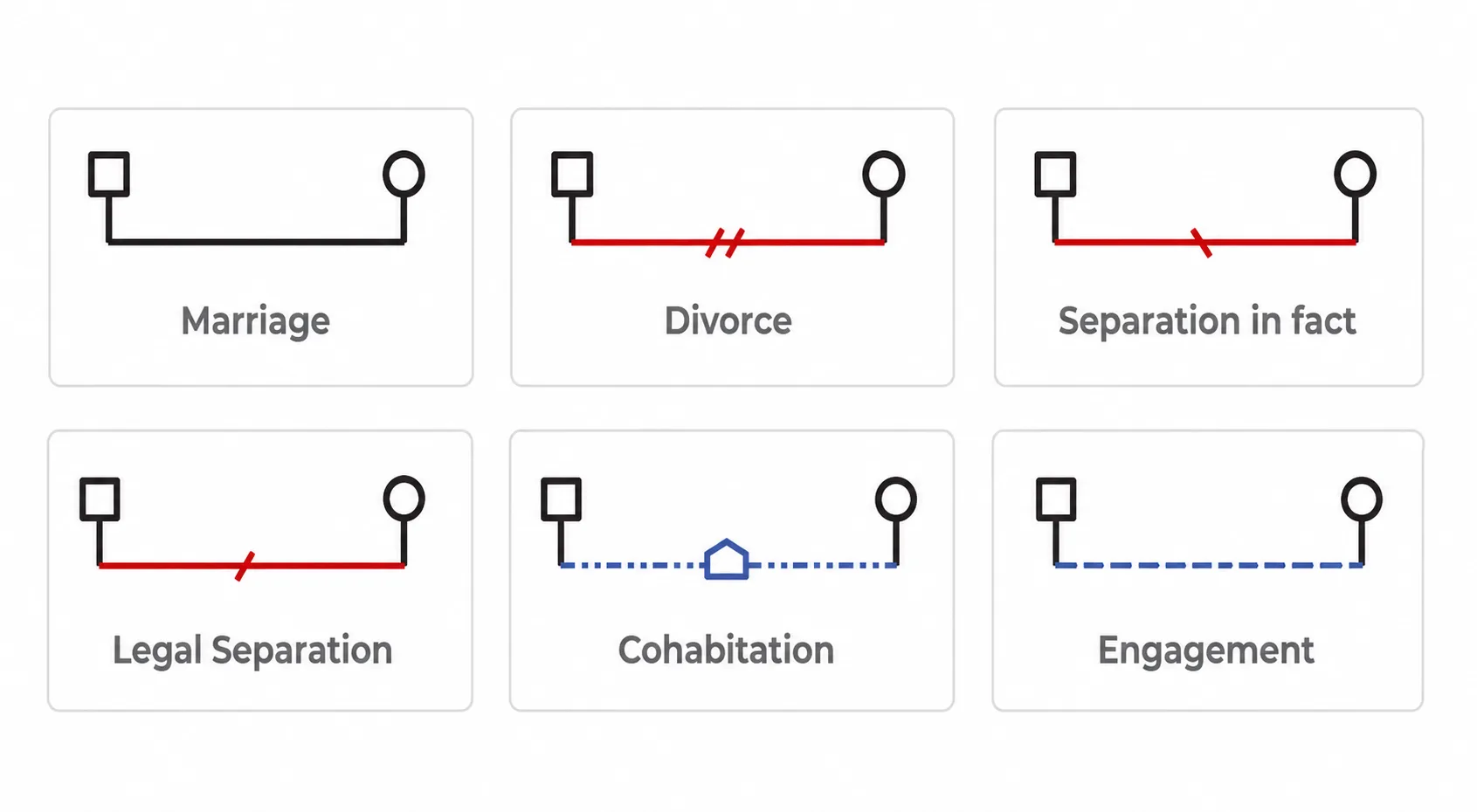
- Marriage - solid horizontal line.
- Divorce - red marriage line with red diagonal slashes through it.
- Separation in fact - red marriage line with a single left slash.
- Legal separation - red marriage line a single right slash.
- Cohabitation - dashed blue line with a small home symbol marker in the middle.
- Engagement - dashed blue line.
The extended set for more specific situations:
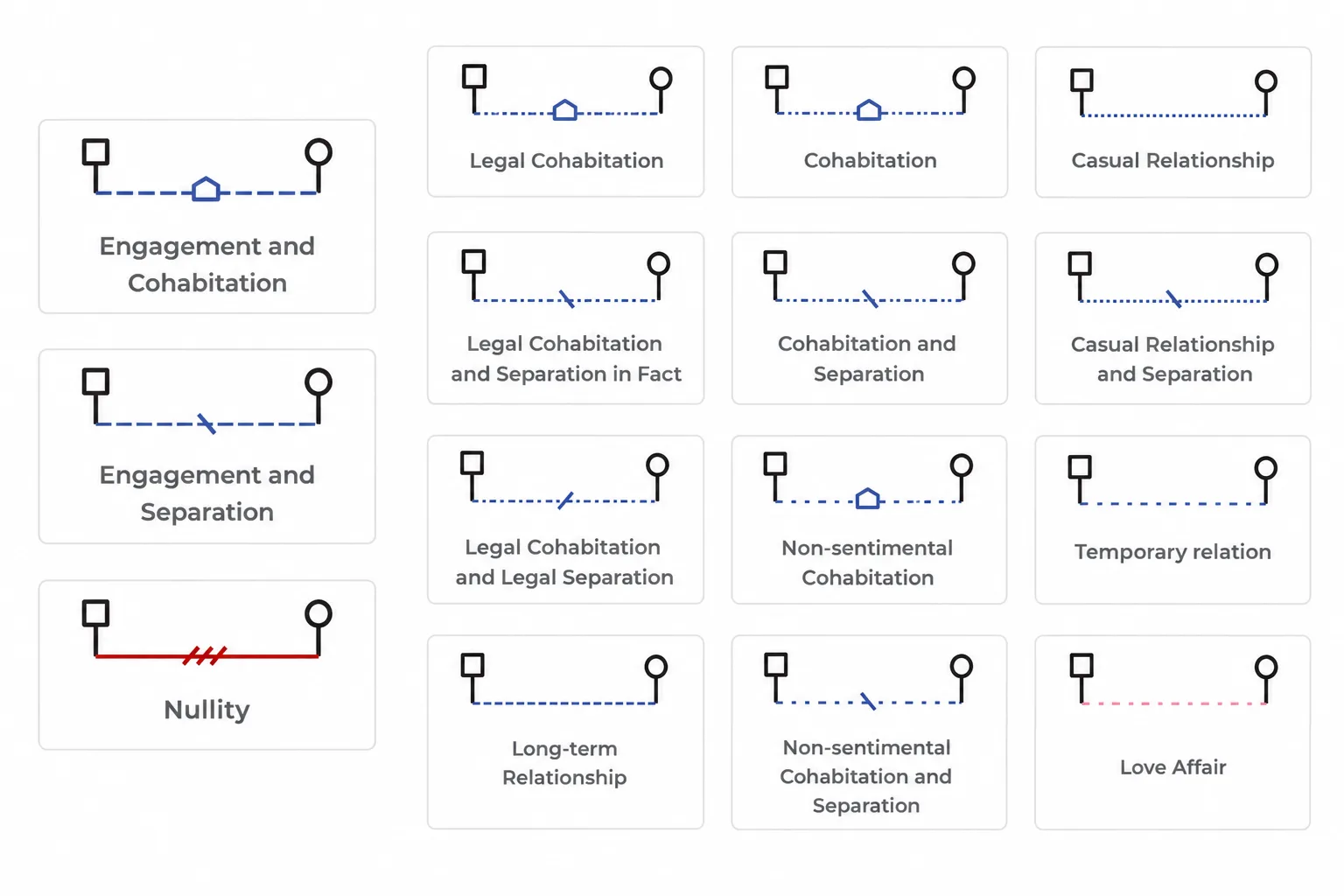
- Legal Cohabitation
- Casual Relationship
- Temporary Relation
- Long-term Relationship
- Love Affair
- Non-sentimental Cohabitation
- Nullity
- Engagement and Cohabitation
- Cohabitation and Separation
- Legal Cohabitation and Separation in Fact
- Legal Cohabitation and Legal Separation
- Casual Relationship and Separation
- Engagement and Separation
- Non-sentimental Cohabitation and Separation
For most genogram assignments and clinical work, marriage, divorce, cohabitation, and separation cover what's needed. The extended set is useful when the relationship history is specific enough to require it.
Children Connections
Children connection lines run from the couple/individual line down to the child's shape.
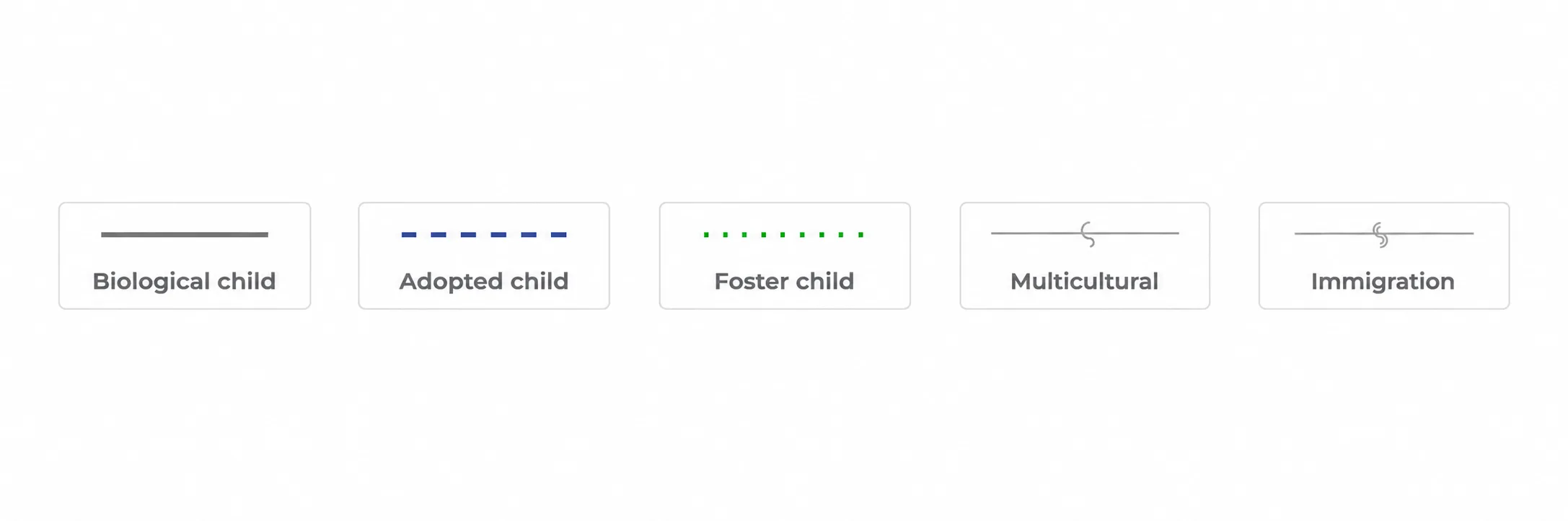
- Biological child - solid line.
- Adopted child - dashed blue line.
- Foster child - green dotted line.
- Multicultural - solid line with a small curved symbol, used when parents are from different cultural backgrounds.
- Immigration - solid line with a curved symbol, used to note immigration history in the connection. See the immigration genogram symbol guide for country and year notes.
Emotional Relationship Lines
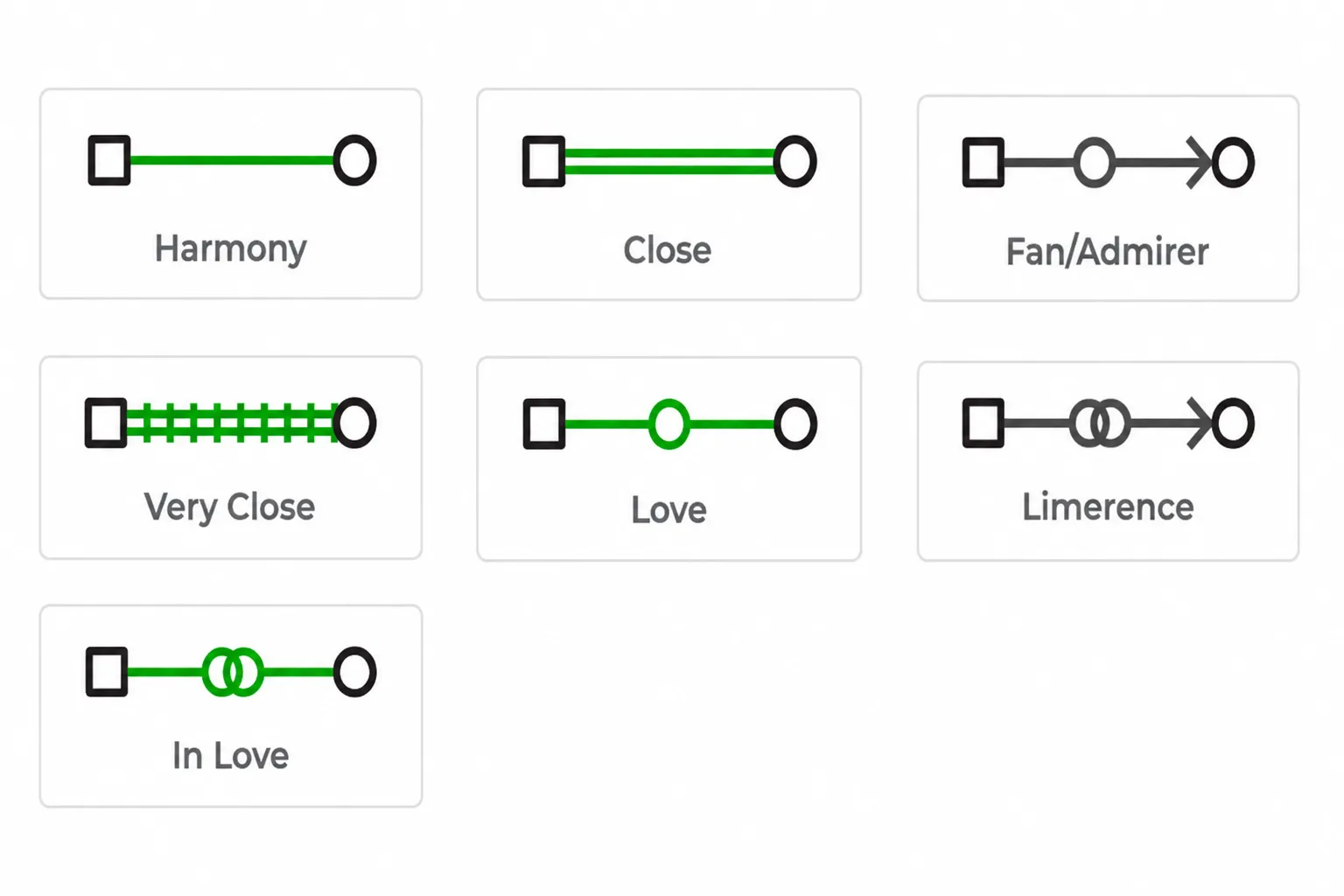
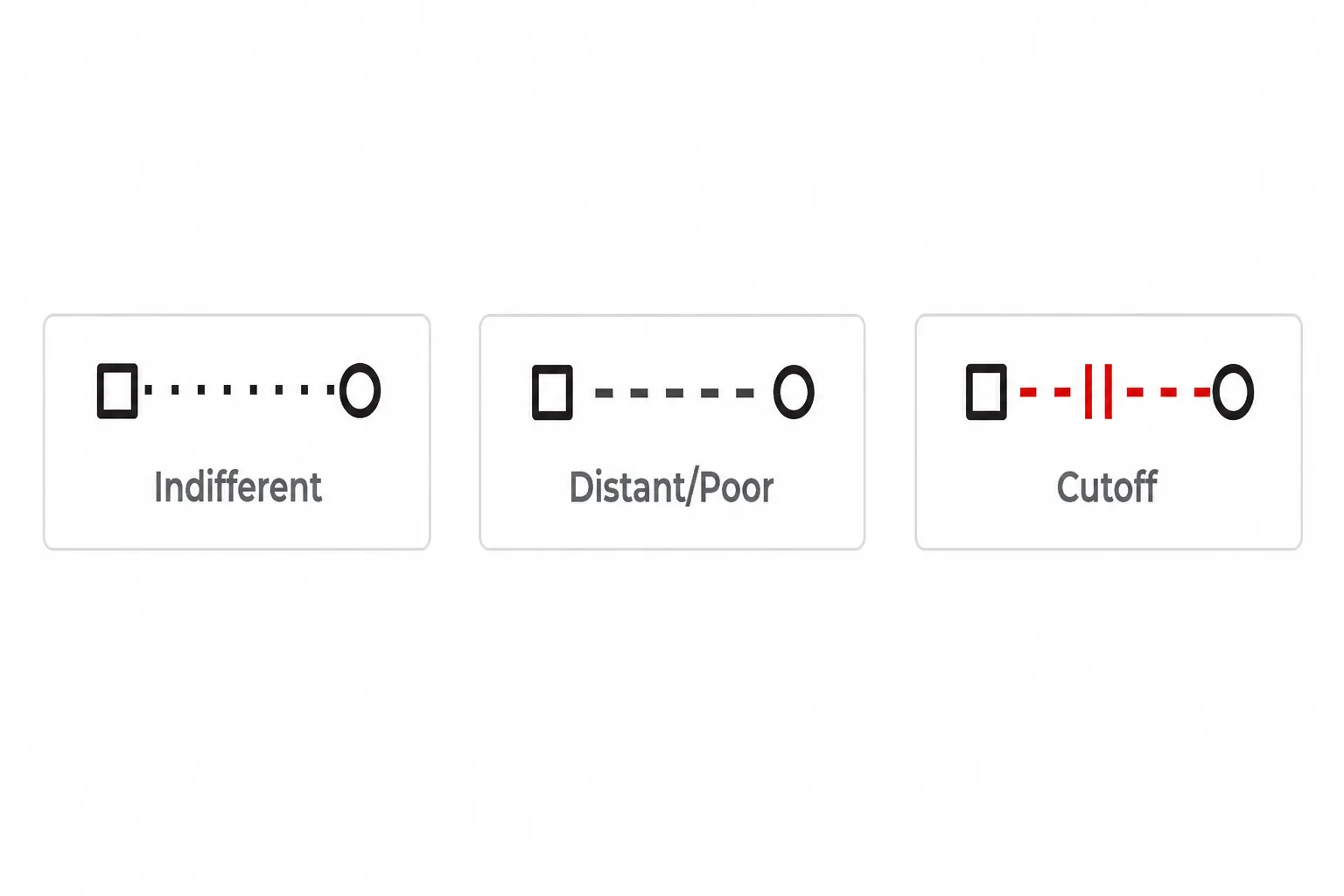
Emotional relationship lines show the quality of the relationship between two people. They run directly between any two shapes.
EasyGenogram has 30 emotional relationship line types, organized here by what they're showing:
Positive or close:
Distant or disconnected:
Conflictual:
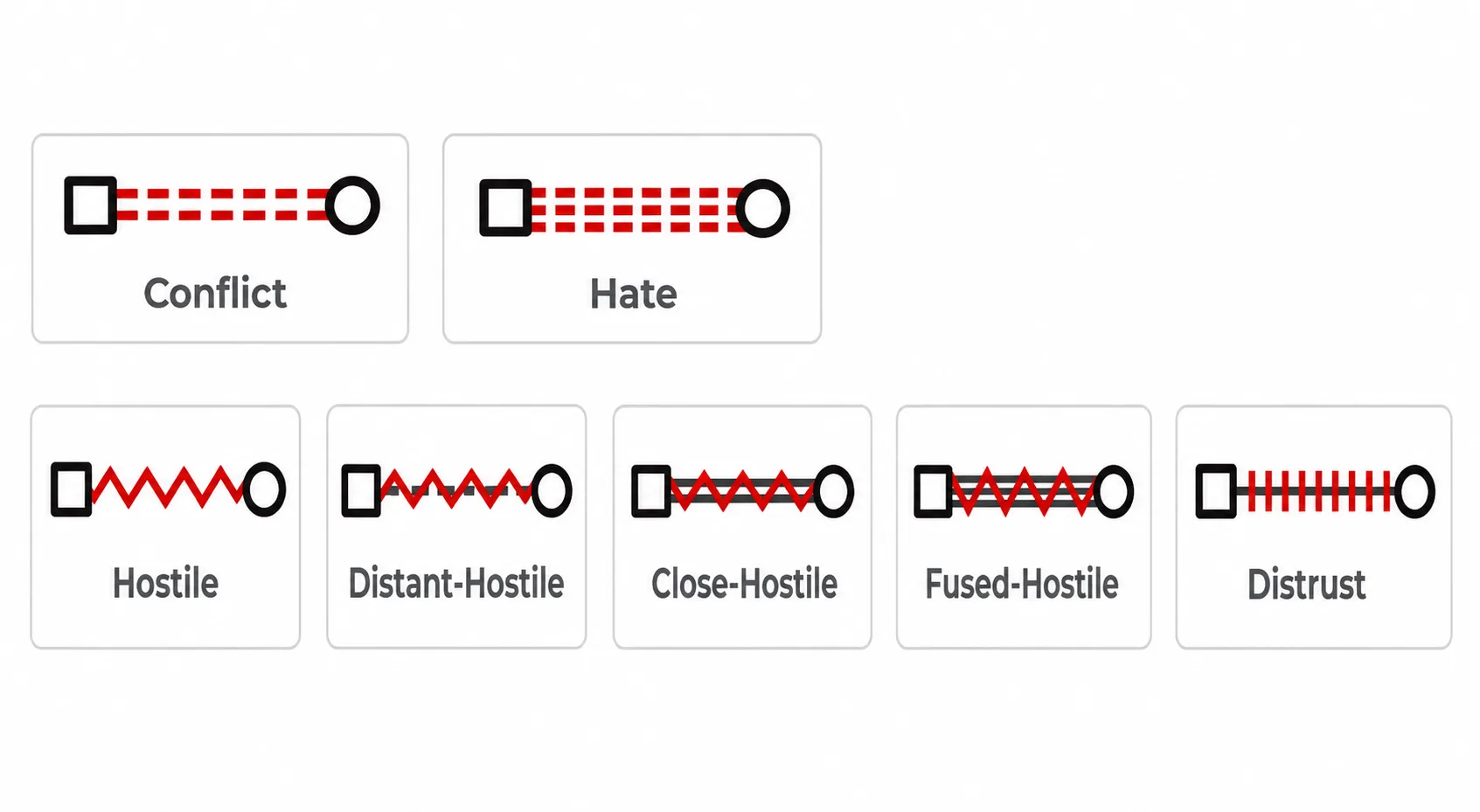
Abusive or controlling:
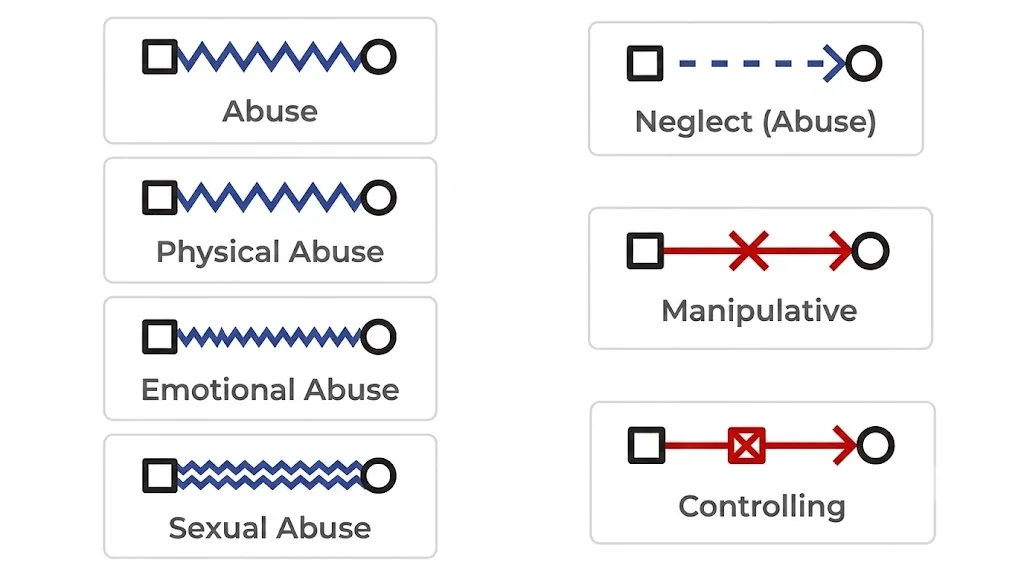
- Abuse
- Physical Abuse
- Emotional Abuse
- Sexual Abuse
- Neglect (Abuse)
- Violence
- Distant-Violence
- Close-Violence
- Fused-Violence
- Controlling
- Manipulative
Directional:

Enmeshed:
- Fused

Most genogram assignments and therapy intakes use a small subset of these.
Close, Distant/Poor, Conflict, and Cutoff are the four that appear most often.
The abuse and violence lines are used in clinical contexts where documenting those dynamics is part of the assessment.
Health Conditions
EasyGenogram has a dedicated Health Conditions system.
To add one, click a person's shape, go to the Health Conditions panel, and click Add Health Condition. Each condition gets:
- A name - type the condition (e.g., Asthma, Type 2 diabetes, Heart disease, etc).
- A color - a colored marker that appears on the shape, distinguishing different conditions visually. The color can be changed from the default.
- Notes - an optional free-text field for additional detail (diagnosis year, treatment status, relevant context).
The colored markers appear as quadrant indicators on the person's shape, similar to the shaded quadrant notation in standard McGoldrick genogram notation.
Multiple conditions on the same person show as multiple colored markers, each with its own color.
Custom Connections
EasyGenogram lets you create a relationship line type that isn't in the standard set.
Go to the connection picker and open the Custom Connections tab, then click Create Connection.
Options include:
- Title - name the connection type.
- Number of lines - one or more parallel lines.
- Line pattern - solid, dashed, dotted, and other options.
- Middle symbol - optional shape on the line.
- Decoration - optional end or midpoint styling.
- Direction - optional directional indicator.
- Color - selected from a preset palette.
A live preview shows what the line looks like before you save it.
Custom connections are useful when a relationship doesn't fit any standard category, or when a specific clinical or academic context uses its own notation system.
What You Need by Purpose
- For a class assignment: Person shapes (male, female, deceased, primary person), marriage and divorce lines, biological and adopted children connections, and 2-3 emotional relationship lines where required. A key listing every symbol used. See the genogram assignment guide.
- For a therapy intake or clinical session: Full person shape set where gender identity is relevant, couple history lines, all children connection types where applicable, and the emotional relationship lines that apply to the family. Custom connections if the family has a dynamic not covered by the standard set. See the genogram sample for a therapy context example.
- For a medical history genogram: Person shapes, deceased notation with age and cause, text annotations for health conditions beside each relevant shape, and structural couple and children lines. Emotional relationship lines are secondary unless the brief asks for them. See how to make a medical genogram.
- For a blended family: Marriage, divorce, cohabitation, and all children connection types. Multiple couple lines where there are previous relationships. See the blended family genogram example for how these are drawn together.
- For foster care: Use the foster child connection alongside biological or adoptive child lines when a child has multiple family placements. See the foster child genogram symbol guide for the specific line type.
FAQ
What are the standard genogram symbols?
The core set covers four types: person shapes (squares for males, circles for females, a triangle for pregnancy, an X for deceased), couple lines (marriage, divorce, cohabitation), children connection lines (biological, adopted, foster), and emotional relationship lines (close, distant, conflict, cutoff). EasyGenogram includes all of these plus extended sets for gender identity, relationship type, and emotional dynamics.
What do the lines mean in a genogram?
Horizontal lines between two people show their couple relationship; the line type indicates whether they are married, cohabiting, divorced, or separated. Vertical and horizontal lines below a couple connect them to their children. Lines drawn directly between any two people on the diagram, without going through a couple line, show the emotional quality of that specific relationship.
What is the symbol for divorce in a genogram?
A marriage line with diagonal slashes through it. In EasyGenogram, divorce shows as red slashes across the couple's horizontal line. A single slash indicates separation in fact; two slashes indicate a completed divorce. Legal separation has its own distinct styling.
What does a genogram key include?
A key lists every symbol and line type used in the diagram and what each one means. It should cover person shapes including any gender variants, couple line types, children connection types, and emotional relationship lines. Any custom connections created for that specific diagram should also appear in the key. Most professors and clinical supervisors require a key on any submitted genogram.
Can I download a genogram symbols PDF?
Yes. Open EasyGenogram, build or open your genogram, and use the PDF or PNG export button.
Sources
- Genograms: Assessment and Intervention (3rd ed.). W.W. Norton & Company.