Appearance
Blended Family Genogram Example
A blended family genogram shows divorces, remarriages, step-parents, half-siblings, household boundaries, and co-parenting arrangements in one diagram. It is the clearest way to map a family when children belong to different relationships or move between households, because a standard family tree cannot show that level of structure and relationship detail.
Example 1 - Blended Step-Family with Shared Child: The Porter Family
Blended Step-Family with Shared Child: The Porter Family
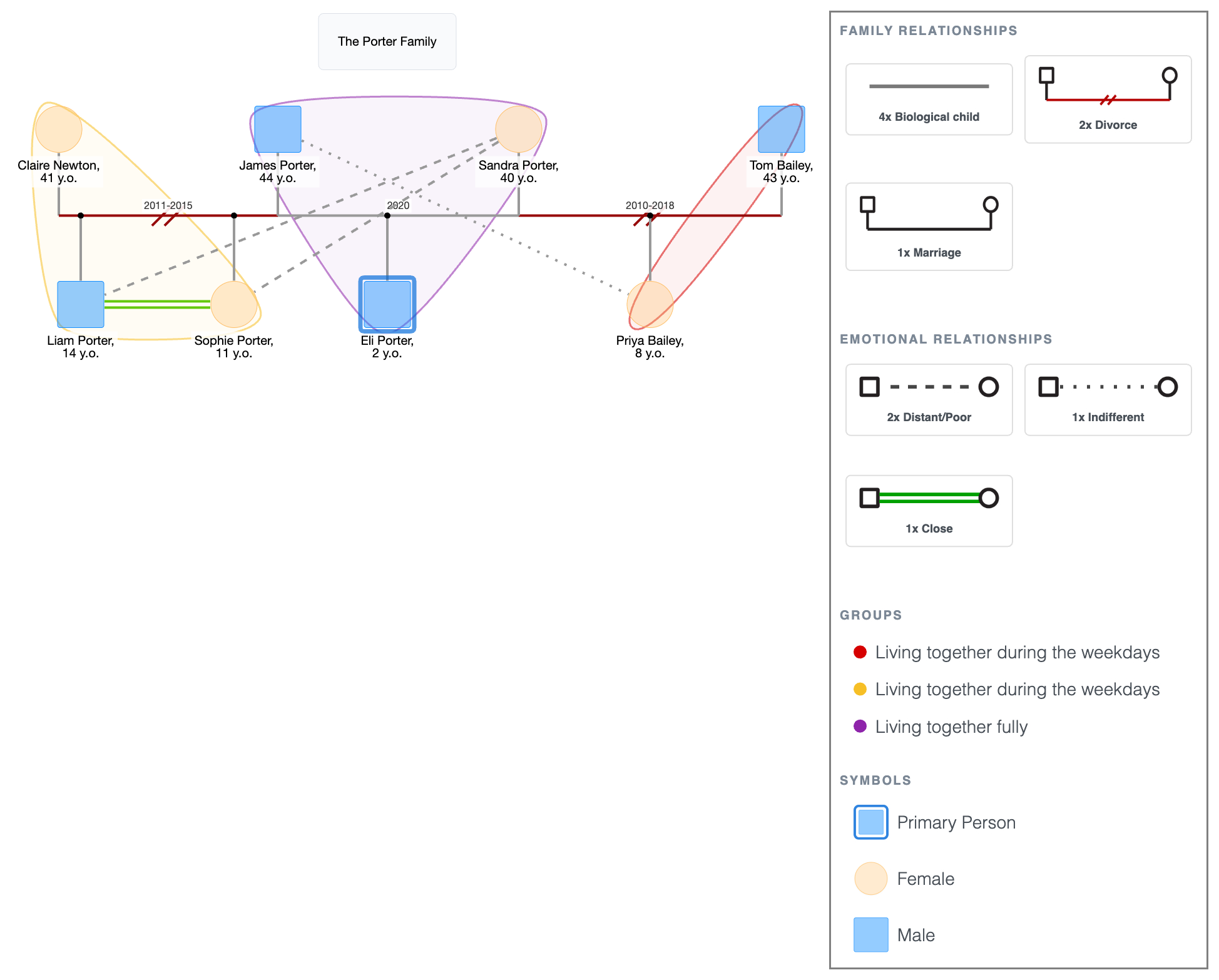
The family:
- James Porter is divorced from his first wife, Claire (double slashes, 2015), and they have two children together: Liam, 14, and Sophie, 11.
- Claire has not remarried; Liam and Sophie live with her during the week. (Co-parents with James).
- James remarried in 2021; his current wife is Sandra, divorced from her first husband, Tom (double slashes, 2019), with whom she has a daughter: Priya, 8.
- James remarried Sandra (in 2020), and they now have a son together: Eli, 2.
What you can now see:
- Eli is the only child with both James and Sandra as biological parents.
- On the diagram, that makes him the structural center; he connects to every sibling in the household through at least one shared parent.
- Liam and Sophie share a father with Eli, but not a mother. (Half siblings).
- Priya shares a mother with Eli but not a father. (Half-siblings).
- Liam and Sophie have no biological connection to Priya; they are step-siblings.
- Distant line between Sandra and Liam/Sophie (still adjusting to step-parent role).
- Indifferent line between James and Priya (same reason).
- Close line between Liam and Sophie (full siblings, natural alliance).
So there are four kids and three sets of sibling relationships, but they aren’t the same type. The genogram makes this visible in one read:
- Liam and Sophie spend the weekends with James, Sandra, Eli, and Priya, but they have a home they go back to, which is Claire’s.
- Priya lives with Tom during the week and goes to Sandra’s on weekends.
- Eli’s primary household (with his mother and father) is the only one he knows.
Before even thinking about how this family feels, it’s important to know how different each child’s baseline is.
A child with another home to retreat to experiences this family differently from the one who doesn’t.
Blended Step-Family with Shared Child: The Porter Family
Explore this genogram and adapt it to your needs.
Example 2 - Multi-Divorce Blended Family: The Walsh Family
Multi-Divorce Blended Family: The Walsh Family
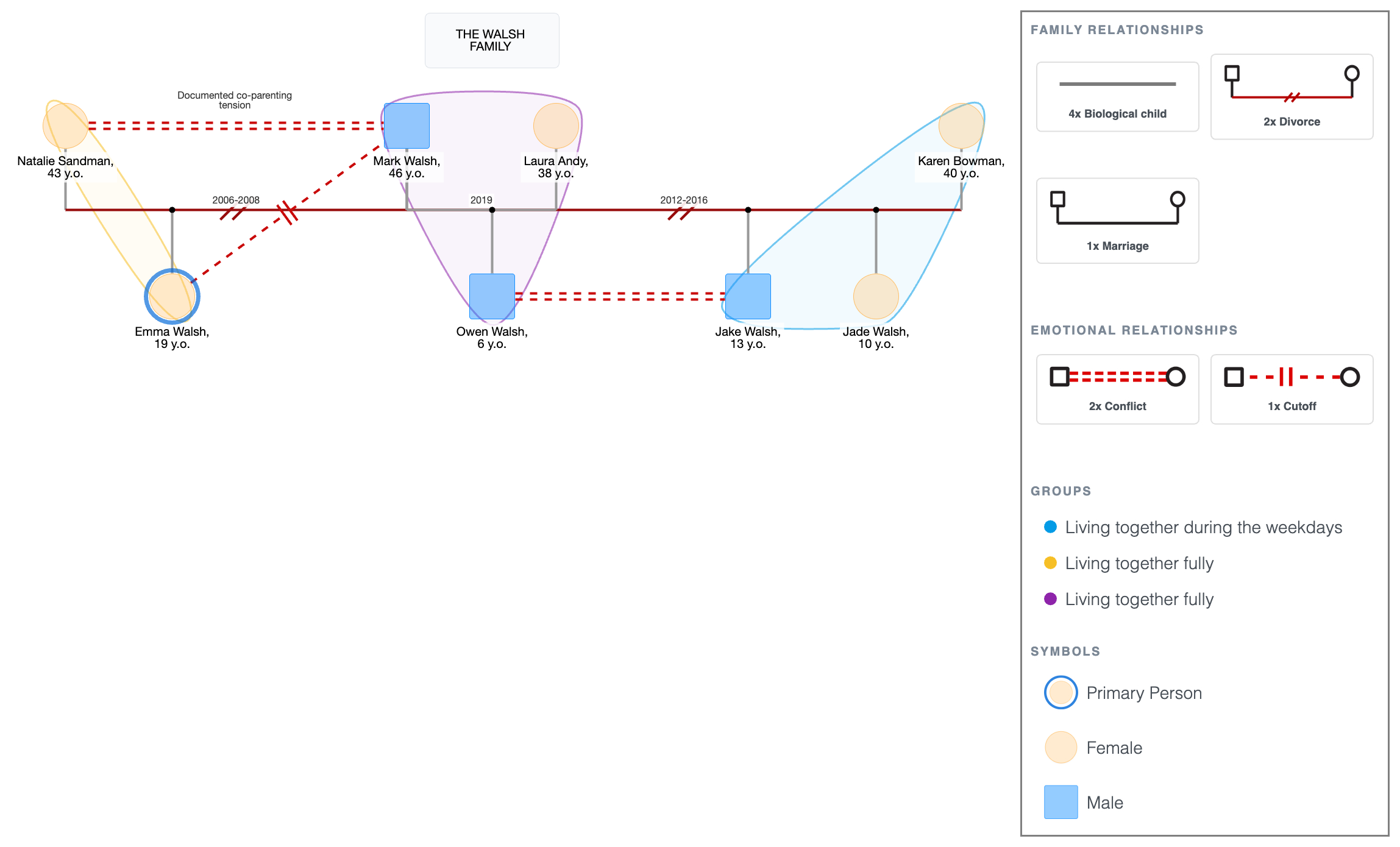
The family:
- Mark Walsh has been married three times.
- First marriage to Natalie (divorced 2008), with one daughter: Emma, 19.
- Second marriage to Karen (divorced 2016), with two children: Jake, 13, and Jade, 10.
- Current marriage to Laura (married 2019), with one son: Owen, 6.
- Emma lives fully with Natalie; Jake and Jade split time between Mark and Karen; Owen lives with Mark and Laura fully.
- Conflict line between Natalie and Mark (documented co-parenting tension).
- Cutoff line between Emma and Mark.
- Conflict between Owen and Jake.
What you can now see:
- Emma, Jake, Jade, and Owen all have Mark as a father, but only Jake and Jade share a mother.
- Jake and Jade have a different co-parenting arrangement from Emma. Mark is still involved in their weekend schedule, while Emma’s role in Mark’s current family system is pretty much cut off.
- Owen has never known a version of this family that included Emma.
What’s really driving things in this situation are the areas of conflict.
- Natalie and Mark are at odds with each other, and Emma is the daughter most in the middle of it all.
- This explains why she’s emotionally removed from the family as it is now.
- Also, the issues between Owen and Jake suggest that Mark’s new family life might not be stable.
These are two sources of trouble, on two separate issues. On paper, all four are Mark’s children, but the genogram shows they don’t share a family, only a father. Which means any intervention that treats them as a single unit is starting from the wrong place, because they are three different families blended into one with the man in common.
Multi-Divorce Blended Family: The Walsh Family
Explore this genogram and adapt it to your needs.
What a Blended Family Genogram Tracks
At a minimum, a complete blended family genogram shows:
- Prior marriages and divorces, with dates.
- Which children belong to which relationship.
- Who the step-parent is, and to which children.
- Half-sibling and step-sibling connections.
- Which household each child lives in, and where they visit.
- Emotional relationship quality, where relevant.
- Co-parenting arrangements across households, between multiple ex-partners.
In blended family situations, those last three often tell a different story from the biological structure alone.
A child might have multiple adults in their life who all technically co-parent, but the genogram shows which of those relationships are functional and which are strained.
When to Use Blended Genograms
A blended family genogram tends to come up in these situations:
- Family therapy intake: mapping the full cast before sessions start, especially when children are the presenting concern.
- Custody-related assessments: social workers and evaluators documenting household membership and relationship quality across households.
- Academic assignments: counseling programs commonly assign genograms using students’ own family structures; blended families are harder to draw without a clear example.
- Estate planning and legal contexts: identifying biological vs. step-relationships, household composition, and dependency arrangements.
- Personal documentation: families recording their own structure for medical history, school records, or family archives.
When Not to Use
- When the family structure is simple: when the family has no divorces, remarriages, or step-relationships, a standard genogram is enough because the blended format adds nothing.
- When you only need one generation: if the question is just about who lives in the household right now, a simple household diagram is faster.
- When the person isn't ready: mapping a blended family requires cooperation from someone who may still be processing a divorce or separation. Timing matters.
How to Draw a Blended Family Genogram
You can edit any of the examples above in EasyGenogram or start from scratch.
- Map the original families first: Draw each prior marriage separately; left partner, right partner, children underneath. Add appropriate divorce slashes and the year.
- Add the new marriage: Draw the remarriage line between the two partners. Add the year.
- Add any shared children: Draw solid lines from both partners in the new marriage to any children they have together.
- Mark household boundaries: Use a dashed box to show who lives in each household full-time. Children who split time or visit can be shown with a note or a partial boundary.
- Add emotional relationship lines: Where relevant (close, distant, or conflictual), draw these between the individuals. Keep it to relationships that are clinically or practically significant.
- Export your genogram: Download as PDF or PNG; ready for an assignment, case file, a supervision meeting, or a court report.
FAQ
How do you show divorce and remarriage on a genogram?
Divorce is marked with two diagonal slashes through the marriage line, usually with the year noted. Remarriage is drawn as a new horizontal line from the same person to their new partner.
How do I show children living in two households?
Draw a household boundary around each home. Put the child inside the home where they primarily live, then add a note or second boundary cue to show shared custody, alternating weeks, or regular visitation in the other household.
How do half-siblings appear on a genogram?
Half-siblings are shown by the parent they share. Two children connected to the same person by solid lines, but to different second parents, are half-siblings. The shared parent is the link, so they don't need a line between them to show the relationship.
What’s the difference between a step-sibling and a half-sibling on a genogram?
Step-siblings share no biological parent; they’re connected because either of their parents married the other. Half-siblings share exactly one biological parent. On the genogram, the difference is visible: half-siblings both have solid lines to the shared parent; step-siblings don't share any solid lines.
Can I use a free tool to make a blended family genogram?
Yes. You can use EasyGenogram to build a blended family genogram from scratch or edit an existing example in the browser. Once the diagram is ready, you can export it or share it depending on your plan.
Sources
- A Portrait of Stepfamilies
- Genograms: Assessment and Intervention (3rd ed.).
- Turning points in the development of blended families.
Related
Genogram for Social Work Assessment Example