Appearance
Genogram with Conflict Example
A genogram with conflict shows where tension is active in a family and whether it repeats across generations. Conflict lines let you mark ongoing strain directly on the diagram, so the pattern is visible at a glance instead of buried in notes.
Genogram with Conflict Between Two Couples (Example 1)
Genogram with Conflict Between Two Couples
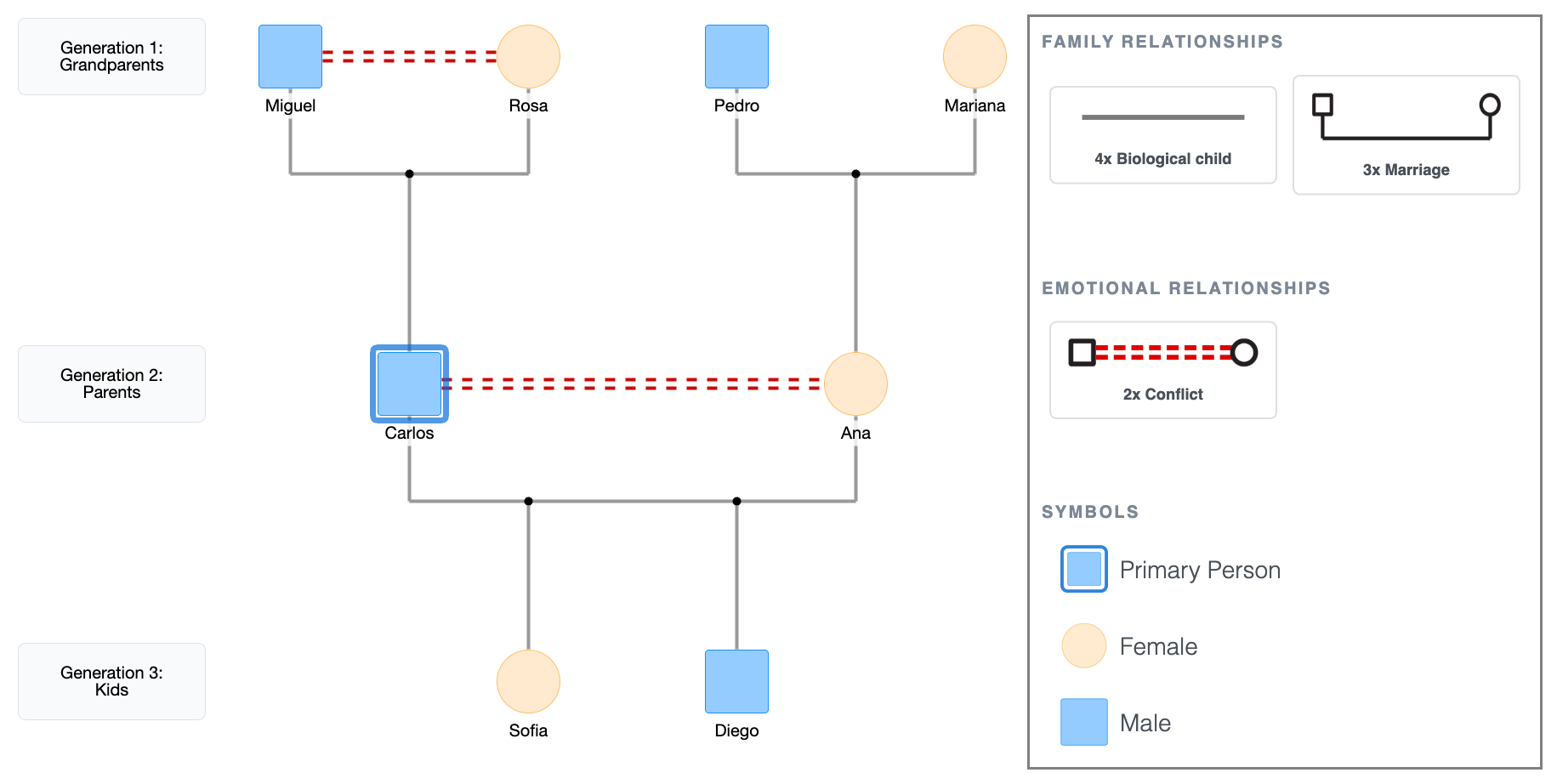
This genogram maps out three generations of a family, and shows conflicts between two pairs of spouses.
- Miguel and Rosa (the paternal grandparents) are in conflict with each other. (Double, dotted lines between them).
- Their son, Carlos, and his wife, Ana, are also in conflict.
With this, you can already see that there’s a tendency towards marital conflict; it doesn’t just happen with one couple, but is repeated in both Carlos and Ana’s marriage and that of Carlos’ parents, Miguel and Rosa.
Genogram with Conflict Between Two Couples
Explore this genogram and adapt it to your needs.
Genogram with Conflict Spreading Across the Family (Example 2)
Genogram with Conflict Spreading Across the Family
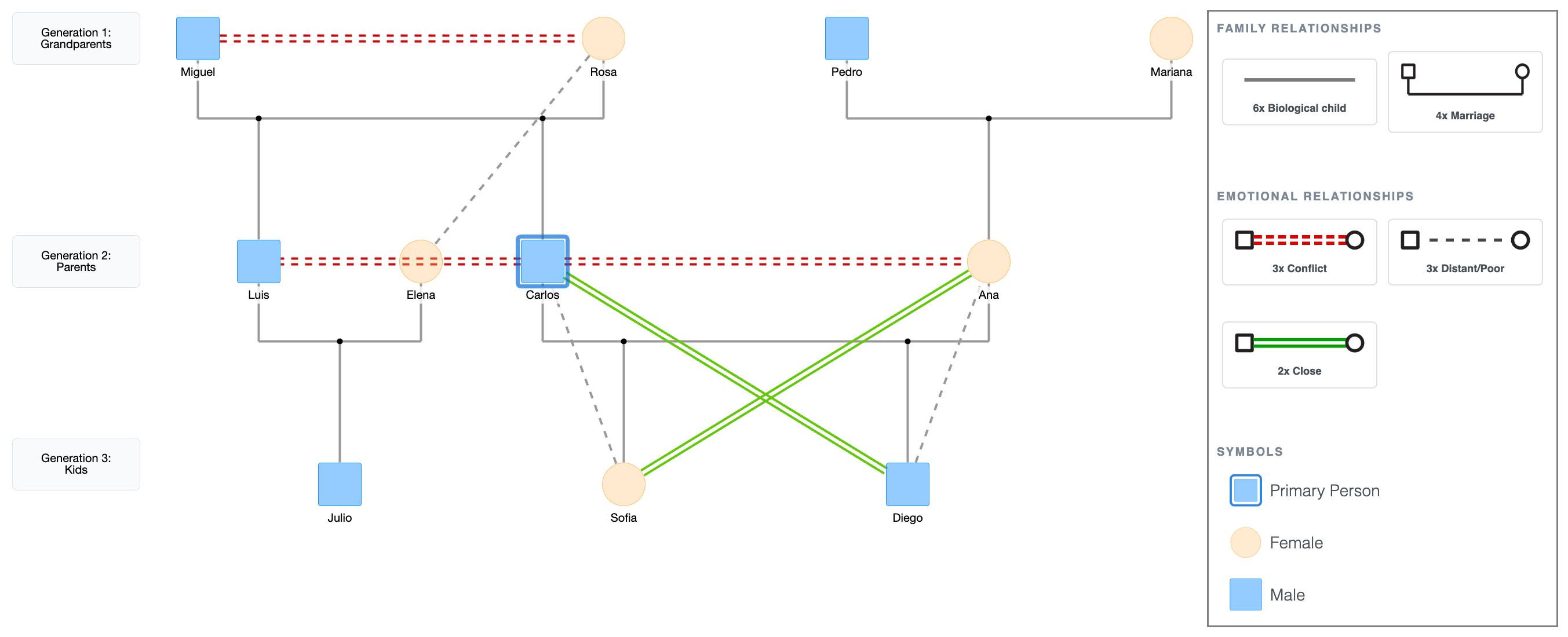
This is the same three-generation family, with more family members added in.
- Miguel and Rosa are still in conflict.
- Carlos and Ana are also still in conflict.
- Carlos and his brother, Luis, are in conflict.
- Sofia is emotionally distant from Carlos, her father (shown with the single dotted line), but close to Ana, her mother (shown with the double green lines).
- Diego is close to Carlos (his father), but distant from Ana (his mother).
- Rosa and Elena (Luis’ wife) are distant.
With this, the original problem between the two couples is now obvious throughout the entire family. You can see the conflicts aren’t happening in isolation; they’re all related.
Genogram with Conflict Spreading Across the Family
Explore this genogram and adapt it to your needs.
Genogram with Conflict as the Dominant Pattern
Genogram with Conflict as the Dominant Pattern
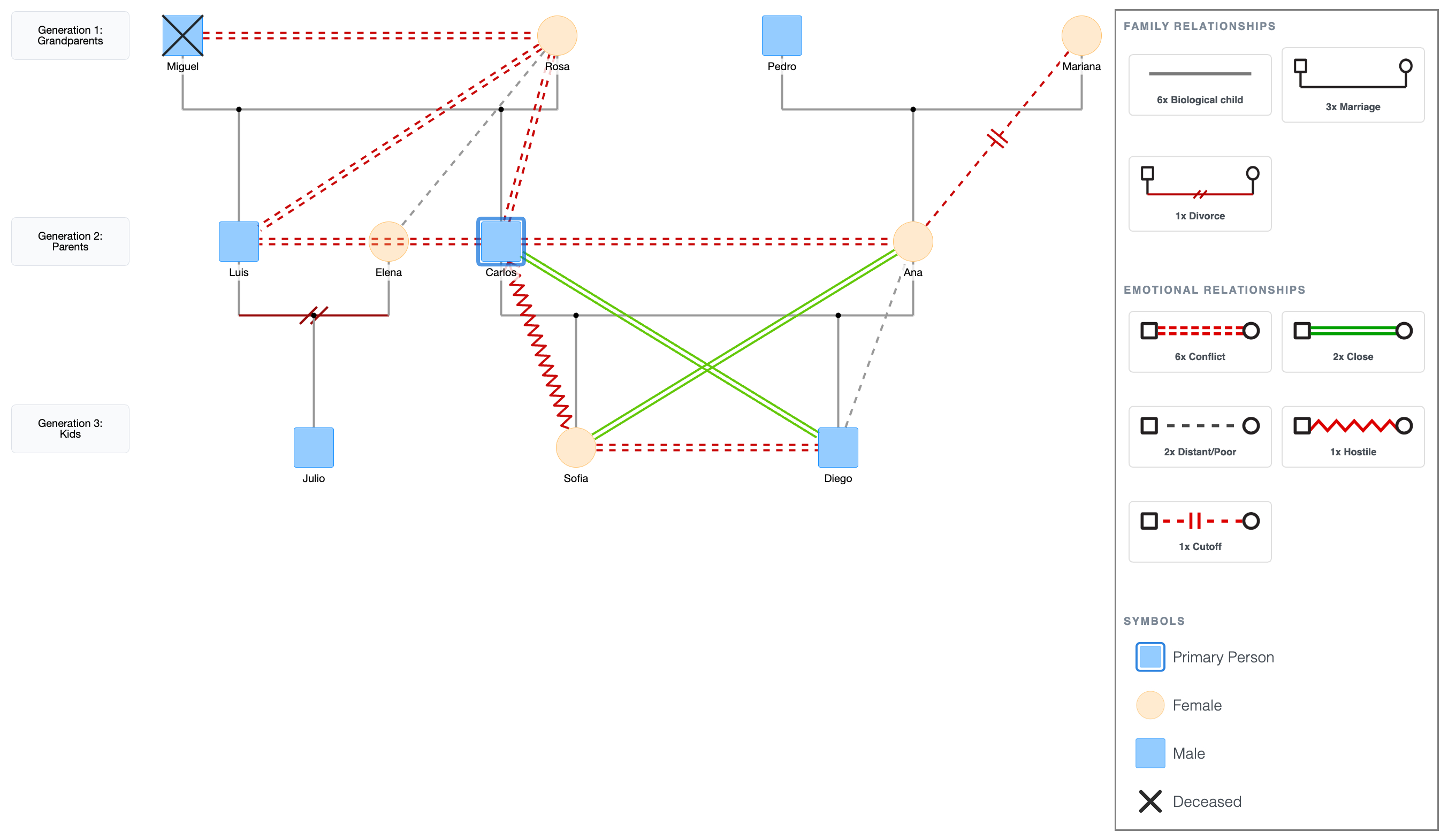
This is what a family with deep, long-running conflict looks like on a genogram.
- Miguel is now deceased (X mark across his symbol).
- Rosa is in conflict with both her sons.
- Both sons (Luis and Carlos) are still in conflict with one another.
- Ana has cut herself off from her own mother entirely (double red lines across their red distant line).
- Carlos' distance from Sofia has hardened; the line between them is now hostile (jagged red line).
- Sofia and Diego, who were neutral in example one, are now in conflict with each other, too.
- Luis and Elena are now divorced (double red lines across their marriage line).
Looking at the family’s history as a whole, with a genogram, reveals all the trouble spots at the same time: you can see where the disagreements are, how thoroughly they’ve worked their way through the family, and which bonds have already broken because of the tension.
Genogram with Conflict as the Dominant Pattern
Explore this genogram and adapt it to your needs.
Conflict vs. Distant vs. Hostile: What’s the Difference?
In a genogram, different lines represent different types of relationships. Here’s how to tell them apart:
- Conflict: is shown by double, dotted red lines. It means the people are actively at odds with each other, being argumentative and even subtly aggressive, and there’s a continuous sense of discomfort. They are interacting, but the interactions are full of tension.
- Distant/Poor: is a single dotted line. It represents a relationship where there isn’t a lot of feeling between the people, and it’s not actually dislike; they simply aren’t emotionally connected.
- Hostile: a much stronger and more obvious red jagged line. It shows a current and direct dislike of each other, expressed openly, and is more serious and aggressive than just being in conflict.
When to Use Conflict Lines
Use a conflict line when the tension between two people is:
- Persistent.
- Affecting how others in the family relate to them.
- A recurring theme that keeps coming up in different forms.
If it’s an occasional disagreement that gets resolved, a conflict line is probably too strong.
If two people avoid each other entirely, the cutoff and distant relationship markers from the genogram symbols guide are more accurate.
If you’re not sure which one to use, it’s best to start with ‘conflict’.
Conflict is one of the most common lines in a genogram, as conflict among family members is usually what prompts someone to map the family in the first place.
You can update it as you learn more about relationship dynamics in this genogram symbols guide.
Build Your Own Genogram with Conflict
You can explore and edit any of the examples above in EasyGenogram, or start from scratch.
1. Add your primary person: Start with whoever the genogram is focused on. Place them in the appropriate generation.
2. Add family members: Build out the structure first; parents, siblings, partners, children. Get everyone on the diagram before adding relationship lines.
3. Add the conflict line: Click the first person's shape; the quick-add buttons appear. Click Connect, then click the second person's shape. A relationship picker pops up; select the conflict line. The red dotted lines then appear between them.
4. Layer in other relationship types: Add close, distant, or hostile lines where they apply. Seeing multiple relationship types together is where the patterns become visible.
5. Add health or life events if relevant: Deaths, divorces, significant events; these often sit alongside conflict and help explain where it came from.
6. Export your genogram: Download as PDF or PNG, ready for an assignment, a session, or your own records.
FAQ
What does a conflict line look like in a genogram?
In a genogram, conflict is shown as double, dotted red lines between two people. It represents ongoing friction in a relationship and a persistent pattern of tension that shows up as arguments, silence, or passive aggression.
How do I show conflict in a family genogram?
Click the first person, drag the line to the second, and choose conflict from the relationship type options. The double, dotted red line will appear between them. You can add notes to describe the nature of the tension if needed.
What is a conflict genogram in psychology?
In psychology and family therapy, a conflict genogram maps persistent tension between family members across generations. It helps identify where conflict lives in a family system, how far it’s spread, and whether it’s repeating across generations, which is more useful than looking at one relationship in isolation.
What’s the difference between conflict and hostile in a genogram?
Conflict shows ongoing tension where people are still engaging, but the relationship is charged. Hostile is more intense; it is usually an active and openly expressed antagonism. If you're mapping a relationship and are unsure which fits, conflict is usually the safer starting point.
Can I download a genogram with conflict as a PDF?
Yes. Once you’ve built your genogram in EasyGenogram, you can export it as a PDF or PNG.
Sources
- "How to Add Relational Dynamics to Your Genogram"
- "How to Make a Genogram"
Related Genograms