Appearance
Genogram for Social Work Assessment
A genogram for social work assessment shows more than who is related to whom. It maps family structure alongside custody arrangements, CPS history, household membership, health issues, caregiving capacity, and repeated patterns across generations so a worker can assess risk, support, and placement options in one view.
Example 1 - Child Welfare Social Work Assessment Genogram
Child Welfare Social Work Assessment Genogram
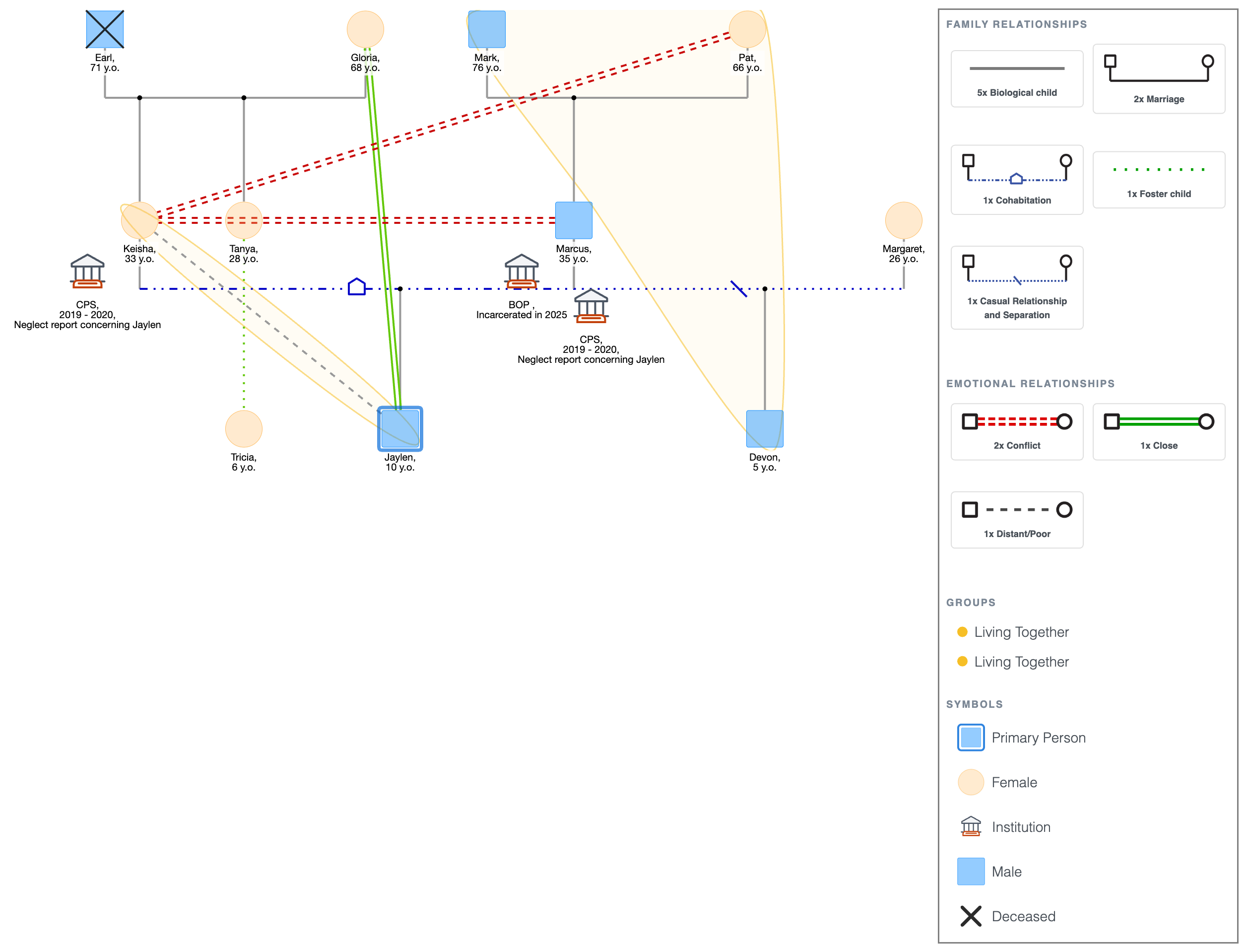
This is what a complex child welfare genogram looks like.
- Jaylen is the primary person here.
- His parents, Keisha and her partner, Marcus, were living together but hadn’t gotten married (cohabitation line connecting them).
- They are in conflict (double red dotted lines).
- Marcus is incarcerated (BOP, 2025), leaving Keisha as the sole parent in the household, though Jaylen isn’t very close to her (the dotted line shows this).
- Both Keisha and Marcus have a CPS history; a neglect report concerning Jaylen was filed against both of them in 2019, and the case was closed in 2020.
- But with the family back under assessment, that history is now relevant.
- Devon is Marcus’ son from a previous casual relationship with Margaret (the dotted blue line with a line through it shows this).
- Devon now lives with Marcus’ father, Mark, and mother Pat (the household line shows this).
- Tanya, Keisha’s younger sister, is an active foster parent (the dotted green line connecting her to Tricia shows a current foster placement).
- Keisha’s mother, Gloria, has a close bond with Jaylen (double green lines between them).
- Keisha’s father, Earl, is deceased (X mark over his symbol), so Gloria is managing the grandparent household alone.
- Pat, Marcus’ mother, and Keisha are currently in conflict.
Looking at this genogram, two kinship options are already visible:
- Gloria is the best option for Jaylen to be with because of how close they are and because she has no past problems.
- Tanya is an alternative, since she’s already fostering and familiar with the process.
- Jaylen’s paternal grandparents are already caregiving for Marcus’ other child, but Pat has a strained relationship with Keisha. That’s not a reason to rule them out, but it’s information you need to take note of before making a placement recommendation.
With this context, you can already see how the genogram is helping to do the assessment. This is why a genogram is much better at dealing with this kind of complicated situation than a lot of writing. You can see all the relationships and links in a single picture. To understand the full breakdown of the symbols used, see the genogram symbols guide.
Child Welfare Social Work Assessment Genogram
Explore this genogram and adapt it to your needs.
Example 2 - Mental Health Social Work Assessment Genogram
Mental Health Social Work Assessment Genogram
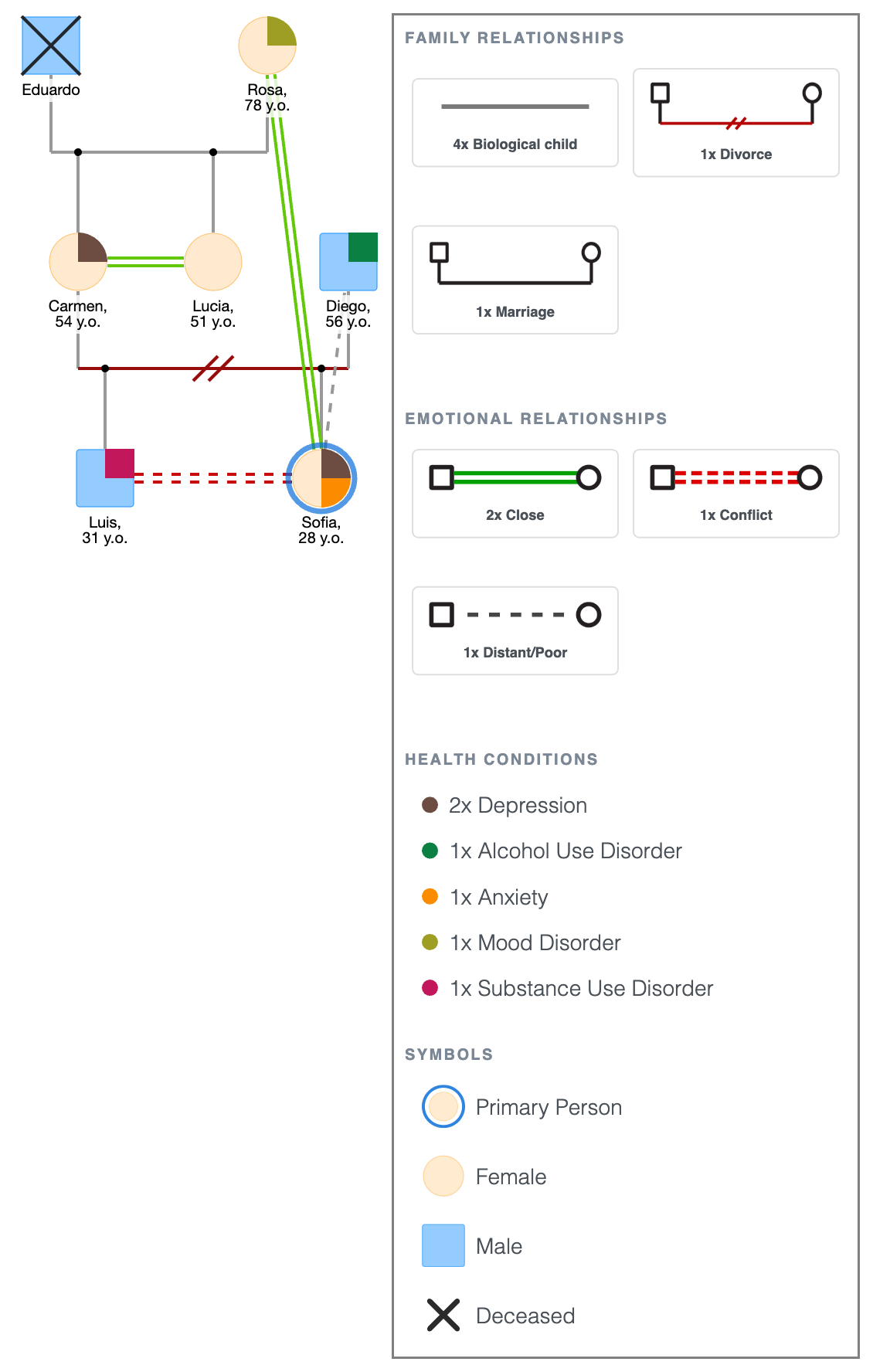
In this case, Sofia, at 28, is dealing with depression (marked brown) and anxiety (marked orange), and this genogram of her family shows far more than just her own struggles.
- At the top of the family’s patterns is Sofia’s maternal grandmother, Rosa, 78, who hasn’t been officially diagnosed, but the family knows she’s had trouble with her mood for nearly her whole life.
- Carmen, Sofia’s mother, has been diagnosed with depression (marked gray).
- Carmen and Diego, Sofia’s father, are divorced (red line with two red lines slashed across).
- Diego struggles with alcohol misuse (marked green).
- Luis, 31, is presently in recovery from a problem with substance abuse (marked pink).
- Sofia and Luis don’t get along (conflict line); in contrast, Carmen has a close relationship with her sister, Lucia (double green lines).
- Sofia is very close to Rosa, but she and Diego are emotionally distant.
Without this genogram, Sofia’s depression looks like an individual problem. But with it, you can see how it’s obvious the family has been carrying this pattern of depression and anxiety, with alcohol and substance abuse in the mix, for three generations.
Mental Health Social Work Assessment Genogram
Explore this genogram and adapt it to your needs.
Example 3 - Genogram for Healthcare and Elderly Care Social Work Assessment
Genogram for Healthcare and Elderly Care Social Work Assessment
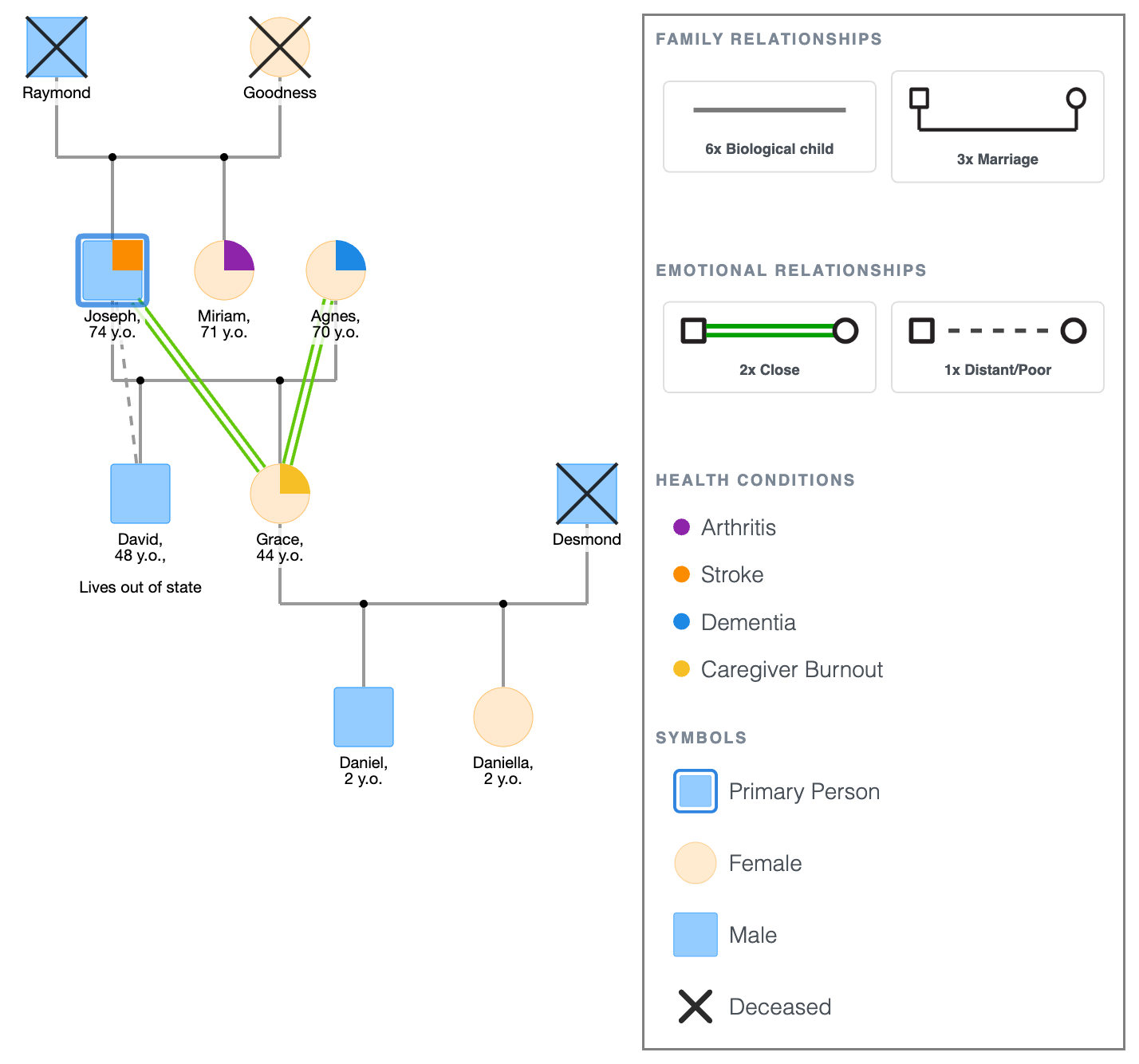
Joseph is 74, just got discharged from the hospital after a stroke (marked orange), and the issue is getting him someone to look after him.
- His wife, Agnes, is 70 and has dementia at an early stage (marked blue), meaning she can’t be Joseph’s main carer, even though they live together.
- Their son, David, at 48, lives out of state and isn’t likely to be able to help with care, given his emotional distance from his father.
- His daughter, Grace, 44, is emotionally close to both of her parents, but she is a widow with twin toddlers.
- The genogram also points to the fact that she’s already under strain with caregiving (marked yellow).
- Joseph’s sister, Miriam, 71, battles with arthritis (marked purple), and this limits how much she can manage.
In this genogram, you can see that there isn’t an obvious person to step in and provide a lot of care, and that in itself is a crucial thing to know when Joseph is being discharged from the hospital.
That’s the value of a genogram in a medical context. It isn’t simply a list of family members, but a display of what support each of them can actually give, and crucially, what the problems will be.
Genogram for Healthcare and Elderly Care Social Work Assessment
Explore this genogram and adapt it to your needs.
When to Use Genograms for Social Work Assessment
How and when you’d use a genogram depends on your role and the specific situation. They’re most useful in these settings:
- Child Welfare: for case staffing, court reports, and placement decisions where family complexity needs to be visible at a glance.
- Healthcare: for discharge planning, to identify who can realistically provide care and what support is actually available.
- Mental Health: for mapping intergenerational patterns like addiction, trauma, or mental illness across generations.
- Counseling: for building with the client collaboratively, which often opens conversations that wouldn’t happen otherwise.
- School Social Work: for getting a fast picture of a student’s home situation without reading through a full case file.
Where the situation allows, consider building it with the client; the process of drawing it together often surfaces information and opens conversations that a standard interview might not.
When Not to Use One
Genograms are only worth reaching for when the situation calls for it. You shouldn’t use them in these situations:
- The family is straightforward: a simple, stable situation with no relevant history doesn’t need a genogram.
- You’re in a crisis: immediate action comes first; come back to the genogram when things stabilize.
- The client isn’t ready: mapping family can surface difficult emotions; build rapport before going there.
- It won’t be used: if it’s going to sit in a file and never inform a decision, it’s probably not worth the time.
If you also need to map the family’s connection to external services and institutions, that’s where an ecomap comes in. A genogram maps the family system, while an ecomap maps the world around it, and many social workers use both together. Start with the ecomap guide, then compare it to an ecomap example for social work or the broader ecomap in social work article.
Build Your Own Social Work Genogram
You can edit any of the examples above in EasyGenogram or start from scratch.
1. Add your primary person: Start with whoever the assessment is focused on. Place them clearly in the diagram; you can add an arrow or label to mark them.
2. Add the immediate household: Draw a boundary line around everyone living together. This is often the first thing a supervisor or court wants to see.
3. Add the extended family: Build out at least three generations. Include both sides of the family; kinship resources often come from unexpected places.
4. Add case-relevant detail: This is where a social work genogram differs from a standard one. Add CPS history, incarceration, foster placements, custody arrangements, and significant life events using text labels.
5. Add relationship lines: Mark close bonds, conflict, distance, and cutoffs. These are often as important as the structural information for placement and intervention decisions.
6. Export your genogram: Download as PDF or PNG; ready for a case file, a supervision meeting, or a court report.
FAQ
What is a genogram in social work?
A genogram in social work is a visual map of a family system used for assessment and intervention planning. It shows family structure, relationships, and relevant case details, such as custody arrangements, CPS history, and household composition, across at least three generations. It gives workers a way to see the whole family picture at once, which written notes alone rarely provide.
What should a social work genogram include?
At minimum, a social work genogram should include names and ages, the primary person, household boundaries, and at least three generations. For assessment work, it should also include relationship lines, custody arrangements, CPS or abuse history, incarceration, foster placements, and any other details that affect safety, care, or support.
Is a genogram required in social work?
It depends on the setting and the agency. In child welfare, genograms are often required for case documentation, court reports, and placement staffing. In other settings, they’re used at the worker’s discretion. Some agencies have their own documentation standards that specify when and how genograms should be created.
What’s the difference between a genogram and an ecomap in social work?
A genogram maps internal family relationships across generations. An ecomap maps the family’s connections to external systems such as schools, services, institutions, and community support. Both tools are useful, and many social workers use them together for a complete picture.
Can I download a social work genogram as a PDF?
Yes. Once completed, a social work genogram can be exported as a PDF or PNG for case files, court reports, supervision, or team discussion.
Sources
- "A Picture Is Worth a Thousand Words: Exploring the Use of Genograms in Social Work Practice"
- "Genograms for Psychotherapy"
- "Family History: The Three-Generation Pedigree"
Related