Appearance
Genogram Sample
A genogram sample is a completed diagram you can study before building your own. This sample shows a self-of-therapist genogram: a trainee counselor's own family mapped for supervision, with health history, estrangement, and relationship lines already in place.
The Sample: Grace Ellis
Grace Ellis is a 28-year-old second-year counseling trainee. Her program requires a completed self-of-therapist genogram reviewed in supervision before she begins her first placement.
Grace Ellis' Family Genogram
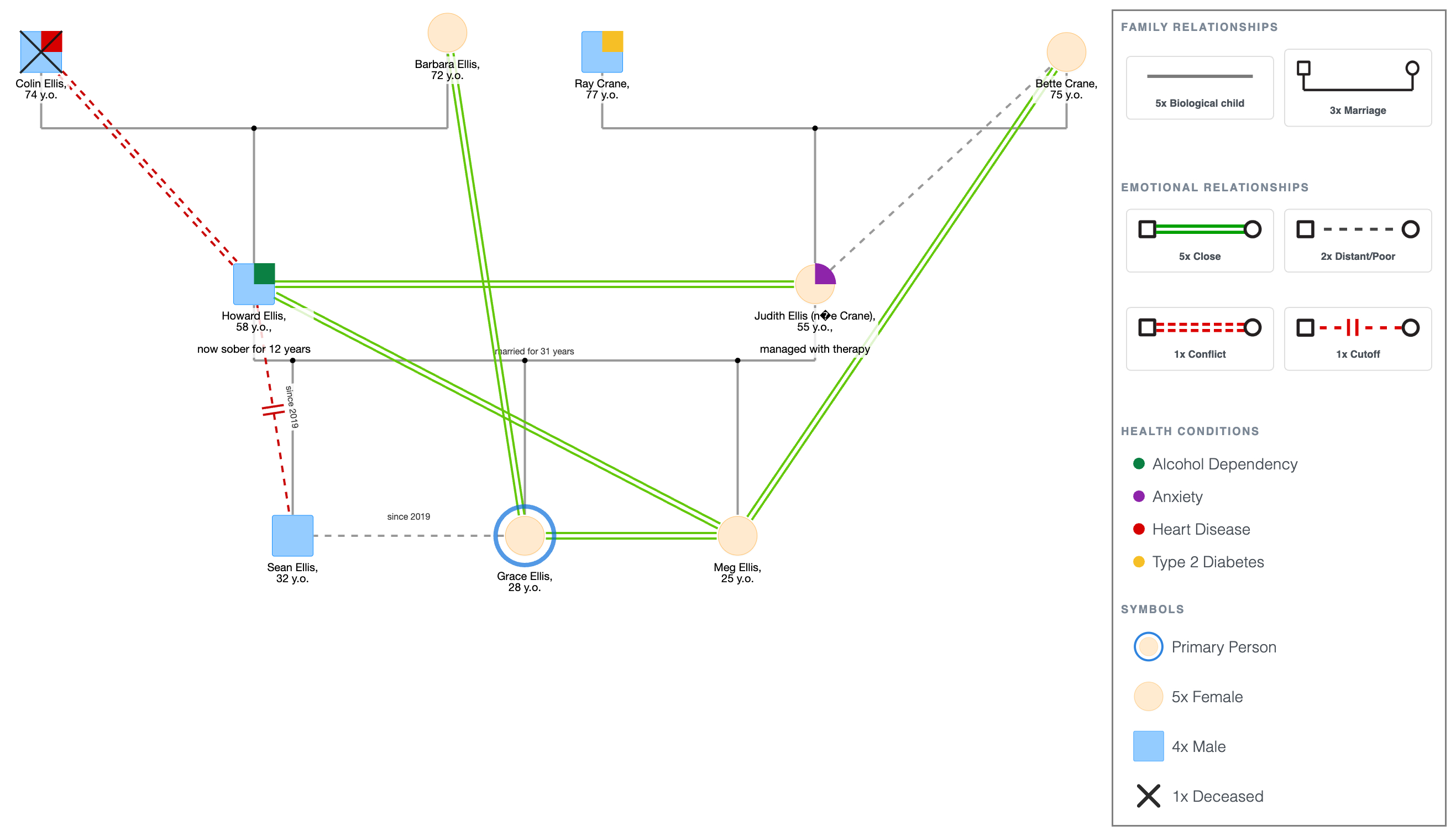
The family:
- Grace Ellis, 28, is the primary person.
- Grace's parents: Howard Ellis, 58 (alcohol dependency, now sober 12 years) and Judith Ellis (née Crane), 55 (anxiety, managed with therapy). Married 31 years.
- Grace has two siblings: Sean Ellis, 32, and Meg Ellis, 25.
- Paternal grandparents: Colin Ellis (deceased, 2020, heart disease, age 74) and Barbara Ellis, 72. Howard and Colin had a conflict line; long-standing and pre-dating Grace's birth. Close line between Grace and Barbara.
- Maternal grandparents: Ray Crane, 77 (type 2 diabetes) and Bette Crane, 75. Distant line between Judith and Bette; also pre-existing. Close line between Bette and Meg.
- Other relationship lines: close between Howard and Judith; close between Grace and Meg; cutoff between Howard and Sean (2019); distant between Grace and Sean (since 2019); close between Howard and Meg.
What You Can Now See
- Howard's alcohol dependency sits in his symbol with a sobriety note. Colin's conflict line with Howard sits one row above it. Howard grew up in a conflictual relationship with his own father and developed a dependency that lasted into his adult years. Both facts are on the diagram.
- Sean's cutoff sits in the middle of the diagram. Howard and Sean have a cutoff line; Grace and Sean have a distant line. Meg has no relationship line to Sean at all. These are three siblings with three different responses to the same estrangement.
- Judith's distant line to Bette is another relationship line in the diagram. Bette has a close line to Meg, Grace's younger sister, a skipped-generation bond that runs alongside Judith's distance. Grace grew up watching her sister have access to a grandmother she could not reach in the same way.
- Grace is drawn to work with clients experiencing family estrangement and intergenerational tension. Her supervisor can see, in one diagram, that her family carries an unresolved cutoff, a historical conflict between father and grandfather, and a pattern of maternal and paternal-side distance.
- Also, Howard and Meg have a close line, while Howard and Sean have a cutoff. Both are in the same generation, children of the same two parents. The diagram shows that Howard's relationships with his children are not uniform.
Grace Ellis' Family Genogram
Explore this genogram and adapt it to your needs.
What a Complete Genogram Sample Includes
A self-of-therapist genogram is considered complete when:
- Three generations are mapped; grandparents, parents, and the trainee's generation.
- All significant family members are present, including those who are deceased or estranged.
- Health conditions and causes of death are noted beside relevant members.
- Relationship lines are drawn for every significant connection.
- Life events with dates are included where they matter: deaths, marriages, divorces, estrangements, significant diagnoses, etc.
- The diagram can be read by a supervisor who has never met the family.
For a full reference of what each symbol and line type means, see the genogram symbols guide.
When to Use This Type of Genogram
- Clinical training programs: MFT, counseling, social work, and psychology programs commonly require a self-of-therapist genogram before or during fieldwork placement.
- Personal reflection: mapping your own family to understand the patterns you carry before they surface in a professional or personal relationship.
- Supervision preparation: building a diagram to bring to a supervision session focused on countertransference or personal history.
For genograms built around a client's family rather than the trainee's own, see the genogram for social work assessment or the family genogram example.
How to Build a Genogram Sample
Open the Ellis family genogram in EasyGenogram and replace the details with your own, or start from scratch. For a full walkthrough, see how to make a genogram.
- Place yourself as the primary person: mark your symbol with a double border. Everything else is built around your position in the family.
- Add parents and siblings: place parents in the row above connected by a marriage line. Add siblings beside yourself on the same row, oldest on the left.
- Add grandparents: go up one more level, both sides.
- Add health notes and life events: note conditions, diagnoses, causes of death, and significant dates beside the relevant person.
- Add relationship lines: this is where the self-of-therapist genogram does its work. Map every significant relationship, including the difficult ones. Missing lines are also information.
- Export: download as PDF or PNG when done.
FAQ
What is a genogram sample?
A genogram sample is a completed genogram you can use as a reference before building your own. The sample on this page shows a finished self-of-therapist genogram; a map of a trainee clinician's own family of origin, built for review in clinical supervision.
What is a self-of-therapist genogram?
A self-of-therapist genogram is a diagram of the trainee's own family, built during clinical training to identify the relational patterns and personal histories they bring into clinical work. It is usually reviewed in supervision rather than submitted for grading. The focus is on the relationship lines and what they reveal.
What should a genogram sample include?
Three generations of family members, structural connection lines, health conditions and causes of death where known, significant life events with dates, and relationship lines for every meaningful connection. A self-of-therapist genogram should include all of these, with particular attention to relationship quality.
Can I use this sample for a class assignment?
Yes, as a reference. If your assignment requires a genogram of your own family, use the Ellis family sample to understand the format and level of detail expected, then build your own in EasyGenogram.
How is a self-of-therapist genogram different from a clinical one?
A clinical genogram maps a client's family, built to inform assessment and treatment. A self-of-therapist genogram maps the trainee's own family, built to inform the trainee's awareness of what they carry into clinical work. The symbols and structure are identical; the difference is in whose family is being mapped and what the diagram is being used for.
Sources
- Genograms: Assessment and Intervention (3rd ed.). W.W. Norton & Company.
- Family Therapy in Clinical Practice. Jason Aronson.
- The cultural genogram: Key to training culturally competent family therapists. Journal of Marital and Family Therapy, 21(3), 227–237.