Appearance
Basic Genogram Example
A basic genogram example shows the minimum structure most people need for a class assignment, intake, or first family map. It gives you a finished three-generation diagram with standard symbols, one health marker, and a small number of relationship lines so you can copy the format directly.
What Is a Basic Genogram?
A basic genogram maps a family across two or three generations using standard symbols. It shows who is in the family, how they are related structurally, and with a few added lines, how they relate to each other emotionally.
It is the foundation every more specialized genogram builds on. Medical genograms, social work genograms, and conflict genograms all start here.
A Basic Genogram Example: The Ward Family
Basic Genogram Example
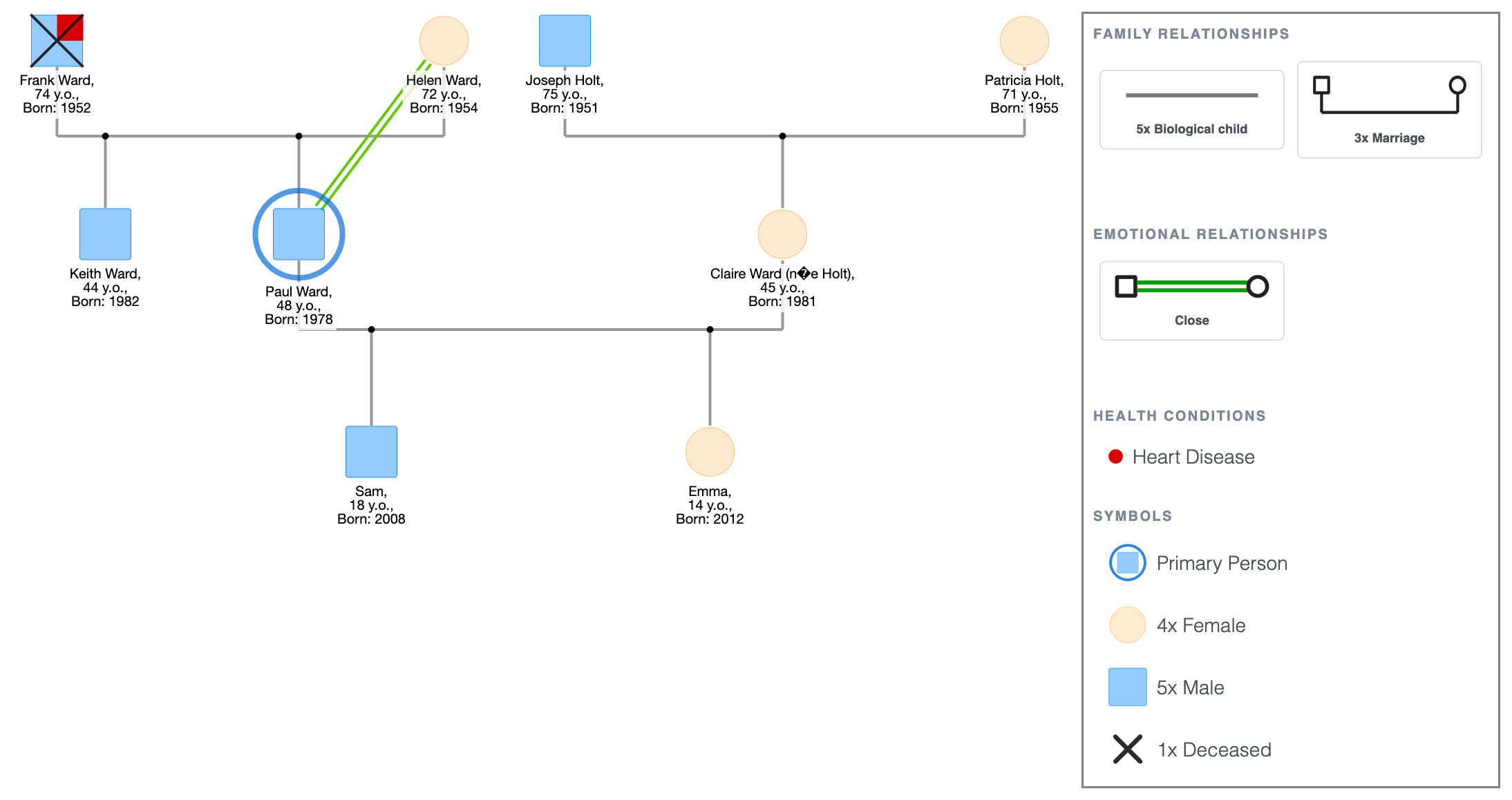
The family:
- Paul Ward, 48, is the primary person. He is married to Claire Ward (née Holt), 45. They have two children: Sam, 18, and Emma, 14.
- Paul's parents: Frank Ward (deceased, heart disease, age 74) and Helen Ward, 72. Paul and Helen have a close relationship.
- Paul has one sibling: his brother Keith Ward, 44.
- Claire's parents: Joseph Holt, 75, and Patricia Holt, 71.
What This Genogram Shows
For a full breakdown of what each symbol means, see the genogram symbols guide.
- Frank's heart disease is documented and visible at a glance. Paul is 48; roughly the age his father was when the condition likely became significant.
- Keith appears on the paternal side with no notable lines or markers. He is part of the family structure; there is nothing significant to flag about his relationships or health at this stage. A basic genogram includes everyone, including the unremarkable.
- Paul's close line to Helen, his widowed mother, is the one relational detail the diagram adds beyond structure. It changes how you read his position in the family: he is the adult child who stayed close after his father's death.
Basic Genogram Example
Explore this genogram and adapt it to your needs.
When to Use a Basic Genogram
- First genogram assignment: most introductory coursework in social work, nursing, psychology, and counseling asks for a three-generation diagram. This example meets that requirement.
- Intake documentation: a basic genogram at the start of a session establishes family structure quickly, before deciding whether to go deeper.
- Learning genogram notation: building a basic one first helps you understand what each symbol does before adding clinical complexity.
- Personal records: documenting your own family structure before memory of older generations fades.
When Not to Use
- When the family is blended, see the blended family genogram example.
- When conflict is the central focus, see the genogram with conflict example.
- When the main task is mapping adoptive and biological relatives on the same page before contact or reunion, see A Genogram Example for Your Family.
- When a clinical interpretation layer is required, see the genogram for social work assessment.
How to Build a Basic Genogram
Open the Ward family genogram in EasyGenogram and replace the details with your own, or start from scratch. For a full walkthrough, see how to make a genogram.
- Place the primary person: add the individual the genogram is about and mark them with a double border.
- Add parents and siblings: place parents in the row above, connected by a marriage line. Add siblings beside the primary person, oldest on the left.
- Add grandparents: go up one more level and connect both sets of grandparents to their children.
- Add health notes and life events: note conditions, deaths, or significant events beside the relevant person. Do this after the structure is in place.
- Add one or two relationship lines: draw lines only for the relationships that matter most. A basic genogram does not need every relationship mapped.
- Export: download as PDF or PNG when done.
FAQ
What is a basic genogram example?
A basic genogram example shows a family across two or three generations using standard symbols; squares for males, circles for females, lines for marriages and parent-child connections, and markers for health conditions and relationship quality. The Ward family genogram on this page is a complete example you can study and edit directly.
What does a basic genogram include?
At minimum, family members across two to three generations with names and ages, structural lines showing marriages and parent-child connections, and a primary person marker. Most basic genograms also include at least one health note and one or two relationship lines. A legend showing what each symbol means is standard.
What is the difference between a basic and a simple genogram?
The terms are often used interchangeably. In practice, a simple genogram typically covers at least two generations with emotional relationship lines already drawn, while a basic genogram covers three generations with a focus on structure and health history.
Can I use a basic genogram example for a class assignment?
Yes. Most introductory assignments require three generations, structural connections, and at least one or two health or relationship details. The Ward family example covers all of these. Open it in EasyGenogram, replace the family details with your own, and export when done.
What symbols are used in a basic genogram?
The core symbols are squares (males), circles (females), a double border for the primary person, an X for deceased members, a horizontal line for couples, and vertical and horizontal lines for parent-child and sibling connections.
Sources
- Genograms: Assessment and Intervention (3rd ed.). W.W. Norton & Company.
- Family History: The Three-Generation Pedigree.