Appearance
A Genogram Example for Your Family
A family genogram example shows what a finished three-generation diagram should actually contain before you make your own. This one covers structure, health notes, and relationship lines in one complete family so you can copy the format instead of guessing.
The Fuller-Cole-Ward Family
The Fuller-Cole-Ward Family Genogram Example
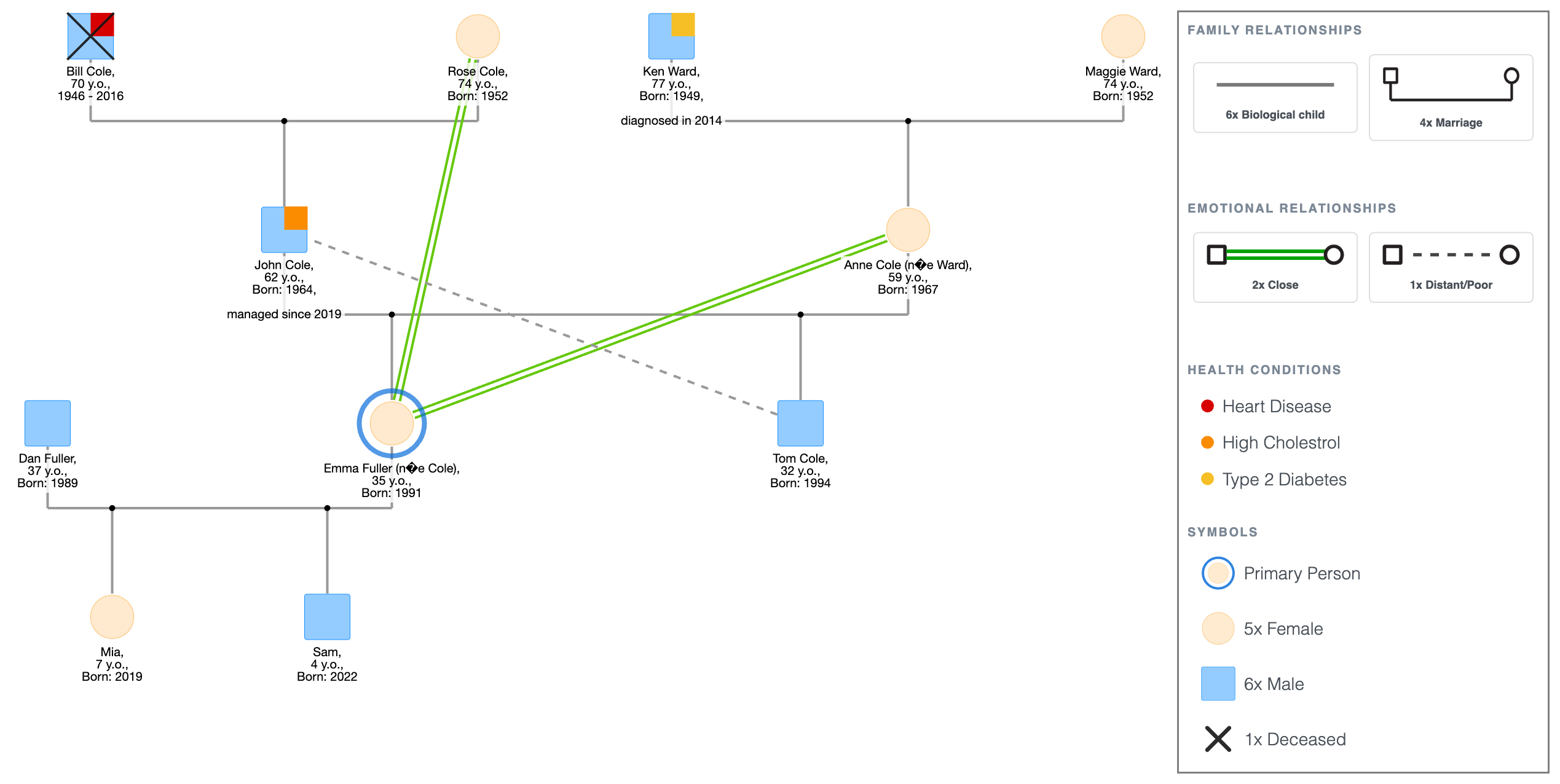
The family:
- Emma Fuller (née Cole), 35, is the primary person. She is married to Dan Fuller, 37. They have two children: Mia, 7, and Sam, 4.
- Emma's parents: John Cole, 62 (high cholesterol, managed since 2019) and Anne Cole (née Ward), 59.
- Emma has one sibling: Tom Cole, 32.
- Paternal grandparents: Bill Cole (deceased, 2016, heart disease, age 70) and Rose Cole, 74.
- Maternal grandparents: Ken Ward, 77 (type 2 diabetes, diagnosed 2014) and Maggie Ward, 74.
- Relationship lines: close between Emma and Anne; close between Emma and Rose; distant between Tom and John.
What you can now see:
- Bill's heart disease sits in the top-left corner with an X through his symbol. John's high cholesterol sits one row below it on the same side. Two conditions, same family line, two generations apart. Mia and Sam are at the bottom of that column. The genogram puts all four generations in the same vertical read.
- The distant line between Tom and John sits between a father and his adult son in the same household generation.
- Rose has a close line to Emma. Bill is gone; Rose is 74 and still present. Emma's close line to her paternal grandmother sits alongside the distant line between Tom and John; two relationships on the same side of the family, running in different directions at the same time.
- Ken's diabetes sits on the maternal side. John's cholesterol sits on the paternal side. Both are metabolic conditions in the grandparent or parent generation.
- Dan's parents are not on this genogram. That is a deliberate choice; the Fuller family genogram is built around Emma. If Dan's family history were relevant to the purpose, they would appear. What is left off a genogram is as much a choice as what is included.
Reading the Key
Every genogram includes a key listing what each symbol means. Here is what the Fuller family genogram uses:
- Square: male family member.
- Circle: female family member.
- Double border: primary person (Emma).
- X through symbol: deceased (Bill).
- Horizontal line between two shapes: married couple.
- Vertical and horizontal lines below a couple: parent-child and sibling connections.
- Color marker inside symbol: health condition.
- Note beside symbol: life event.
- Thick green lines: close relationship.
- Dashed line: distant/poor relationship.
For a full reference of all standard genogram symbols including conflict lines, cutoff lines, divorce slashes, and adoption notation, see the genogram symbols guide.
How to Build Your Own Family Genogram
Open the Fuller-Cole-Ward family genogram in EasyGenogram and replace each person with the equivalent member of your own family. Here is the order that works best:
- Start with yourself: Replace Emma's symbol with your own name and age. The double border stays; you are the primary person.
- Replace the parents: Swap John and Anne's details with your own parents' names, ages, and any health conditions that are relevant. If your parents are divorced, the marriage line changes to a divorce line.
- Replace the grandparents: Work through each grandparent. Add an X and cause of death for anyone who has died. Add health conditions beside those who are living. If you don't have information for a grandparent, leave the symbol blank rather than removing it; the position matters.
- Add or remove siblings: This family has Tom on the paternal side. Add siblings where yours appear; remove the placeholder if you are an only child.
- Add your own household: Replace Dan, Mia, and Sam with your partner and children if applicable. If you don't have children yet, remove those symbols.
- Add relationship lines last: Look at the relationships that are significant in your family, i.e., the ones that change how someone reads the diagram. Close relationships, distant ones, a conflict or cutoff if one exists.
For a full step-by-step walkthrough, see how to make a family genogram.
When to Simplify or Go Deeper
The Fuller family genogram is a complete but straightforward three-generation map.
If your family is simpler, like just a nuclear unit with no significant health history, the basic genogram example is a cleaner starting point.
If your family is more layered with blended structure, multiple health conditions, or a more complex relationship map, the detailed genogram example or the complex genogram example will be closer to what you need.
FAQ
What is a genogram example for a family?
A family genogram example is a completed diagram showing a family across two or three generations using standard symbols. The family genogram on this page is a complete example you can open and edit directly.
What does a family genogram key include?
A key (or legend) lists every symbol and line type used on the diagram and what each one means.
How do I make a genogram for my own family?
Open the example family genogram above in EasyGenogram and replace each person with the equivalent member of your own family, starting with yourself and working outward. The "How to Map Your Own Family" section above walks through the order.
What is an example of a family genogram with explanation?
The family genogram on this page includes a full explanation of what each element shows; what the health conditions reveal in context, what the relationship lines mean, and why certain members are included or left off. The key section explains each symbol type as it appears in this specific genogram rather than as a general reference.
Can I download a family genogram example as a PDF?
Yes. Open the family genogram example in EasyGenogram and use the PDF export button.
Sources
- Genograms: Assessment and Intervention (3rd ed.). W.W. Norton & Company.
- Family Therapy in Clinical Practice. Jason Aronson.