Appearance
How to Make a Family Genogram
A family genogram maps relationships, health history, and repeating family patterns across at least three generations. Use it when you need more than a family tree and want to see how conflict, closeness, illness, or roles repeat across the family. This guide walks through the full build from gathering information to reading the finished diagram.
How to Make a Family Genogram: Step by Step
These are six steps on how to make a family genogram.
Step 1: Gather your family information
The more you know before you draw, the more the genogram reveals.
What to collect:
- Names and ages.
- Birth and death years.
- Marriages, divorces, separations, with dates.
- Children, including birth order.
- Health conditions and causes of death.
- Relationship quality.
How to get it:
- Having a short conversation with a parent or grandparent fills in two generations.
- For medical history, General Practitioner (GP) records and old documents are more reliable than memory.
We’ll be building a family genogram of a fictional family (Caldwell) using EasyGenogram. If you're building by hand, in Word, in Google Docs, or in Canva instead, follow that guide before continuing.
Here’s information on the Caldwells:
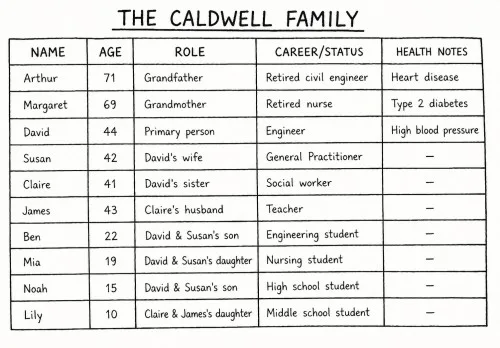
We’ll depict the Caldwell family’s emotional relationships, career, and medical history in this genogram.
Step 2: Build the structure
- Click the + button on the canvas to add a person, or drag a shape from the sidebar.
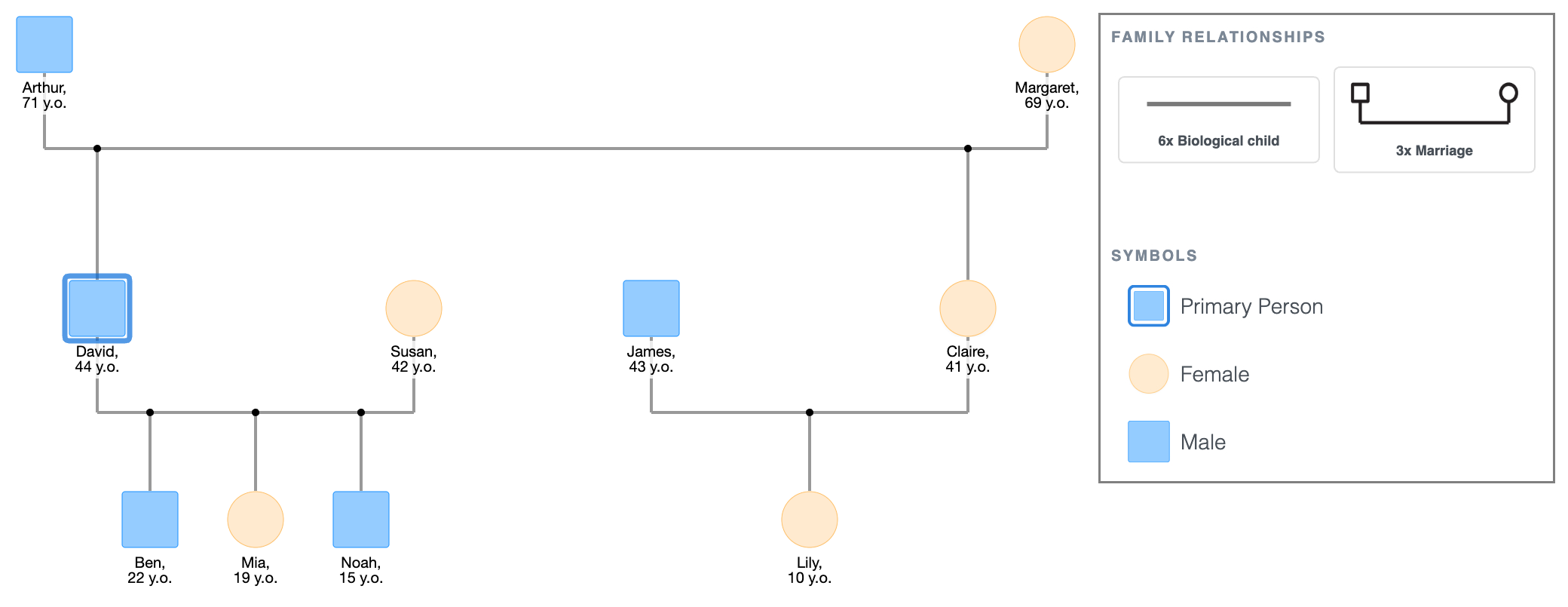
- Place Arthur (square) on the left. Click his shape; the quick-add buttons appear. Click Add Partner to add Margaret; EasyGenogram draws the marriage line between them automatically.
- Click Arthur or Margaret's shape and select Add Children; David and Claire drop in below, already connected to the generation above.
- Move David to the left and Claire to the right. Click David's shape and mark him as the primary person.
- Click David's shape and select Add Partner to add Susan. EasyGenogram draws the marriage line automatically.
- Click Claire's shape and select Add Partner to add James. Drag James to Claire's left so the couple pair reads as male left, female right.
- Click David or Susan's shape and select Add Children; Ben, Mia, and Noah drop in below their marriage line. Move them into birth order left to right.
- Click Claire or James's shape and select Add Children; Lily drops in below their marriage line.
The Caldwell Family Genogram
Step 3: Add emotional relationship lines
Draw emotional lines after the structure is complete so they route cleanly around existing connections.
For the Caldwells:
- Arthur and David: conflict line.
- Margaret and Claire: closeness line.
- David and Ben: closeness line.
To do this:
- Click Arthur's shape; the quick-add buttons appear. Click Connect, then click David's shape. A relationship picker pops up, select the conflict line.
- Click Margaret's shape, click Connect, then click Claire's shape. Select the closeness line.
- Click David's shape, click Connect, then click Ben's shape. Select the closeness line.
Caldwell Family Genogram Showing Emotional Relationships
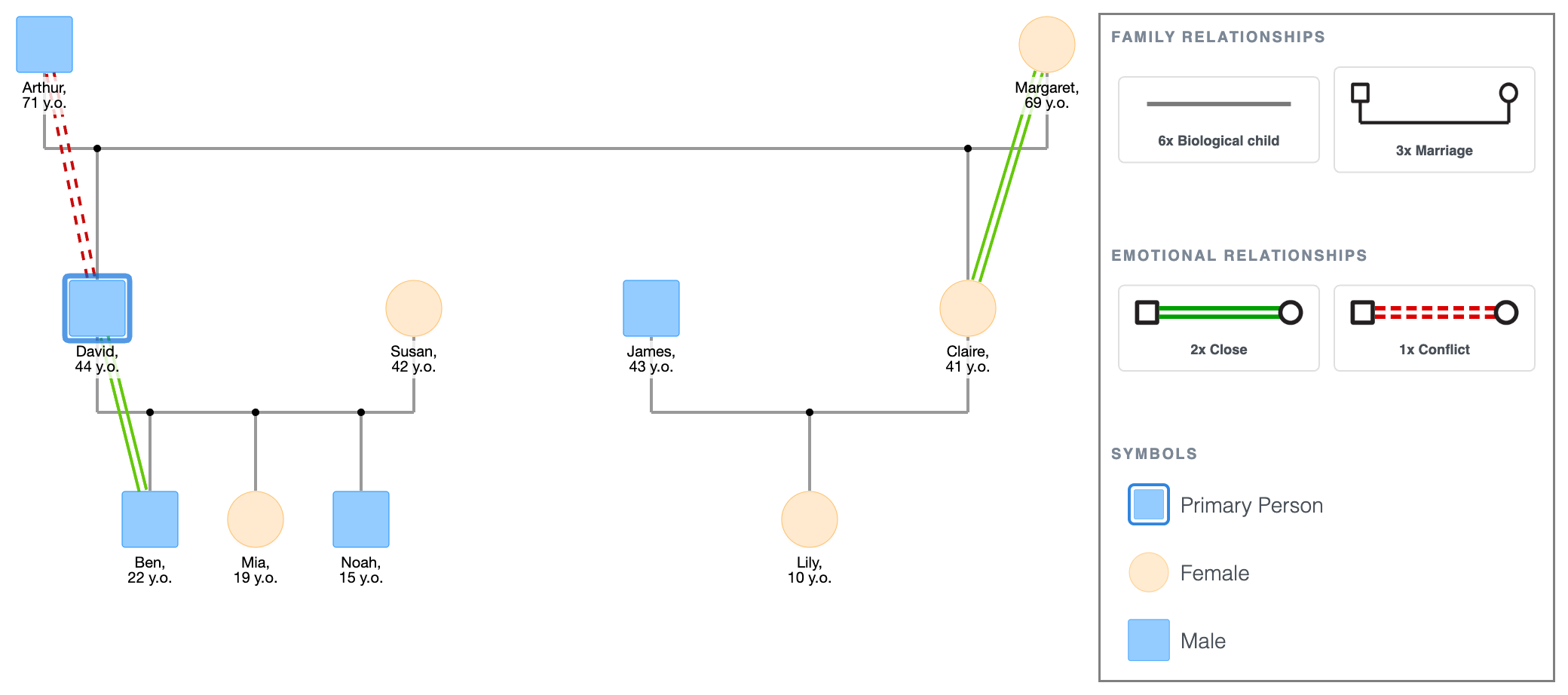
Add lines only where they’re relevant. A diagram with a line between every pair becomes harder to read than one with none.
For the complete reference, see the genogram symbols guide.
Step 4: Add careers
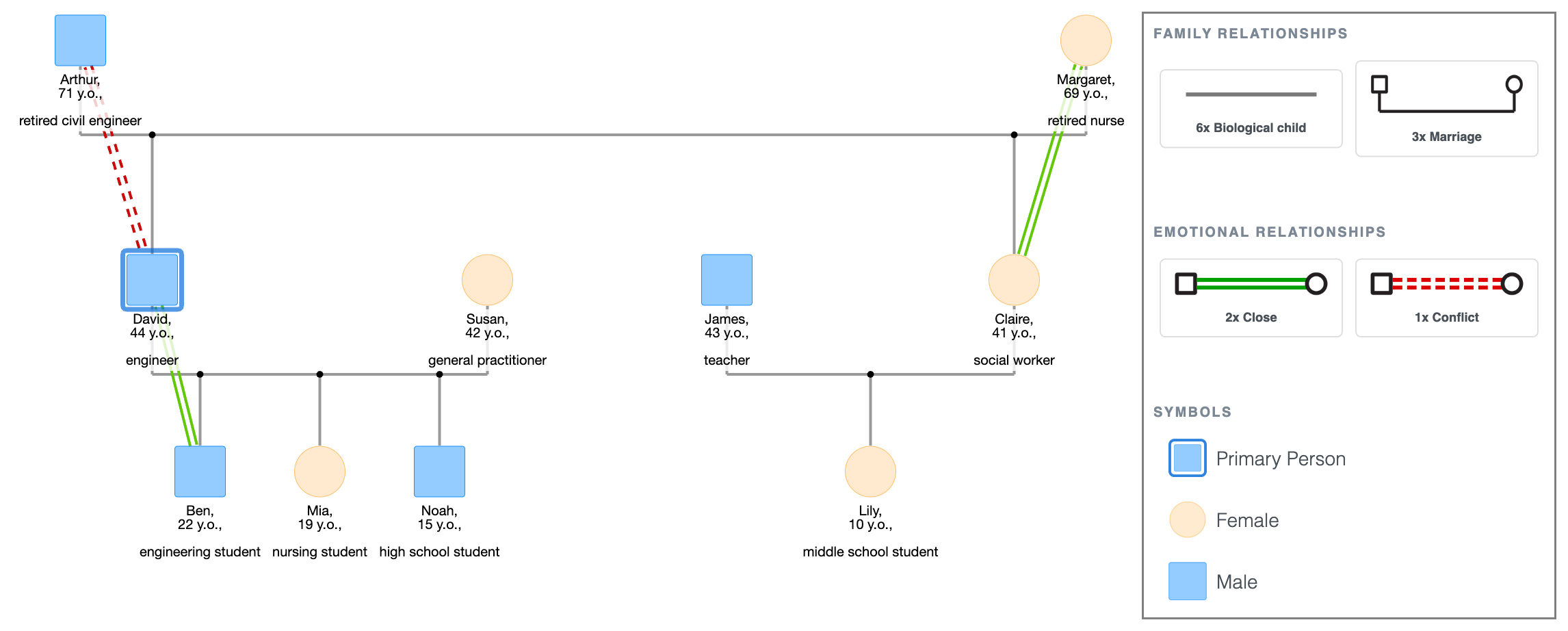
Add each person’s occupation directly on the diagram, below their name.
For the Caldwells:
- Arthur: retired civil engineer
- Margaret: retired nurse
- David: engineer
- Susan: general practitioner
- Claire: social worker
- James: teacher
- Ben: engineering student
- Mia: nursing student
- Noah: high school student
- Lily: middle school student
Caldwell Family Genogram Showing Careers
Step 5: Add medical and behavioral notes
Write health conditions and behavioral patterns on the diagram, next to the person they describe.
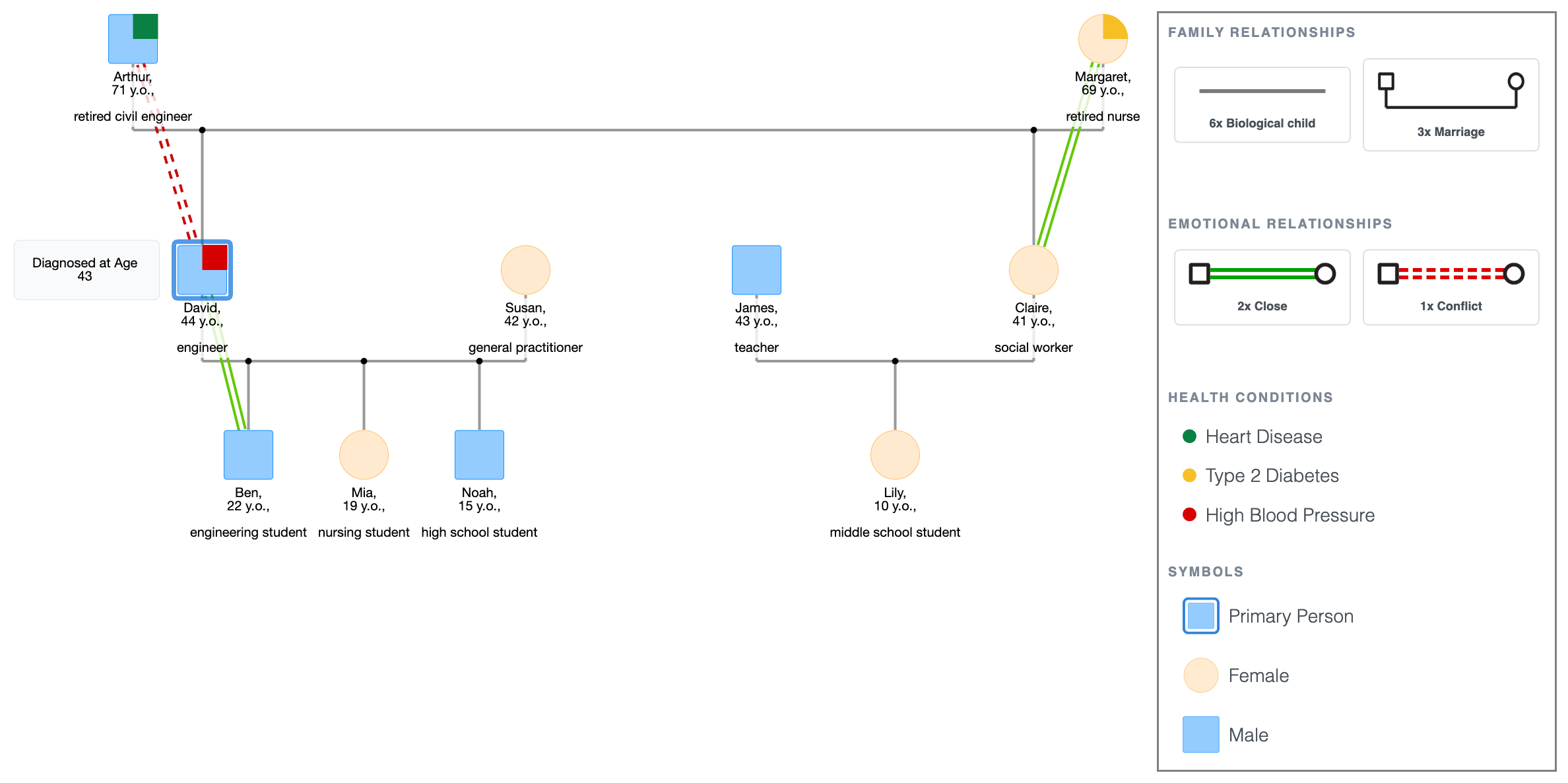
For the Caldwells:
- Mark Arthur's square to indicate heart disease, with "heart disease" noted.
- Shade Margaret's circle and note "type 2 diabetes".
- Mark David with "high blood pressure,” add “diagnosed at age 43" as a note close to David.
Keep notes short. Use a reference letter on the shape and a notes section at the bottom when the diagram gets crowded.
Caldwell Family Genogram Showing Health History
Step 6: Read the patterns
Step back and look at the completed diagram as a whole. This is the reason the family genogram exists.
The Caldwells tell several stories at once.
Health:
On the paternal side, Arthur has heart disease. David was diagnosed with high blood pressure at 43. Both conditions sit on the paternal line, and Ben, now 22, carries that same lineage. This flags something worth tracking.
On the maternal side, Margaret manages type 2 diabetes. Mia, training to be a nurse, is aware of this.
Noah and Lily are young enough that neither pattern has surfaced yet, but the family history is there to reference when it does.
Careers:
Engineering runs through three generations; Arthur built the foundation, David carried it forward, and Ben is now studying the same field.
On the other side, Margaret spent her career in nursing, and Mia is following that path (she also has her mother, a general practitioner).
Claire moved into social work, James into teaching; a generation that leaned toward care and public service rather than technical fields.
Lily, at 10, is the only one whose options are still fully open.
Relationships:
David’s relationship with his own father is strained, yet he’s built a close relationship with his eldest son, the one mirroring his career. That closeness is straightforward, reflecting something about how David relates to a younger version of himself. Whether that pattern holds as Ben grows older is something the diagram prompts you to watch.
Margaret and Claire are close; the maternal bond across generations is visible and consistent.
A family genogram like this gives you the right questions and a structure to revisit as the family changes.
Caldwell Family Genogram Showing Health History
Explore this genogram and adapt it to your needs.
What to Look for in a Completed Family Genogram
Go through this checklist to avoid the common mistakes in making family genograms:
- Does a health condition appear in the same position across generations?
- Do relationship patterns repeat (e.g., conflict between fathers and sons, closeness between mothers and daughters)?
- Do the same roles appear in every generation: the caretaker, the one who cut contact, the one who moved away?
- Do career choices cluster; certain fields passing through one side of the family?
- Have you marked every gap with a question mark where information is missing?
- Have you used approximate ages or date ranges rather than skipping a person entirely?
- Have you noted when a relative won't discuss something?
- For medical history, have you checked GP records, death certificates, or old correspondence?
A family genogram doesn’t need to be complete to be useful. The patterns it shows, and the gaps it reveals, are both part of the picture.
Caldwell Family Genogram Showing Health History
Explore this genogram and adapt it to your needs.
FAQ
What is a family genogram?
A family genogram maps a family across multiple generations using standardized symbols. It shows not just who is related to whom, but the quality of those relationships, such as closeness, conflict, and estrangement, alongside medical history and behavioral patterns.
How is a family genogram different from a family tree?
A family tree shows lineage, only names, dates, and who descended from whom. A family genogram adds relationship quality, health conditions, behavioral patterns, and significant life events. A family tree only tells you who your family is, but a genogram shows how it works across generations.
How many generations should a family genogram include?
Three is the standard. Two rarely show enough to identify patterns. Four or more helps track hereditary or behavioral trends, but the further back you go, the harder it becomes to gather reliable information.
Can I make a family genogram without a therapist?
Yes. The drawing and gathering process requires no therapist. Interpreting a genogram for clinical purposes, which includes identifying patterns and processing trauma, benefits from professional guidance. Building one for a class assignment, personal awareness, or health history does not.
Can I make a family genogram online for free?
Yes. EasyGenogram is free to use. You can build from scratch or edit an existing example, then export as a PDF, PNG, or embed.
Sources
- Genograms: Assessment and Treatment (4th ed.)
- Genograms for Psychotherapy
Related
How to Make a Genogram (Step-by-Step Guide)