Appearance
Trauma Genogram
A trauma genogram traces how a traumatic event in one generation shapes the responses, coping, and relationships of the generations that never directly experienced it.
Trauma Genogram Example
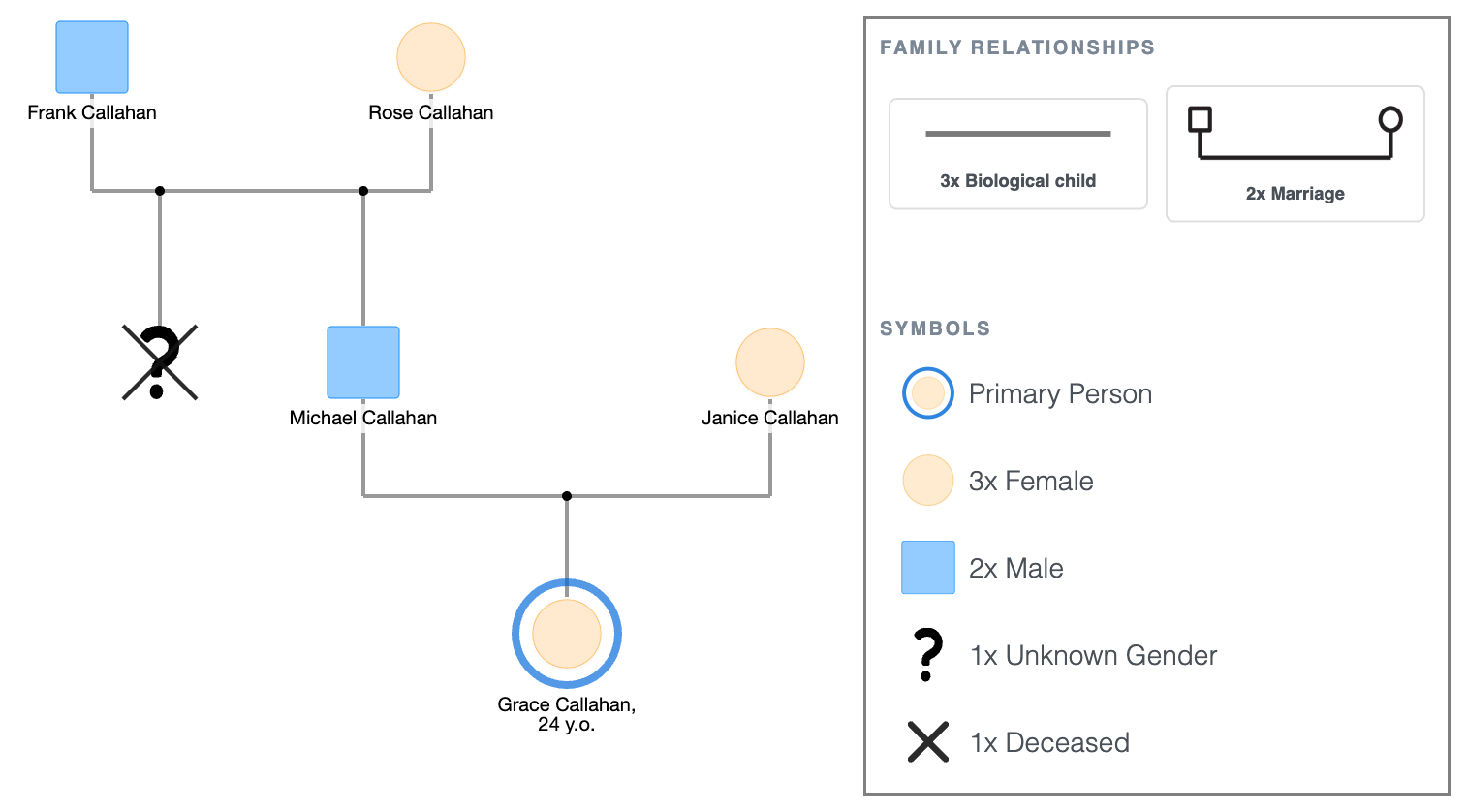
Grace Callahan, 24, came in after a breakup she described as "fine," except she wasn't sleeping and couldn't explain why she felt nothing where sadness should be.
The Family
- Gen 1: Rose Callahan & Frank Callahan — lost a baby before their son Michael was born. The loss was never discussed afterward.
- Gen 2: Michael Callahan (son of Rose & Frank) — grew up under an unspoken rule against sadness. Became a fixer who moves past difficult emotions rather than sitting with them.
- Gen 3: Grace Callahan (24, Michael's daughter, the client) — struggles to grieve or feel sad about anything without immediately trying to fix it or move on.
What This Genogram Shows
The loss that was never mourned became a family rule, three generations deep: don't sit with sadness, fix it or move past it.
Michael learned that rule growing up around a grief no one named.
Grace learned it from Michael, without ever knowing where it started. She wasn't taught to feel sad and let it pass. She was taught to skip past it entirely.
Bringing this into a session instead of moving around it, the way her father and grandmother did, is itself the part of the pattern that's already changing.
Why This Helps in Therapy
"Why can't I just feel sad" turns into something Grace can actually work with once it's traceable. She then realizes it’s not a personal flaw.
What a Trauma Genogram Can Map
- The event itself: what happened, and to whom.
- How each generation responded: silence, avoidance, over-functioning, or something else.
- What got passed down: a coping style, an unspoken rule, a way of relating.
- What resilience looks like: where the pattern already started to shift, as with Grace choosing to name it.
When It Gets Introduced
Most therapists wait until some trust is established before building a trauma genogram. It isn't a first-session exercise. A client needs enough safety in the relationship to explore family history at this depth without it feeling like an interrogation.
Building One With Care
Open a blank canvas in EasyGenogram and build out three generations at whatever pace the client can tolerate, adding relationship lines and notes as the history comes up rather than all at once.
Export as PDF or PNG for the clinical record once it's done.
Read How to Make a Genogram for the full guide.
When Not to Use This Yet
A trauma genogram isn't a first-session tool. Building one before a therapeutic alliance exists, or while a client is in acute crisis or without enough coping resources, risks reopening something before there's a safe place to hold it. The goal is understanding a pattern, not reliving it.
If a client becomes overwhelmed while building one, the genogram can wait. The relationship can't be rushed to get there.
FAQ
What's the difference between a trauma genogram and a regular family genogram?
A regular family genogram maps structure and general relationship quality. A trauma genogram specifically tracks traumatic events, how each generation responded to them, and how those responses were passed down, alongside what helped the family recover.
Does the client need to have experienced trauma directly for this to be useful?
No. Some of the most useful trauma genograms involve a client who never experienced the original event but inherited the response to it, like Grace inheriting a family rule against sadness she never witnessed being set.
How do you avoid making a trauma genogram feel like a list of everything that went wrong?
Map what helped alongside what hurt. Note who broke a pattern, who sought support, and what coping actually worked, not just the events themselves. A trauma genogram that only lists suffering misses half of what it's for.
Is it safe to build one early in treatment?
Generally not in the first session. Most therapists wait until enough trust and stability exist in the relationship before mapping trauma history at this depth.
How is resilience represented on a trauma genogram?
The same way the trauma is as part of the family's actual history. A family member who sought help, broke a silence, or changed a pattern gets marked on the diagram alongside the event that shaped it, not in a separate section.
Sources
- Genograms: Assessment and Intervention (4th ed.)author: McGoldrick, M., Gerson, R., & Petry, S.year: 2020