Appearance
Anger Genogram
An anger genogram is a three-generation family diagram that tracks how anger has been expressed, suppressed, or redirected across a family.
What an Anger Genogram Maps
- Anger expression style: explosive, passive-aggressive, suppressed, assertive, or displaced onto a safer target.
- Triggers: what provokes anger in each person; disrespect, feeling unheard, financial stress, alcohol, fatigue.
- Consequences: what happened after anger was expressed; cutoffs, health problems, repair, or nothing at all.
- Family rules about anger: who's allowed to be angry, and whether those rules differ by gender.
- Where suppressed anger shows up: physical symptoms, withdrawal, or eventual explosive episodes.
The Bennett Family
Anger Genogram Example
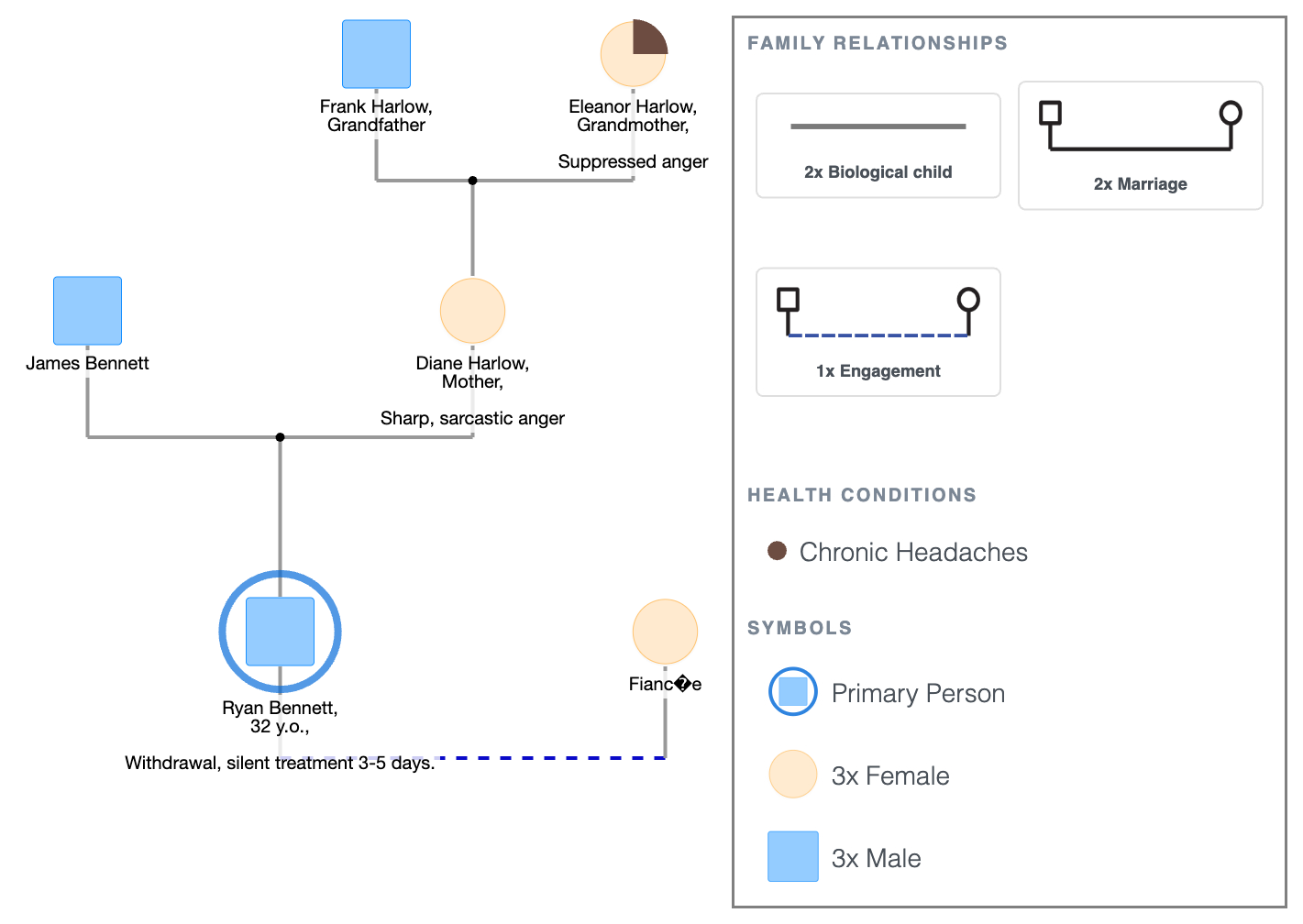
- Eleanor Harlow (grandmother): tag "Suppressed anger, chronic headaches."
- Frank Harlow (grandfather): partner line to Eleanor.
- Diane Harlow (mother), married to James Bennett: tag "Sharp, sarcastic anger."
- Ryan Bennett: primary person, 32, tag "Withdrawal, silent treatment 3-5 days."
Ryan Bennett, 32, came to couples counseling after his fiancée said his silent treatment during arguments "shuts her out for days."
Ryan didn't think of himself as an angry person. He rarely raised his voice. He just stopped talking to her.
What the Genogram Revealed
Ryan's grandmother, Eleanor, never showed anger at all. She kept the peace in her household for decades and developed chronic headaches that no one in the family connected to anything in particular.
Ryan's mother, Diane, grew up watching that and reacted against it, but not by becoming explosive. Her anger came out sharp and sarcastic, a running commentary rather than a raised voice.
Ryan grew up with that and developed a third response entirely; he doesn't suppress anger the way his grandmother did, and he doesn't sharpen it the way his mother did. He withdraws.
Three generations with three different expressions of the same underlying rule; that direct anger isn't safe to show.
How This Shaped the Counseling Plan
Naming the pattern mattered more than fixing it outright.
Ryan's withdrawal stopped looking like a character flaw and started looking like the family's third variation on a rule that had never been questioned.
The counseling plan didn't ask Ryan to become more expressive in the abstract. It worked toward something specific; noticing anger early, saying so directly, and staying in the room instead of leaving it, a fourth way that hadn't been modeled anywhere in his family for three generations.
Build One for a Client Case
Start with the family structure, two to three generations, then tag each person's anger expression style directly rather than leaving it to the diagram alone.
Note triggers and consequences where they're known, and look for where the same underlying rule shows up in a different form from one generation to the next, not necessarily the same behavior repeated.
For the full step-by-step process, see how to make a genogram.
Anger Genogram Example
Explore this genogram and adapt it to your needs.
FAQ
What is an anger genogram?
An anger genogram is a family diagram that maps how anger has been expressed, suppressed, or redirected across at least three generations. It shows each person's anger style, what triggered it, and what happened afterward, revealing the unspoken family rule underneath.
What anger expression styles show up on a genogram?
Common styles include explosive outbursts, passive-aggressive behavior like sarcasm or silent treatment, complete suppression, displaced anger directed at a safer target, and assertive expression. The same family often produces several different styles across generations, not just one repeated pattern.
Can an anger genogram help with anger management therapy?
Yes. It shifts the conversation from treating anger as a fixed character trait to treating it as a learned pattern, which gives clients somewhere concrete to identify what they inherited and what they want to do differently.
What if anger was never openly expressed in a family?
That's just as worth mapping as an explosive family. Suppressed anger tends to surface elsewhere as physical symptoms, depression, passive-aggression, or an eventual explosive episode once the suppression fails.
Is an anger genogram used in domestic violence treatment?
Yes, particularly to show multigenerational patterns of violence or intimidation. It's used to provide context for the behavior, not to excuse it.
Sources
- Anger Genograms (chapter)
- Genograms: Assessment and Intervention (4th ed.)