Appearance
Genogram in Addiction Treatment
Map substance use across generations alongside the family dynamics that surround it, enabling, cutoff, recovery, so a client sees the pattern as something bigger than personal failure and a clinician sees who to involve in treatment.
Why Genograms Reduce Shame in Treatment
A client who believes their addiction is a personal moral failing tends to treat every setback as proof of that belief.
Seeing the same pattern mapped across a family, a grandfather, a parent, sometimes a sibling, shifts the framing from "something is wrong with me" to "this is a pattern I inherited and can respond to differently."
That shift doesn't excuse anything but changes what the client is working against.
The Hartley Family
Addiction Treatment Genogram
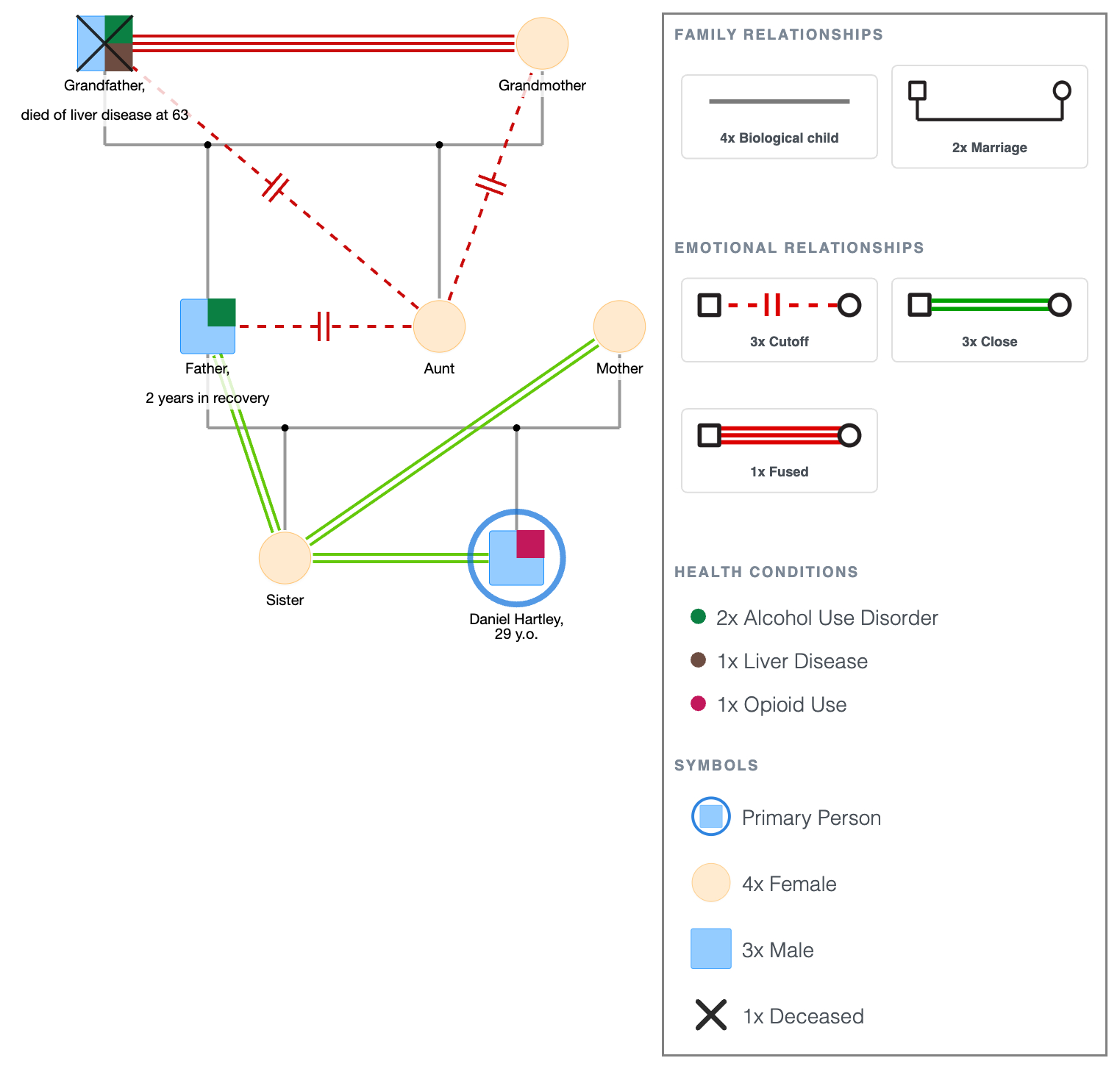
- Gen 1: grandfather (deceased, alcohol use disorder, died of liver disease at 63); grandmother - Fused line to grandfather.
- Gen 2: father (alcohol use disorder, 2 years in recovery); aunt - Cutoff line, estranged from the family.
- Gen 3: Daniel Hartley, 29, primary person, presenting for opioid use treatment; his older sister.
Daniel Hartley is 29 and entered treatment for opioid use following a period of escalating use after a job loss.
During intake, his counselor built a genogram with him rather than relying on a verbal history alone.
What emerged wasn't a repeat of his father's exact substance, but the same underlying pattern showing up differently one generation later.
Reading the Patterns
Daniel's grandfather had alcohol use disorder and died of liver disease at 63.
His grandmother's Fused line to him reflects years of covering for his drinking, calling in sick on his behalf, managing the family's image around it, the kind of enabling that kept the addiction contained but never addressed.
Daniel's father developed the same disorder as a younger man and is now two years into recovery, which makes him a genuine resource on the genogram rather than another entry in the pattern.
Daniel's aunt, his father's sister, carries a Cutoff line; she confronted her father about his drinking decades ago and hasn't been part of the family since.
Daniel's own use is opioids, not alcohol, which matters less than it might seem.
The genogram shows a family with a documented vulnerability to substance use passing through two generations by two different routes, not evidence that addiction runs in exact copies.
His older sister, meanwhile, took on the role their family needed someone to hold: the reliable one, the one who managed things when their parents couldn't.
How This Shapes Daniel's Treatment Plan
The genogram gives Daniel's counselor concrete decisions to make instead of general ones.
His father, two years sober, is a candidate to invite into a family session as a model that recovery is possible, not just a cautionary tale further up the tree.
His sister's caretaker role is worth naming directly, since she may need support in stepping back from managing Daniel's recovery the way she managed the household growing up.
The aunt's cutoff isn't necessarily something to repair during early treatment, but it's worth knowing that reconciliation attempts run in this family's history and haven't gone well before.
None of this replaces a full clinical assessment. It gives the assessment a family map to work from instead of Daniel's account alone.
Build One During Intake
Start with three generations and mark substance use through the Health Conditions panel under the Substance category, using status to distinguish active use from recovery.
Add relationship lines as the history comes out, Fused for enabling dynamics, Cutoff for estrangements, Close for genuine support.
Ask directly who else in the family has struggled with substances, what happened when they did, and whether anyone in the family is currently in recovery.
Export as PDF for the treatment record once it's built, and revisit it as family therapy sessions add detail.
For the full guide, see How to Make a Genogram.
Addiction Treatment Genogram
Explore this genogram and adapt it to your needs.
FAQ
Does the genogram need to show the same substance across generations to be useful?
No. Daniel's family shows alcohol in one generation and opioids in the next. What the genogram tracks is a documented vulnerability passing through the family, not a requirement that every generation use the same substance.
How do I mark someone as in recovery versus actively using on a genogram?
Use the Health Conditions panel's status field; an active fill for current use, a striped fill for recovery, consistent with the McGoldrick standard. Always include a legend, since there's no single universal symbol set for this.
Should a client build this genogram alone, or with family present?
Both approaches are used. Building it with the client alone during intake gets a starting picture quickly. Rebuilding or expanding it with family members present, later in treatment, often surfaces different perspectives on the same events.
What if a client doesn't want to talk about a specific family member?
Leave that branch sparse and revisit it later if the client becomes more comfortable. A genogram doesn't need to be complete on the first pass, and pushing past a client's readiness can undermine the trust the process depends on.
Can this genogram double as a relapse prevention tool later in treatment?
Yes. The same diagram that maps enabling relationships and cutoffs during intake can be revisited to identify family triggers, like gatherings where alcohol is present, and protective factors, like a family member in recovery, once relapse prevention planning begins.
Sources
- The Genogram as a Tool in Family Assessment for Substance Use Disorders
- Genograms: Assessment and Intervention (4th ed.)