Appearance
Bowen Family Systems Genogram
Follow a client’s issue back far enough and it usually connects to a pattern that started somewhere else in the family, sometimes generations earlier. A Bowen family systems genogram is built to trace exactly that.
What Is a Bowen Family Systems Genogram?
It's a genogram used to apply Murray Bowen's family systems theory:
- Differentiation of self
- Triangles
- The nuclear family emotional process
- Family projection process
- Multigenerational transmission
- Emotional cutoff
- Sibling position, and
- Societal emotional process.
Standard genogram symbols come from McGoldrick and Gerson, but the theory behind what the symbols are tracking is Bowen's.
Each concept has its own signature on the diagram, and once you know what to look for, the family's patterns stop looking random.
The Castellano Family
Bowen Family Systems Genogram Example
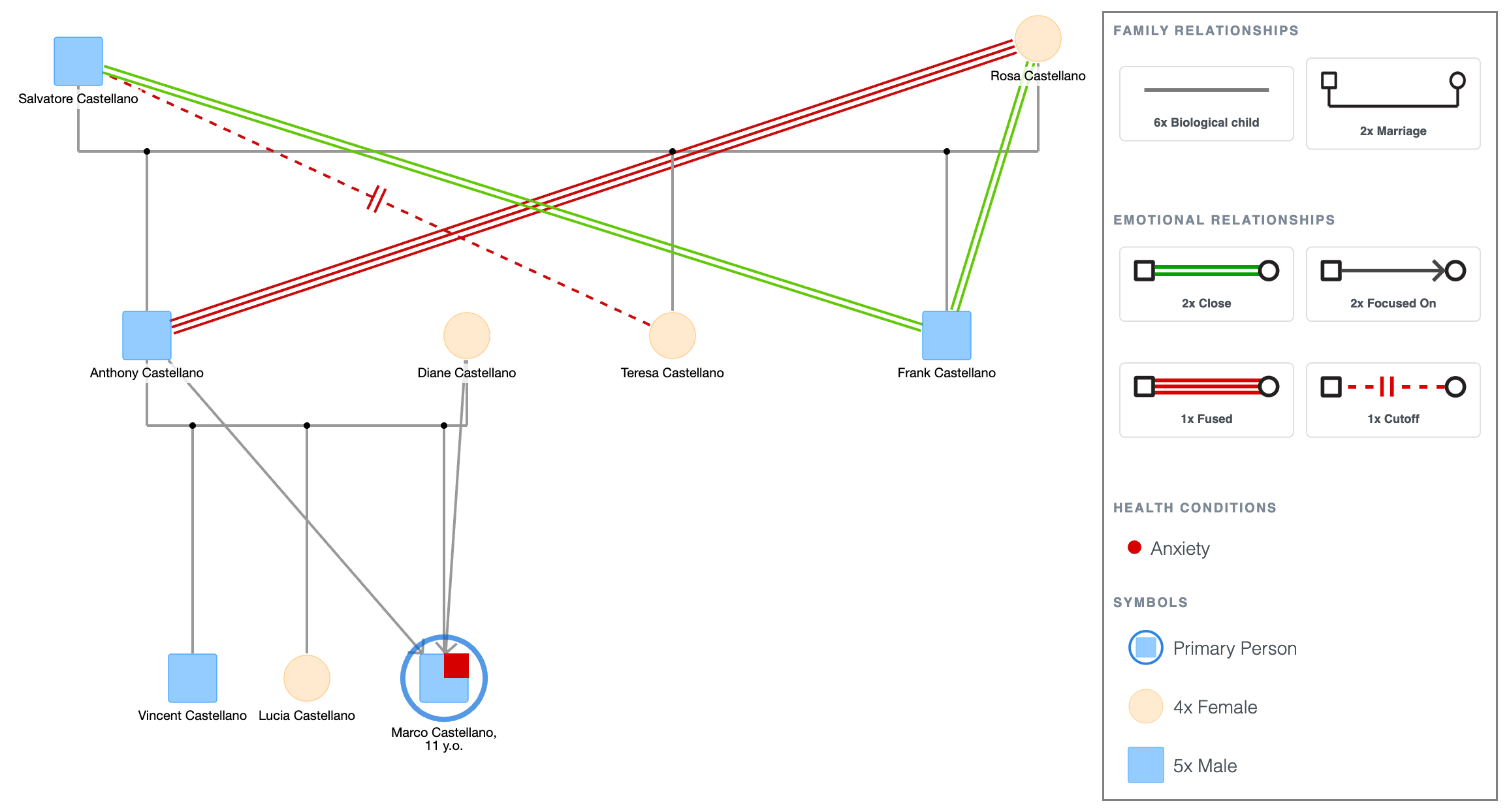
- Gen 1: Salvatore Castellano & Rosa Castellano
- Gen 2: Anthony Castellano (oldest, son of Salvatore & Rosa) - Fused line to Rosa; married to Diane Castellano.
- Gen 2: Teresa Castellano (middle child) - Cutoff line to Salvatore.
- Gen 2: Frank Castellano (youngest) - Close line to Salvatore and Rosa.
- Gen 3: Vincent Castellano (oldest, son of Anthony & Diane).
- Gen 3: Lucia Castellano (middle child).
- Gen 3: Marco Castellano (youngest) - Focused On line from both Anthony and Diane.
Salvatore and Rosa Castellano raised three kids in a factory town that lost its main employer twice in one generation.
Anthony, their oldest, married Diane and had three kids of his own: Vincent, Lucia, and Marco.
Marco is the identified patient, an eleven-year-old with anxiety severe enough that his school asked the family to bring in outside support.
Nothing about Marco's anxiety makes sense on its own. But it makes sense once you look at the rest of the diagram.
Differentiation of Self
Differentiation is the ability to stay yourself under emotional pressure instead of automatically absorbing whatever anxiety is in the room.
On the Castellano genogram, it shows up as a contrast between siblings, not a single number you can assign to one person.
Anthony carries a Fused line to Rosa. He calls her daily, defers to her opinion on his own marriage, and reacts to any criticism of her as if it were aimed at him directly.
Frank carries a Close line to both parents instead, close enough to stay involved, but not close enough to lose his own opinions in theirs.
They have the same parents, grew up in the same household, but have two different outcomes.
That gap is what differentiation looks like on paper: not distance versus closeness, but fusion versus closeness that holds its shape under stress.
Triangles
A triangle forms when tension between two people gets stabilized by pulling in a third.
On the Castellano genogram, Anthony and Diane's marital tension runs through Marco, marked with a Focused On line from each parent to him.
When Anthony and Diane disagree, neither raises it directly.
Instead, one of them starts worrying out loud about Marco, his grades, his stomach aches, his trouble sleeping, and the conversation shifts from the marriage to the child.
Marco absorbs the anxiety that was never actually about him. The triangle doesn't resolve the tension between his parents, but rather, relocates it.
Nuclear Family Emotional Process
Bowen described four patterns families use to manage anxiety:
- marital conflict
- dysfunction in a spouse
- impairment in a child, or
- emotional distance.
The Castellanos default to the third.
Anthony and Diane rarely fight openly, but their conflict shows up as concern about Marco instead.
This is why Marco's symptoms flare in a predictable rhythm.
His anxiety gets worse in weeks when Anthony and Diane are more withdrawn from each other, and eases when things between them are calmer, even though nobody in the family would describe it that way if you asked them directly.
Family Projection Process
Family projection process explains why Marco specifically, not Vincent or Lucia, became the anxious one.
Anthony has spent years worried that he's not steady enough, a doubt tied back to his own Fused relationship with Rosa.
Marco was born during a stretch when that doubt was especially loud, and Anthony started monitoring him more closely than his siblings from early on.
Vincent got treated as the capable one from the start.
Lucia mostly got left alone.
Marco got the anxiety.
None of that was a conscious decision.
It's the pattern of where a parent's own unresolved anxiety tends to land.
Multigenerational Transmission Process
This is the concept that connects all three generations.
Teresa, Anthony's sister, carries a Cutoff line to Salvatore after a conflict neither side ever resolved. She skips holidays, and Salvatore doesn't ask about her.
Now look at Vincent.
He's already the one who mediates between his parents, the same role Anthony played between Salvatore and Teresa before the cutoff happened.
The pattern of one child absorbing family tension didn't start with Marco.
It's been present for at least three generations, just landing on a different person each time.
Multigenerational transmission is what makes that visible: not a repeat of the same event, but a repeat of the same role.
Emotional Cutoff
A cutoff manages unresolved tension by reducing or ending contact, not by resolving what caused it.
Teresa's Cutoff line to Salvatore is the clearest example on this genogram.
The conflict that caused it, an argument over Teresa's choice of partner, happened over a decade ago.
The distance since then hasn't settled anything. It's just made the original issue harder to raise.
Cutoffs also tend to skip a generation and reappear.
Vincent's mediating role puts him in the same position Anthony held right before Teresa's break with Salvatore, which is part of why a genogram like this one gets revisited over time rather than filed away after one session.
Sibling Position
Birth order shapes the roles siblings take on, and the Castellano genogram shows this twice, once per generation.
Anthony, the oldest, became the responsible one who mediates.
Frank, the youngest, stayed the most relaxed and least entangled.
One generation down, Vincent, the oldest, has already stepped into the mediator role, and Marco, the youngest, has become the one who absorbs the family's anxiety instead of naming it.
Neither pattern is a coincidence specific to this family.
It's a documented tendency in birth-order research that Bowen folded into his theory, and it's part of why the same role can show up in the same sibling position two generations apart.
Societal Emotional Process
Family patterns don't form in isolation.
Salvatore and Rosa raised their kids through two rounds of factory closures in the same town, with no financial safety net either time.
Their fusion and their self-reliant, don't-ask-for-help style weren't just personality but a response to real, sustained instability.
That context doesn't excuse the cutoff or the fusion that followed.
It explains where the family's baseline anxiety came from before it ever reached Anthony, Diane, or Marco.
A genogram that only tracks the family and ignores the conditions around it misses part of the picture.
Build One Like This
Start with three generations in EasyGenogram: grandparents, parents, and the current kids.
Add each person, then use the relationship lines, Fused, Close, Cutoff, Focused On, Conflict, to mark what you're hearing as the family history comes out.
Note sibling order as you go; it matters more than it looks like it should.
Export as PDF or PNG once the diagram reflects what the family actually described.
For the full guide, see How to Make a Genogram.
Bowen Family Systems Genogram Example
Explore this genogram and adapt it to your needs.
FAQ
What's the difference between a regular genogram and a Bowen family systems genogram?
A regular genogram records family structure, like who's related to whom, births, deaths, marriages. A Bowen family systems genogram uses that same structure to track theory-specific patterns, differentiation, triangles, cutoff, projection, so the diagram shows why the family functions the way it does, not just who's in it.
Do you need all eight Bowen concepts on every genogram?
No. Most genograms end up highlighting two or three concepts that are clinically relevant for that family. The Castellano genogram touches all eight because it's a teaching example. In practice, a cutoff and a triangle showing up clearly is often enough to work with.
How do you show a triangle on a genogram?
Use a Focused On line running from each of the two people in tension to the third person who absorbs it. On the Castellano genogram, that's the line from both Anthony and Diane to Marco.
Can one child really absorb a whole family's anxiety?
That's what the family projection process describes, and it's a well-documented clinical pattern, not a stretch. It's usually not one dramatic event but years of a parent's anxiety landing more often on one child than their siblings.
Does a cutoff ever fully resolve on its own?
Rarely. Bowen's theory holds that cutoff manages tension through distance rather than resolving it, which is why the underlying issue tends to resurface, sometimes in the next generation, unless it's addressed directly.
Sources
- Family Therapy in Clinical Practice
- Family Evaluation: An Approach Based on Bowen Theory
- Genograms: Assessment and Intervention (4th ed.)