Appearance
Genograms in Therapy
During an intake session, a client's account of their family only goes so far. A genogram in therapy is a structured family map, built together with the client, that shows relationship patterns like conflict, distance, or closeness across three or more generations. It's a direct way to make a family system visible instead of just described.
Genogram in Therapy Example
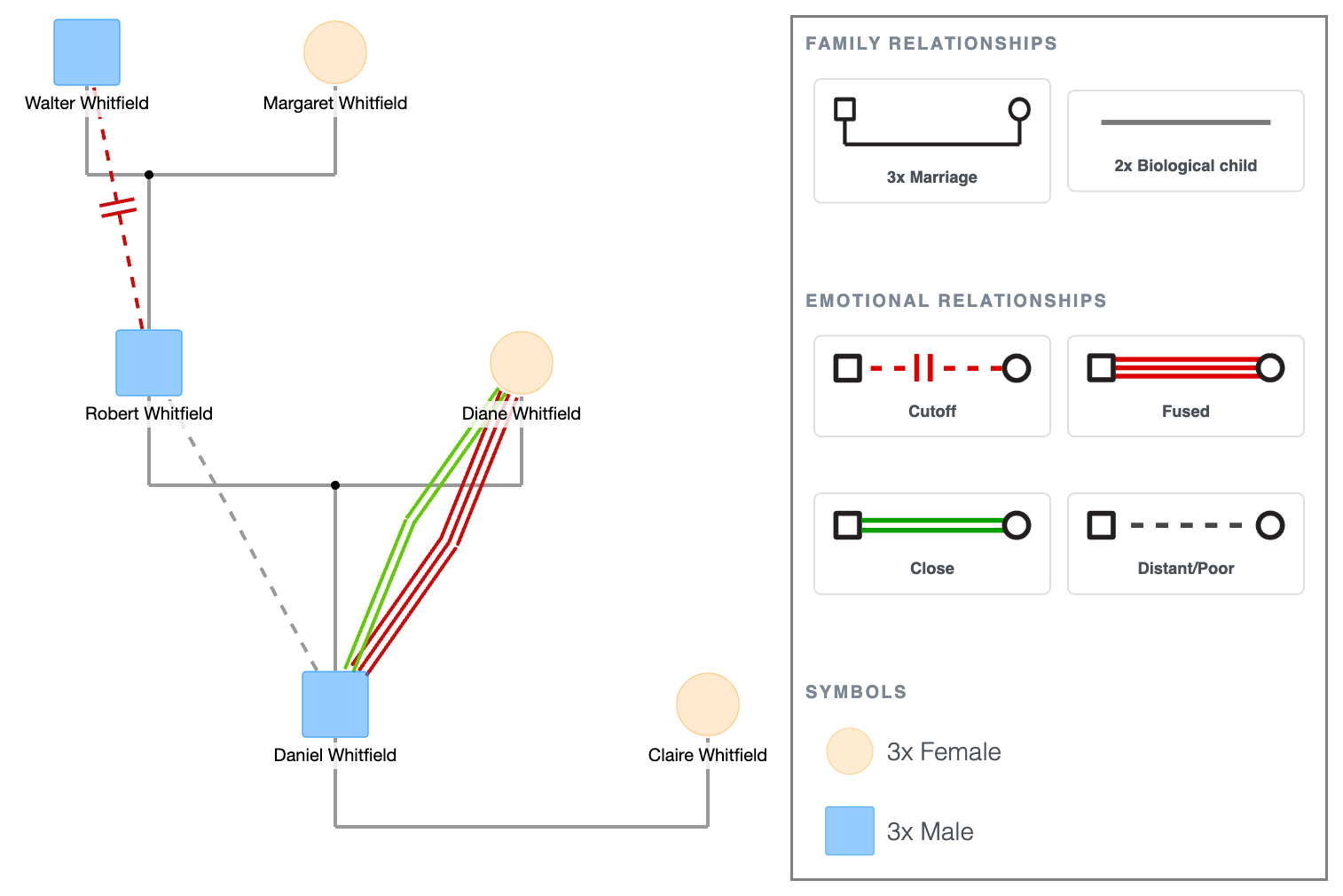
Daniel came in describing the same complaint: things get serious with a partner, and he pulls away.
The Family
- Gen 1: Walter Whitfield & Margaret Whitfield.
- Gen 2: Robert Whitfield (son of Walter & Margaret) married to Diane Whitfield. Robert cut off from Walter after a conflict, marked with a cutoff line.
- Gen 3: Daniel Whitfield (son of Robert & Diane); fused/close line to Diane, distant line to Robert. Current partner, Claire shown.
What This Genogram Shows
The genogram makes the reason easier to see than to explain.
His father, Robert, cut off from his own father decades earlier after a conflict neither side resolved.
Daniel grew up watching that distance play out as normal between fathers and sons.
At the same time, he was raised close, arguably too close, to his mother, Diane.
What looks like an unrelated relationship habit turns out to be two inherited templates: distance from one side, fusion from the other.
Neither one taught him what an ordinary, steady closeness looks like.
Why Therapists Use a Genogram Here
A client can describe a feeling, but a genogram shows a pattern.
Daniel could always say he "pulls away," but he couldn't connect it to anything until the diagram put his father's cutoff and his mother's closeness on the same page, three generations deep.
That shift, from a personal quirk to a traceable family pattern, is usually what makes the tool worth the session time it takes to build.
When It Gets Introduced
Most therapists sketch a basic genogram during intake, while gathering family history anyway.
Others bring it in later, once a client repeats the same complaint enough times that a session benefits from seeing it mapped rather than just discussed again. Either timing works.
What matters is that the diagram gets revisited as new information comes up, not treated as a one-time form.
Where This Fits by Modality
- Individual therapy: helps a client trace a personal pattern, like Daniel's, back to its source instead of treating it as an isolated trait.
- Couples therapy: two genograms compared side by side often show why each partner reacts to conflict the way they do. See Genogram for Couples Therapy.
- Family therapy: the genogram gets built with the family in the room, and the structure itself becomes part of the conversation. See the Family Therapy Genogram Template for a ready starting structure with emotional relationship lines already in place.
Build One for a Session
A genogram like Daniel's takes a few minutes to sketch once the family structure is clear.
Open a blank canvas in EasyGenogram, add each generation, and use the relationship lines (close, fused, distant, cutoff) to mark what the client describes as you go.
Export as PDF or PNG for the clinical record once the session is done.
Read How to Make a Genogram for the full guide.
Genogram in Therapy Example
Explore this genogram and adapt it to your needs.
FAQ
What's the difference between a genogram and a family tree in therapy?
A family tree records who belongs to a family only, while a genogram adds relationship lines, close, distant, cutoff, fused, and conditions like mental health or substance use, so the diagram shows how the family functions, not just who's in it.
Does the client build the genogram, or does the therapist build it alone?
Most therapists build it together with the client, asking about each relationship as they go. The conversation that happens while building it is often as useful as the finished diagram.
What if a client doesn't know parts of their family history?
Gaps get marked and left as gaps. Missing information, like a relative no one talks about, is often clinically relevant on its own and worth a note rather than a guess.
Is a genogram required for treatment planning?
No single format is required across therapy settings. Many therapists use a genogram because it gives treatment planning something concrete to reference instead of a verbal summary of family history.
Can a genogram be updated as therapy continues?
Yes. Most therapists treat it as a living document, adding relationships, events, or corrections as new information comes up in later sessions rather than finalizing it after the first draft.
Sources
- Genograms: Assessment and Intervention (4th ed.)