Appearance
Genograms in Counseling
Genograms in counseling are used more narrowly to quickly show who's actually involved in a client's daily life. Counselors use them across settings, school, career, individual, group, to get a fast, accurate picture before deciding who else needs to be involved.
Genogram in Counseling Example
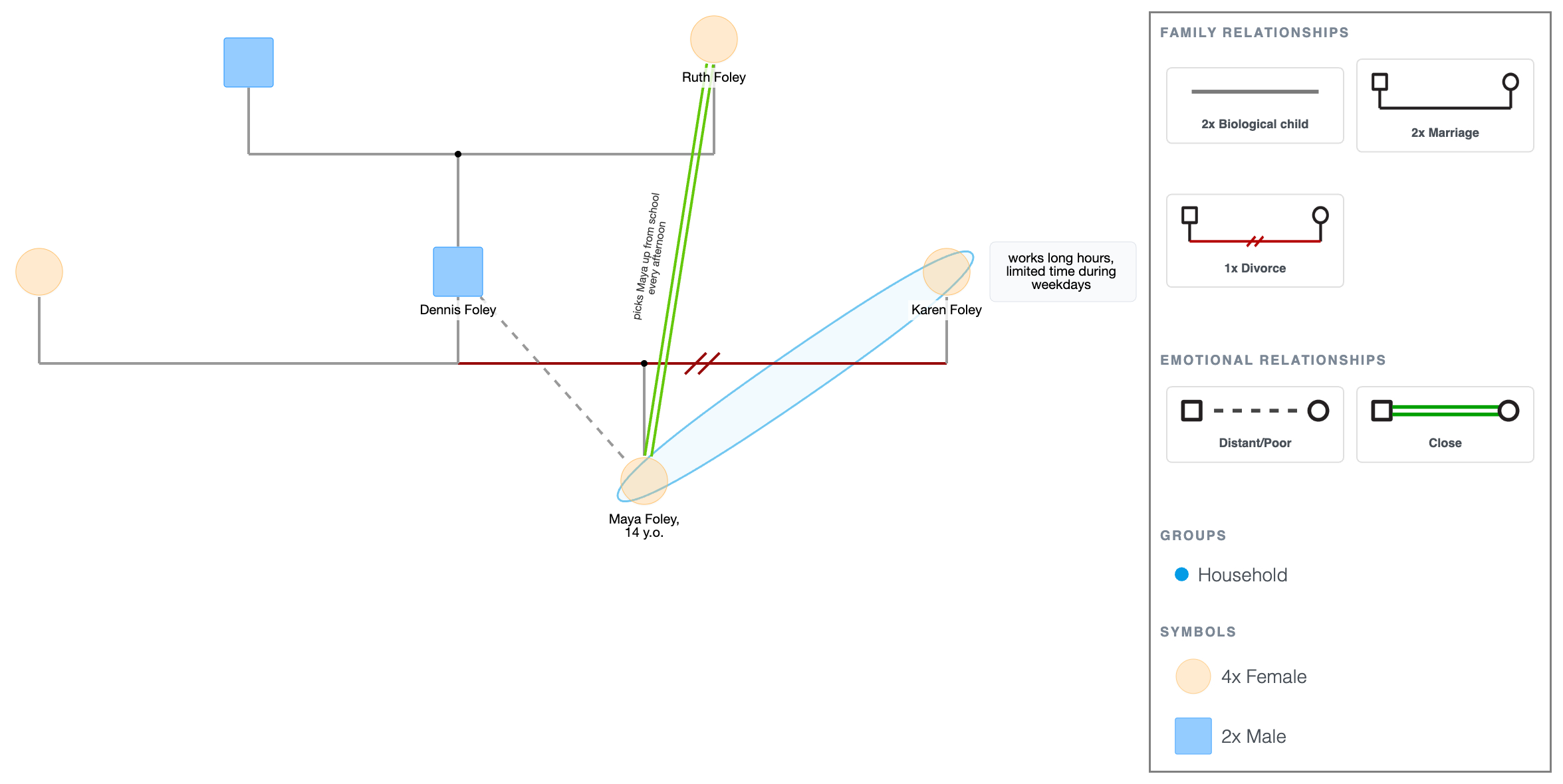
Maya, 14, was referred to her school counselor as withdrawn. Her intake form listed two parents.
The Family
- Karen Foley and Maya Foley (14) share a household, marked with a household boundary.
- Dennis Foley, Maya's father, remarried, shown separately with a distant relationship line to Maya.
- Ruth Foley, Dennis's mother, shown with a close, daily-contact line to Maya.
What This Genogram Shows
The genogram showed something more specific than the intake form did.
Karen has primary custody but works long hours, so her time with Maya is limited on weekdays.
Dennis has had less contact since remarrying.
Ruth, Maya's grandmother, is the one who actually picks her up most afternoons and would be the first to notice if something was off.
Once that is mapped, the counselor knows who to call first, and it isn't either parent listed on the intake form.
Why Counselors Use a Genogram Here
A counselor doesn't always need a full multigenerational history to help a client.
Sometimes, the more urgent question is simpler: who's actually around this person right now?
Maya's genogram took a few minutes to sketch and answered that question faster than reading through her file.
Where This Shows Up
- School counseling: mapping a student's household and support system quickly, often within a single meeting, to know who to involve.
- Individual and career counseling: getting a fast read on a client's family context and support system without building out a full clinical history.
- Group counseling: helping members explain their family situation to the group in a shared, visual format instead of a verbal summary each time.
- Addiction and pastoral counseling: identifying who in a client's life is a support and who may be a trigger, without needing three generations of detail to do it.
How This Differs From Therapy Use
Genograms in counseling tend to stay closer to the present: who's around, who's supportive, who isn't.
Family therapy genograms usually go further back, tracing patterns like conflict or cutoff across generations to explain a client's current behavior.
Both use the same notation, but the difference is depth and purpose.
For the deeper, pattern-focused version, see Genograms in Therapy.
Build One for a Session
A genogram like Maya's doesn't need to be complicated.
Open a blank canvas in EasyGenogram, add the household and the people involved, and mark the relationship lines that reflect what the client tells you.
Export as PDF or PNG for the file once it's done.
Read How to Make a Genogram for the full guide.
FAQ
What's the difference between a genogram used in counseling and one used in therapy?
A counseling genogram usually maps a client's current support system and household. A therapy genogram, especially in family therapy, traces relationship patterns like conflict or cutoff across three or more generations. Counseling genograms tend to be quicker and more present-focused.
Do school counselors need special training to use a genogram?
No special certification is required to sketch a basic genogram. Most counselor education programs cover the standard notation, close, distant, cutoff, household boundaries, as part of general training.
How much of a client's family history does a counselor need before building one?
Enough to answer the immediate question. A school counselor mapping a student's support system might only need the current household and a few key relationships. A deeper clinical assessment would call for more.
Can a genogram be built in a single session?
Yes. Many counseling genograms, like a quick support-system map, take only a few minutes and don't require multiple sessions the way a full family therapy genogram might.
Is a genogram the same thing as an intake form?
No. An intake form usually records basic facts like names and contact information. A genogram adds relationship lines and household structure, showing how those people actually relate to the client, which an intake form doesn't capture.
Sources
- Genograms: Assessment and Intervention (4th ed.)