Appearance
Genogram for Counseling Students
A self-genogram maps your own family of origin instead of a client's, used early in counselor training to surface patterns you carry into the therapeutic relationship before they show up unnoticed with an actual client.
Why Counseling Programs Assign a Self-Genogram
Counselor training programs generally require some form of self-awareness work before students see clients, and the self-genogram is one of the most common tools for it.
The premise is straightforward; a counselor who hasn't examined their own family patterns is more likely to unconsciously replay them in session, over-identifying with a client whose situation echoes their own, or avoiding a topic that hits too close to home.
Building the genogram on yourself first is meant to catch that before it happens with someone else's case.
What to Map
Start with three generations; your grandparents, your parents, and yourself.
For each relationship, use the standard relationship lines, like Close, Fused, Distant, Cutoff, Conflict, to mark what you actually know rather than what you assume.
Pay particular attention to roles that repeat, such as:
- who was the caretaker
- who mediated conflict
- who avoided it
- who was the one everyone leaned on.
These roles often pass down the family line with more consistency than people expect, and they're usually more revealing than the bare facts of who married whom.
Reading Your Own Pattern
Once the structure is built, look for a role or dynamic that shows up more than once.
A grandparent who managed everyone's moods, followed by a parent who did the same thing, is worth noting even if you haven't thought of yourself the same way. Many students recognize themselves in a pattern only once it's laid out generation by generation; a tendency to smooth things over, to notice tension before anyone names it, to step in and fix what nobody asked you to fix.
These aren't personality quirks invented out of nowhere. They're frequently roles that existed in the family before the student was born into them.
The Sinclair Family Example
Genogram for Counseling Students
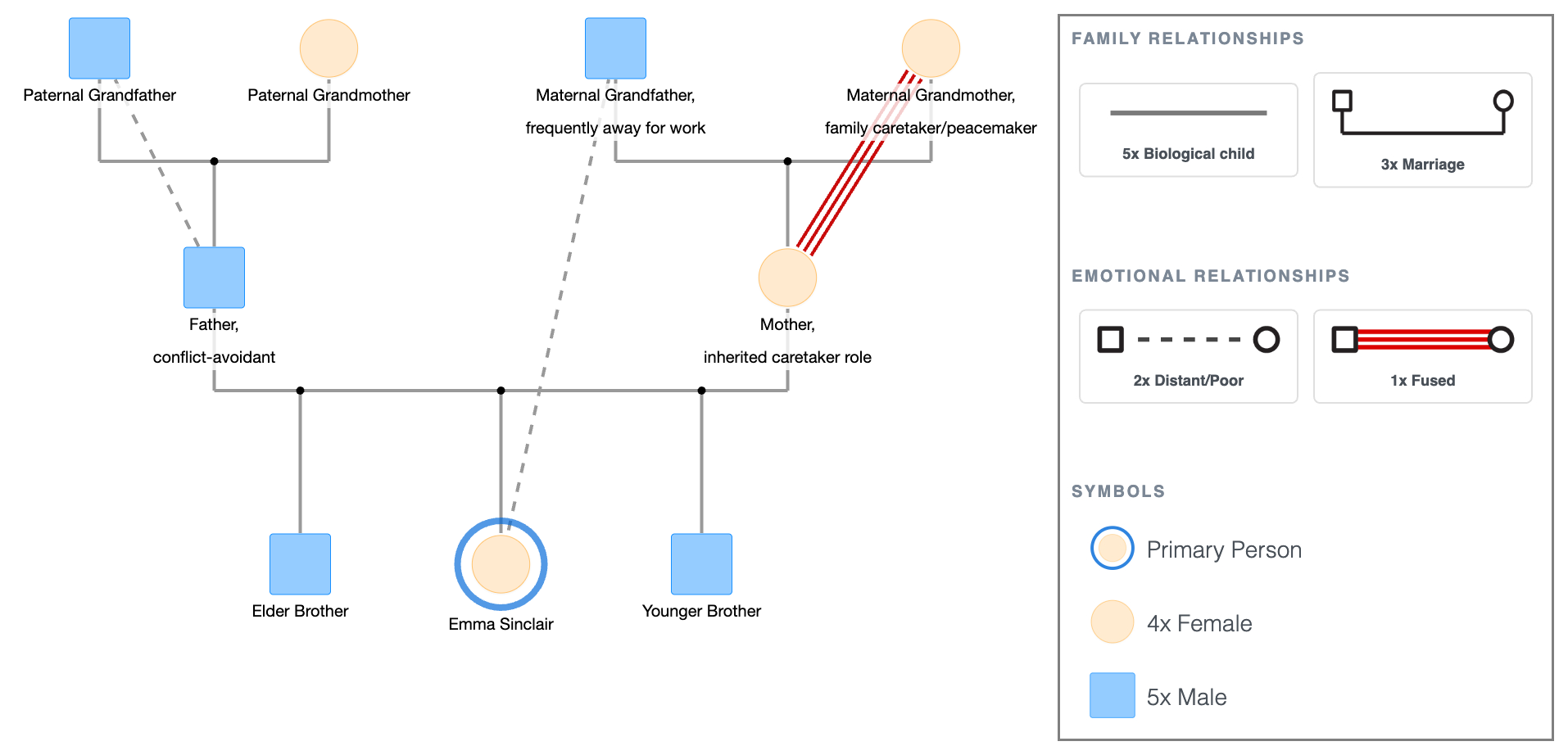
- Maternal grandmother: family caretaker/peacemaker; maternal grandfather — Distant line, frequently away for work.
- Mother: Fused line to her own mother, inherited caretaker role; father: conflict-avoidant, Distant line to his own father.
- Emma Sinclair, primary person, middle child.
Emma Sinclair built this genogram for a first-year Theories of Counseling course, mapping her own family rather than a case study.
What Emma's Genogram Revealed
Emma's maternal grandmother had been the one who held the family together, smoothing over her husband's frequent absences and managing everyone's moods so conflict rarely surfaced directly.
Emma's mother took on the same role a generation later, carrying a Fused line to her own mother and stepping in as the emotional manager of her own household once she had kids.
Emma's father, on the other hand, learned early to avoid conflict rather than name it, mirrored in his own Distant line to his father.
Looking at the diagram, Emma recognized herself in the pattern before she'd consciously named it: the one who smooths things over, who notices when someone's upset before they say anything, who has a hard time letting tension sit unresolved. It was a role that had existed in her family for three generations before she was born into it.
Why This Matters Once You're Seeing Clients
The real value of the assignment shows up later, usually during practicum, when a client's situation echoes something from your own family history.
A student who's mapped their own caretaking pattern is more likely to notice when they're working unusually hard to fix a client's problem instead of letting the client sit with it, a countertransference risk that's much easier to name in supervision if you already recognize it from your own genogram.
Without that groundwork, the same pull can go unnoticed and shape the session without either the student or their supervisor immediately understanding why.
Build Your Own Self-Genogram
Map three generations using EasyGenogram, marking relationships with the standard lines as you go.
Note the roles that repeat and mark yourself as the primary person.
Sit with what the pattern actually shows before treating the diagram as finished; the point isn't the diagram itself, it's what you notice once it's built.
Export as PDF for your assignment when it's complete.
For the full guide, see How to Make a Genogram.
Genogram for Counseling Students
Explore this genogram and adapt it to your needs.
FAQ
Is a self-genogram assignment the same as a client genogram assignment?
No. A self-genogram maps your own family of origin for self-awareness purposes. A client genogram, usually assigned later in a program, maps a case study or an actual client's family for clinical assessment practice.
What if I don't want to share sensitive family history in a class assignment?
Most instructors allow students to note that certain information is private without detailing it, or to focus the reflection on patterns rather than specific events. Check with your instructor about how much detail the assignment actually requires.
Why does a counseling program care about my own family patterns?
Because unexamined patterns tend to surface anyway, usually in a session with a client whose situation resembles your own family history. The self-genogram is meant to bring that pattern into conscious awareness before it affects clinical work.
How many generations should a self-genogram include?
Three is standard; grandparents, parents, and yourself. That's usually enough to see whether a role or dynamic repeats rather than being a one-generation coincidence.
Does finding a difficult pattern in my own genogram mean I shouldn't be a counselor?
No. Recognizing a pattern is the point of the exercise, not a disqualifier. Every counselor carries some family history into the work. The self-genogram is meant to make that history visible enough to manage rather than something to be free of entirely.
Sources
- Reading Genograms: A Clinical Guide
- Genograms: Assessment and Intervention (4th ed.)