Appearance
Genogram for MFT Students
See what makes the self-of-the-therapist genogram different from a standard class assignment, and why MFT programs require it before practicum.
What Makes This Assignment Different
Most genogram assignments ask you to map a case study or apply a theory to any family.
A self-of-the-therapist genogram asks you to map your own, specifically to surface personal patterns that could affect your clinical work before they show up unexamined with a client.
For the Bowen-concept application angle used in most psychology coursework, see Genogram for Psychology Students.
For the two-family-systems structure used in couples coursework, see MFT Genogram Template.
An MTF Student Genogram Example
An MTF Student Genogram Example
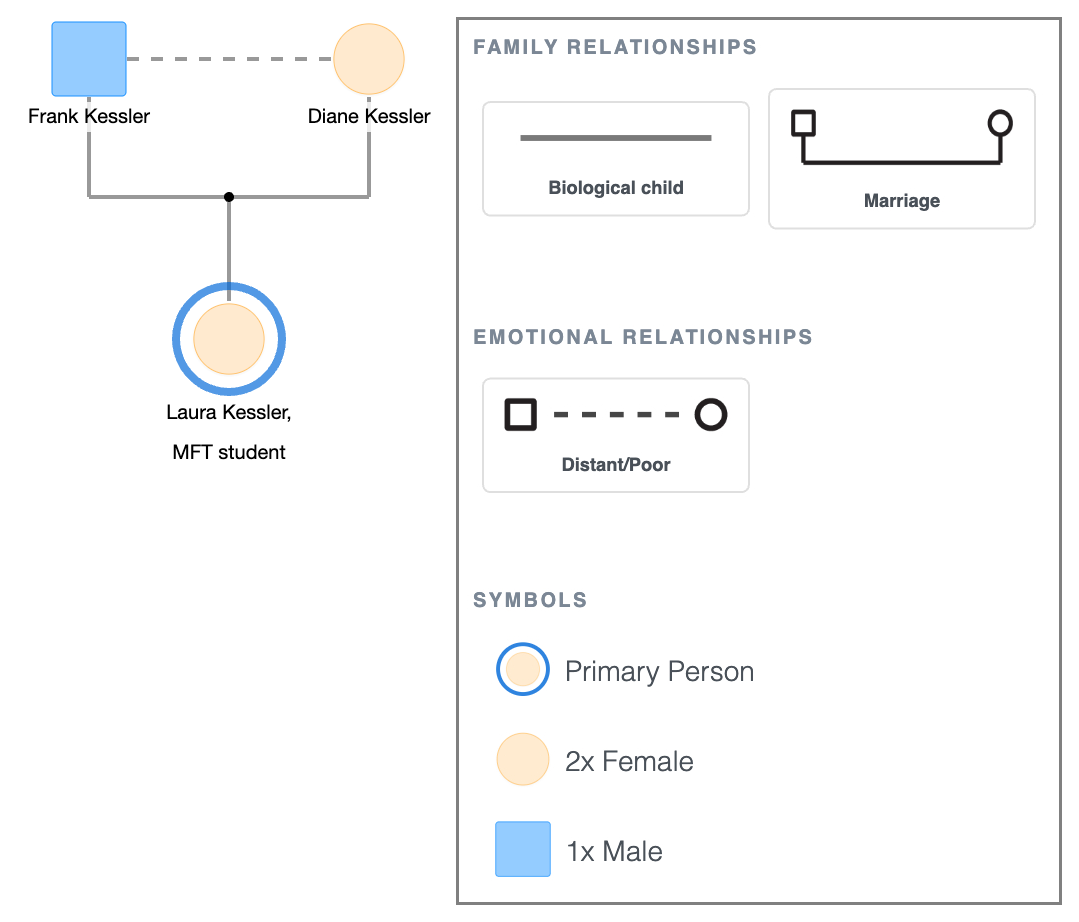
Laura Kessler, an MFT student, built this genogram of her own family before starting practicum.
The Family
- Laura Kessler, the primary person and MFT student.
- Her parents, Diane Kessler and Frank Kessler, connected by a distant/poor line. (Disagreements between them were rarely voiced; tension got absorbed rather than discussed.)
What This Genogram Shows
The distant line between Diane and Frank doesn't mean they fought often. It means they usually didn't.
Laura grew up watching tension get managed through silence rather than conversation.
Building this genogram before starting practicum surfaced something she hadn't named yet: she gets visibly uncomfortable and tends to redirect the conversation whenever a client expresses anger in session.
That reaction is the same conflict-avoidance pattern she learned at home, now showing up as a blind spot in her clinical work.
Catching that connection before it plays out unexamined with a real client is exactly what this assignment is for.
Why MFT Programs Require This
COAMFTE-accredited programs treat self-awareness as a core clinical competency, not an optional reflection exercise.
The point isn't to diagnose your own family but to identify the triggers and blind spots you're bringing into the therapy room before a client's story activates one you haven't examined.
What to Look For in Your Own Genogram
- Recurring conflict styles across generations, not just individual disagreements.
- Roles you were assigned growing up, like peacemaker or over-functioner, and whether you still play them.
- Patterns you react strongly to when you see them in others.
- Relationships or dynamics you'd find hardest to sit with if a client described them in session.
Common Mistakes That Cost Points
- Treating the assignment like a case study instead of a personal reflection.
- Skipping the write-up that connects the family pattern to a clinical implication.
- Stopping at description without naming a specific blind spot the pattern could create.
FAQ
Is a self-of-the-therapist genogram the same as a regular family genogram?
The structure and notation are the same. The difference is purpose: a self-of-the-therapist genogram is built specifically to surface personal patterns relevant to your future clinical work, not to document a case or apply theory to any family.
How honest does this need to be if a professor or supervisor will read it?
Honest enough to be useful to you, within whatever level of detail you're comfortable sharing. Most programs allow you to keep certain details private while still identifying the pattern and its clinical implication in the write-up.
What if I don't see any clear pattern in my own family?
Look at smaller things first, e.g., how conflict got handled, who took on which role, what topics were avoided. A pattern doesn't have to be dramatic to be clinically relevant.
Does this replace the two-family comparison genogram used in couples coursework?
No. They're different assignments with different purposes. See MFT Genogram Template on Qwoach if your course specifically requires mapping both partners' family systems together.
How far back do I need to go for a self-of-the-therapist genogram?
Three generations is standard, the same as most genogram assignments. Go back further only if a pattern you're tracking clearly started earlier than that.
Sources
- Genograms: Assessment and Intervention (4th ed.)
- Family Therapy in Clinical Practice