Appearance
Genogram for Couples Therapy
A genogram for couples therapy places both partners' family systems on the same diagram.
Genogram for Couples Therapy Example
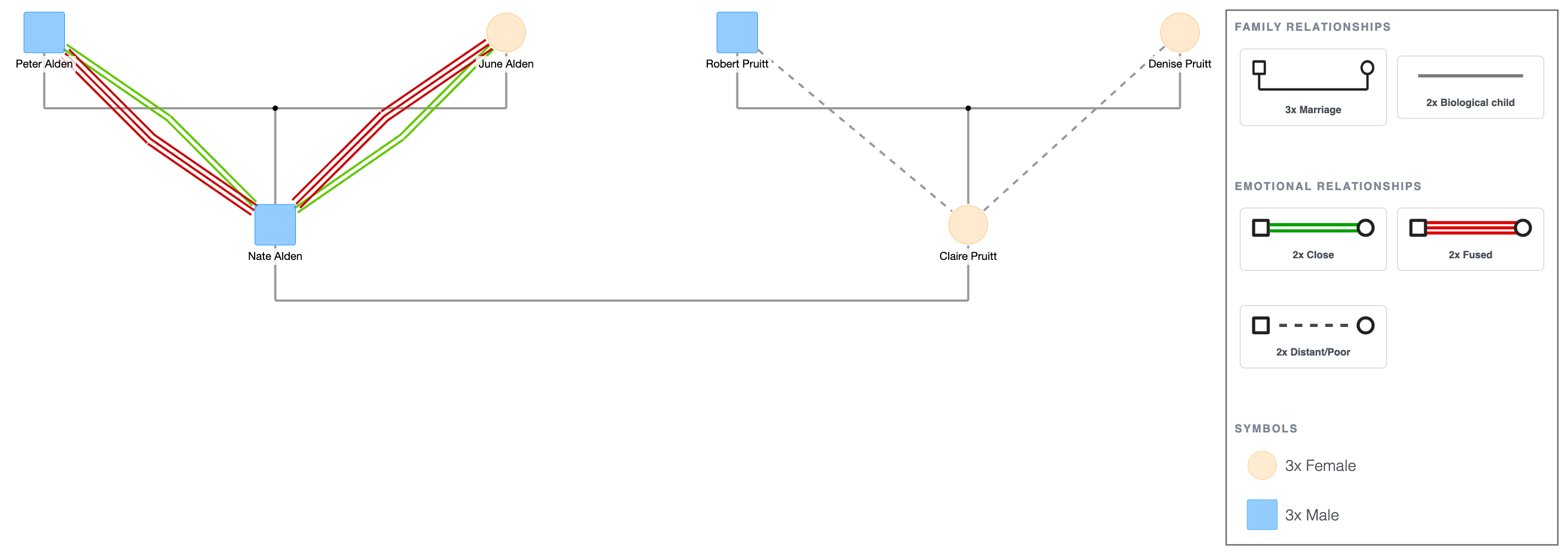
Nate and Claire have been married two years and came to therapy after their third holiday season in a row ending in the same fight, neither one able to say exactly why it kept happening.
The Family
- Alden family: Peter Alden and June Alden, Nate's parents, shown with a close, fused relationship line to Nate Alden.
- Pruitt family: Robert Pruitt and Denise Pruitt, Claire's parents, shown with a distant relationship line to Claire Pruitt.
- Nate Alden and Claire Pruitt shown together where both family systems meet
What This Genogram Shows
Nate grew up in a family where frequent contact meant love. His parents called weekly, visited often, and treated distance as a problem to be fixed.
Claire grew up in a family where independence meant respect. Her parents encouraged her to build her own life early and didn't expect much contact once she did.
Neither of them is wrong about their own family. The holiday fight isn't really about the holiday. It's two inherited closeness norms running into each other, and it's not something either partner can out-argue.
Why This Helps in Couples Work
Once Nate and Claire can see both patterns on the same page, the conversation changes. Instead of "you don't care about my family" versus "you're smothering me," they have "your family showed love through closeness, mine showed respect through space." Neither felt like the villain anymore.
What a Couples Genogram Can Focus On
A couples genogram doesn't need to map everything at once. Most therapists work through one theme at a time:
- Conflict style: how each partner's family handled disagreement.
- Closeness and boundaries: how much contact and independence each family modeled, as with Nate and Claire.
- Finances: who managed money, and what each family treated as normal or taboo.
- Gender-role expectations: what each family modeled about roles in a marriage or partnership
When It Gets Introduced
Couples genograms come up in a few common situations:
- premarital counseling
- before expectations calcify into conflict
- a recurring argument that keeps resurfacing no matter how it's resolved in the moment; or
- ongoing in-law and boundary tension, like Nate and Claire's.
Building Both Partners' Genograms
Each partner's family gets mapped on its own first, then placed side by side so the patterns are easy to compare.
Open a blank canvas in EasyGenogram, build out each partner's three generations separately, and position them next to each other with the couple at the center.
Export as PDF or PNG for session notes once it's done.
Read How to Make a Genogram for the full guide.
When Not to Use This Yet
A full family-of-origin mapping exercise isn't always the right first step.
If a couple is in acute crisis, or if there are active safety concerns in the relationship, establishing safety and stability comes before tracing inherited patterns.
The genogram is a tool for understanding a pattern once things are stable enough to look at it together.
FAQ
Do both partners need to build their own genogram?
Yes. The value comes from comparing both family systems side by side. One partner's genogram alone only shows half the pattern.
How is a couples genogram different from a regular family genogram?
A regular family genogram usually maps one family across generations. A couples genogram places two separate family systems next to each other, with the current relationship as the point where they meet.
Can a couples genogram be used in premarital counseling?
Yes. It's often used early, before patterns from each partner's family have had a chance to calcify into conflict in the new relationship.
Does a couples genogram help with recurring arguments that don't seem to be about anything specific?
Often, yes. Recurring arguments that resist resolution are usually a sign that something inherited, not the immediate topic, is driving the conflict. Mapping both families tends to surface what that is.
How much of each partner's family history is actually needed?
Enough to see the pattern relevant to the presenting issue. A therapist working on closeness and boundaries, for example, doesn't need a full medical or financial history for either family, just enough structure and relationship detail to show how each side handled that specific theme.
Sources
- Genograms: Assessment and Intervention (4th ed.)