Appearance
Attachment Theory Genogram
A client can usually describe their current relationship pattern in detail, but what's harder to see without help is where that pattern actually started. An attachment theory genogram traces it back.
What Is an Attachment Theory Genogram?
It's a genogram built to map attachment styles, secure, anxious, avoidant, and disorganized, across at least three generations.
Attachment theory, developed by John Bowlby and expanded by Mary Ainsworth, holds that early caregiving shapes how a person relates to closeness for the rest of their life.
Layered onto a genogram, that theory stops being abstract. You can see which caregiving pattern produced which attachment style, and where it resurfaces one or two generations later.
The Bennett–Reyes Family
Attachment Theory Genogram Example
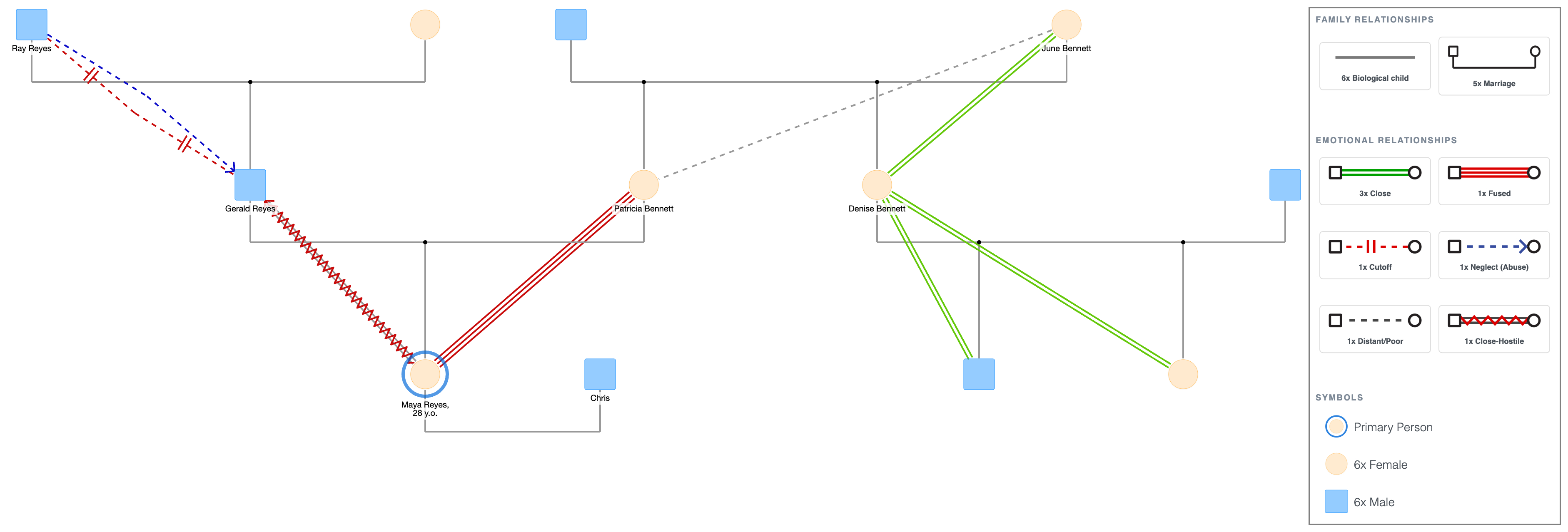
- Gen 1: June Bennett - Distant/Poor line to daughter Patricia; Close line to daughter Denise.
- Gen 1: Ray Reyes - Neglect line to son Gerald; Cutoff line between Ray and Gerald (current).
- Gen 2: Patricia Bennett married to Gerald Reyes - Patricia has Fused line to daughter Maya.
- Gen 2: Denise Bennett (June's other daughter) - Close lines to her own kids, shown as contrast.
- Gen 3: Maya Reyes - Close-Hostile line to Gerald; partner Chris shown.
Maya Reyes is 28 and came into therapy because her last two relationships ended the same way: she'd feel a partner pulling back, escalate to get their attention, and then feel ashamed of how intensely she'd reacted.
She assumed this was just how she was built.
Her genogram tells a more specific story, one that runs through both sides of her family.
Secure Attachment
Secure attachment comes from caregiving that's consistent and responsive enough that a child learns closeness is safe and separation is survivable.
On this genogram, that's Denise, June's other daughter.
Denise carries a Close line, not a Fused one, to her own two kids: involved, affectionate, but not anxious about it. She can leave for a work trip without guilt and reconnect without a production when she's back.
Denise has the same mother as Patricia. The difference is what happened next in each of their own adult relationships, which is part of why attachment style isn't fixed at childhood. It's a starting point that later relationships can reinforce or interrupt.
Anxious Attachment
Anxious attachment tends to come from inconsistent caregiving, sometimes responsive, sometimes not, so the child learns to stay hypervigilant about whether connection is about to disappear.
Patricia's Fused line to Maya is the clearest marker of this on the genogram. Patricia checks in constantly, reads distance as rejection, and has a hard time letting Maya make a decision without weighing in.
Trace it back one generation and the origin is visible: June's Distant/Poor line to Patricia. Patricia didn't inherit anxious attachment directly from an anxious parent. She grew up with an avoidant one and overcorrected, becoming hyper-attentive to the closeness she didn't reliably get. That's a documented pattern, not just this family's story: an avoidant parent can produce an anxious child as easily as an anxious one can.
Avoidant Attachment
Avoidant attachment develops when a caregiver is physically present but emotionally unavailable often enough that the child learns to stop bringing needs forward at all.
June worked two jobs through Patricia and Denise's childhood and had little emotional bandwidth left when she was home. The Distant/Poor line to Patricia reflects that as a consistent absence of attunement.
The same upbringing produced two different results in her daughters, which is the point worth sitting with here. Avoidant caregiving doesn't guarantee an avoidant child. It guarantees a child who has to adapt to inconsistent access to closeness, and the adaptation varies.
Disorganized Attachment
Disorganized attachment is the hardest of the four to place on a genogram because it comes from caregiving that was frightening rather than simply absent, so the child ends up both wanting closeness and fearing it from the same person.
Gerald's father, Ray, carries a Neglect line to him, and the two now have a Cutoff between them after years of Ray's drinking made contact unpredictable at best.
Gerald's own line to Maya is marked Close-Hostile: present, affectionate at times, but capable of sudden withdrawal or irritability that Maya could never predict.
That inconsistency is what disorganized attachment passes down; the felt sense that the person you need comfort from might also be the source of the next disruption.
How This Shows Up in Maya's Relationships Now
Maya's genogram carries two inherited patterns pointed at the same target: her mother's Fused, anxious closeness, and her father's unpredictable Close-Hostile pull.
In her romantic relationships, she pursues the way Patricia taught her to, and she braces for sudden withdrawal the way Gerald trained her to expect it.
When a partner goes quiet, both patterns activate at once, which is part of why the reaction feels disproportionate to her from the outside.
None of this makes Maya's response irrational. It makes it explainable, and explainable is what makes it workable in session.
Build One Like This
Start with a standard three-generation genogram: names, birth order, marriages, and separations.
Then go back through it a second time asking specifically about caregiving, who was the primary caregiver, how they responded to distress, whether there were separations or losses, and mark what you hear using the relationship lines, Close, Fused, Distant/Poor, Cutoff, Close-Hostile.
Export as PDF or PNG once the pattern is clear enough to reference in session.
For the full guide, read How to Make a Genogram.
Attachment Theory Genogram Example
Explore this genogram and adapt it to your needs.
FAQ
How do I mark attachment styles on a genogram if there's no single line for each one?
Use the closest relationship line for the caregiving pattern you're hearing about: Close for secure, Fused for anxious, Distant/Poor for avoidant, and Close-Hostile or Cutoff for disorganized, depending on whether the pattern was inconsistency or an outright break in contact.
Can two siblings raised by the same parent end up with different attachment styles?
Yes, and it's common. Denise and Patricia had the same mother and different outcomes. Attachment style isn't only set by the caregiving a child received. It's also shaped by temperament and by what happened in their own adult relationships afterward.
Is disorganized attachment the same as trauma?
They overlap but aren't identical. Disorganized attachment specifically describes a caregiver who was a source of both comfort and fear. Trauma can produce that pattern, but not all trauma involves a caregiver, and not all disorganized attachment involves a single traumatic event.
Does an anxious parent always produce an anxious child?
No. Patricia's anxious attachment came from an avoidant parent, not an anxious one. Children adapt to whatever caregiving pattern they got, and the adaptation isn't always a direct copy of the parent's style.
How is an attachment theory genogram different from a Bowen family systems genogram?
Bowen theory tracks differentiation, triangles, and reactivity in the family system. Attachment theory tracks the quality of early caregiver bonds specifically. Many clinicians use both lenses on the same genogram, since they explain related but distinct parts of a family's patterns. :::sources title: A Secure Base: Parent-Child Attachment and Healthy Human Development author: Bowlby, J. year: 1988 title: Attachment Theory and the Genogram: Working with Intergenerational Patterns author: Byng-Hall, J. year: 1995 title: Genograms: Assessment and Intervention (4th ed.) author: McGoldrick, M., Gerson, R., & Petry, S. year: 2020