Appearance
Genogram for Psychology Students
See what makes a psychology genogram assignment different from any other discipline's version, and what your professor is actually grading.
What Makes a Psychology Genogram Assignment Different
A psychology genogram assignment isn't graded on structure alone.
It's graded on whether you can identify and label family systems concepts, like triangulation or differentiation of self, on the diagram itself.
Getting the shapes and lines right is the baseline; applying the theory is the actual assignment.
For the general mechanics of building one, see Genogram Assignment Guide.
For a ready-made starting structure with mental health markers already in place, see Psychology Genogram Template.
A Psychology Student Example
A Psychology Student Genogram Example
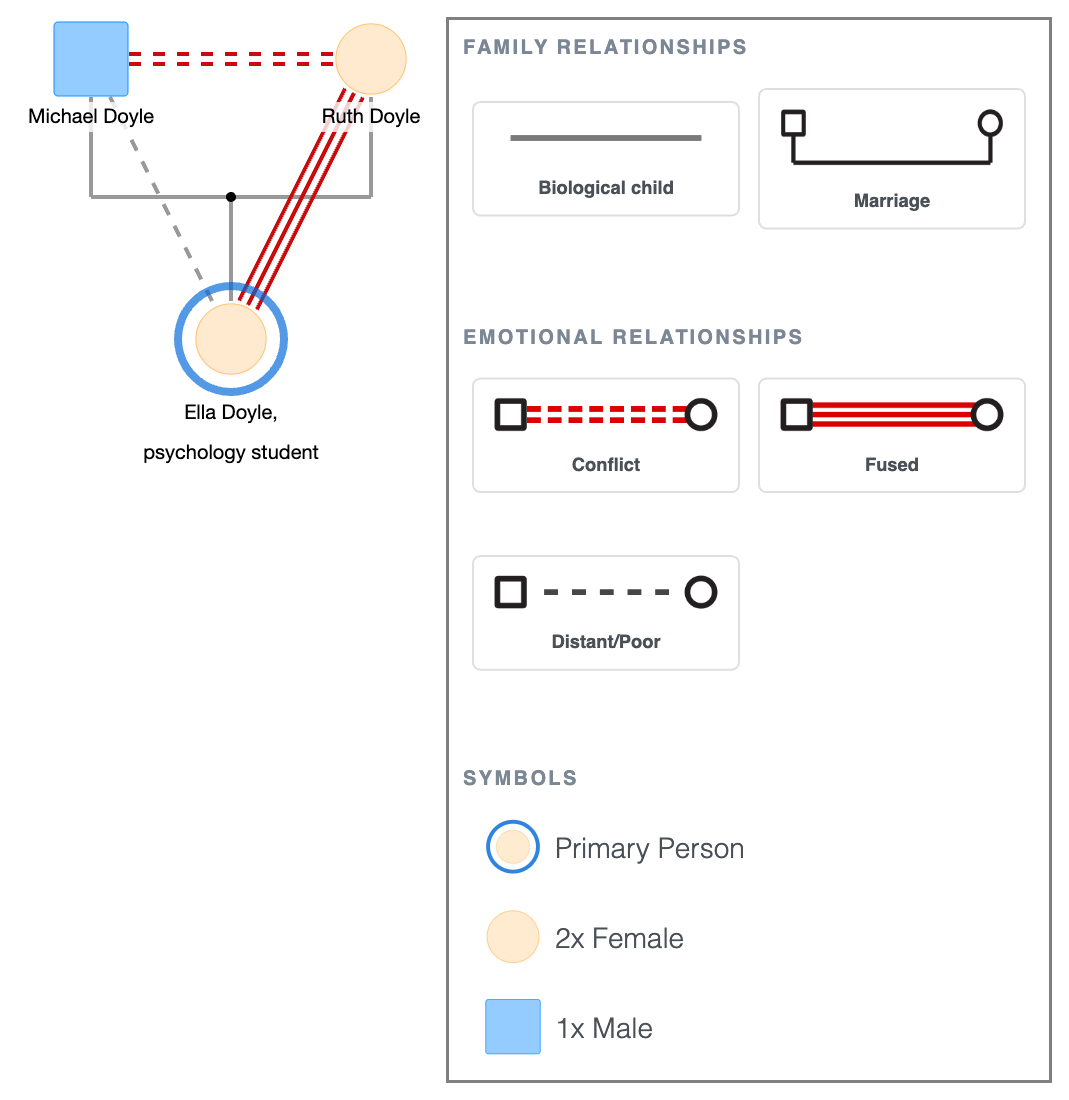
Ella Doyle, a psychology student, built this genogram of her own family for a family systems assignment.
The Family
- Ella Doyle, the primary person and a psychology student.
- Her parents, Ruth Doyle and Michael Doyle, have a conflict line (marital tension).
- Ruth and Ella connected by a fused line, showing Ella's role as her mother's confidant.
- Michael and Ella connected by a distant/poor line, showing the pull away from her father that comes with being drawn to her mother's side.
What This Genogram Shows
A triangle forms between Ruth, Michael, and Ella: instead of Ruth and Michael working through their tension directly, Ruth brings Ella in as a third point, which temporarily lowers the tension between the couple but keeps Ella pulled into a conflict that isn't hers.
This is the pattern Bowen called triangulation, and it shows up clearly once the relationship lines are drawn between all three people, not just the couple line.
Once all three relationship lines are drawn, not just the couple line between Ruth and Michael, the
The fused line between Ruth and Ella also points to Ella's own level of differentiation.
A fused relationship, meaning over-involvement or lack of separateness, is a direct visual marker of lower differentiation of self, one of the core concepts a psychology genogram assignment is usually asking students to identify and discuss.
Common Bowen Concepts You'll Be Asked to Identify
- Differentiation of self: how much a person maintains their own identity while staying connected to the family.
- Triangulation: a third person drawn into tension between two others, as with Ella.
- Multigenerational transmission: a pattern, like conflict avoidance or anxiety, repeating across generations.
- Emotional cutoff: managing unresolved tension by reducing or ending contact.
- Sibling position: birth order's influence on role and relationship patterns.
For the full theoretical breakdown, see Bowen Family Systems Genogram.
Where Attachment Fits In
Some programs also want attachment patterns marked on the same diagram, alongside the Bowen concepts above.
If that's part of your assignment, see Attachment Theory Genogram for how attachment styles get represented.
Common Mistakes That Cost Points
- Drawing accurate structure with no emotional relationship lines at all.
- Leaving off a key or legend.
- Labeling a triangle without showing all three relationship lines that make it one.
- Forgetting to mark the primary or index person.
FAQ
Do I need to use my own family, or can I use a case study?
Check the assignment brief first. Many family systems courses specifically want your own family, since the point is often self-reflection alongside the theory application, but some allow a case study or composite family instead.
What's the difference between a genogram for a psychology class and one for a counseling or MFT class?
The structure and notation are the same. The difference is emphasis as a psychology assignment usually centers on Bowen concepts like triangulation and differentiation, while a counseling or MFT assignment may lean more toward the individual client's relational context.
How many generations does a psychology genogram assignment usually need?
Three is standard. Check your specific assignment brief, since some family systems courses ask for four when the pattern being tracked started further back.
Do I need to explain the Bowen concepts in writing, or is the diagram enough?
Most assignments require both; the diagram itself, plus a short written analysis naming the patterns you found, like a specific triangle or a cutoff, and connecting them to the theory.
What if my own family doesn't have an obvious triangle or cutoff to point to?
Look for subtle patterns first, like sibling roles or differences in closeness across the family, before assuming there's nothing there. If genuinely nothing fits, ask your professor whether a composite or case-study family is acceptable instead.
Sources
- Genograms: Assessment and Intervention (4th ed.)
- Family Therapy in Clinical Practice