Appearance
Genogram for School Counselors
Map a student's household, recent family changes, and key relationships so a declining grade or a behavioral referral can be traced back to what's actually happening at home, instead of guessed at from the classroom alone.
Why School Counselors Use a Genogram
A student rarely volunteers the full picture.
"Everything's fine at home" is often the honest answer a student gives when they haven't connected a family change to what's happening in their grades or behavior.
A genogram gives a counselor a structured way to ask about household composition, recent transitions, and support systems without relying on the student to name the connection themselves.
For a quick read on who's currently supporting a student, see Genograms in Counseling; this page covers the fuller process, from referral to intervention plan.
The Weller Family
Genogram for School Counselors
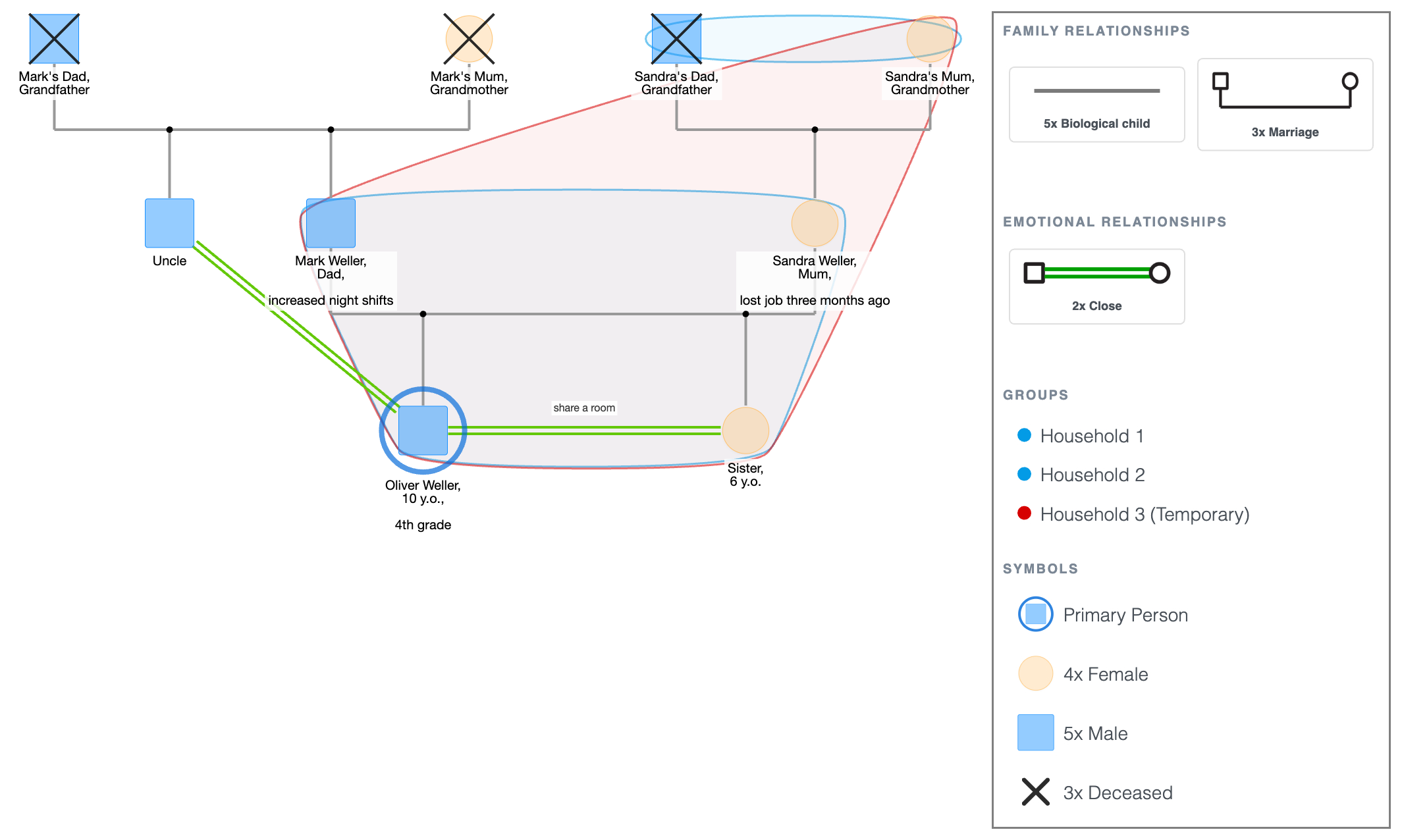
- Oliver Weller, 10, primary person, 4th grade.
- Parents: Mark Weller (increased night shifts); Sandra Weller (lost job three months ago).
- Household: temporarily living with Sandra's mother after a rent increase; Oliver shares a room with his younger sister.
- Mark's brother (uncle), Close line to Oliver, previously unknown to the school.
- Younger sister, 6.
Oliver Weller was referred by his teacher after his grades dropped and he'd been falling asleep in class for about six weeks.
Asked directly, Oliver said nothing had changed. His counselor built a simple household map with him instead of pressing further on the same question.
What the Genogram Revealed
The diagram showed that Oliver's family had moved in with his grandmother three months earlier, after a rent increase Sandra couldn't cover following her job loss.
Oliver now shares a bedroom with his six-year-old sister and sleeps on a pull-out, which lines up closely with when his grades started slipping and explains the daytime sleepiness on its own.
None of this came up when the counselor asked "is everything okay at home," but it came up readily once the household map was being built together.
The genogram also surfaced something useful the school didn't know: Mark's brother lives nearby and has been taking Oliver to basketball most weekends, a relationship marked with a Close line that had nothing to do with the presenting problem but mattered for the plan.
How This Shaped the Plan
Knowing the cause changed what the counselor could actually do.
She coordinated with Oliver's teacher to temporarily adjust homework expectations, connected the family with district housing resources, and, with the family's input, looped in Oliver's uncle as an additional support contact, someone the school hadn't had on file before.
None of these actions would have made sense based on "declining grades" alone. They followed directly from what the household map showed.
Building One With a Student
For younger students, a simple "who lives in your house" drawing works better than formal genogram notation.
Older students can usually engage with standard symbols directly.
Either way, build it collaboratively rather than presenting a finished diagram, students often share information while the map is being built that they wouldn't offer to a direct question.
Check your district's consent policy before using a genogram for anything beyond routine counseling conversation, particularly if it will inform a formal evaluation like an IEP or 504 plan.
Genogram for School Counselors
Explore this genogram and adapt it to your needs.
FAQ
How is a genogram used in counseling?
It maps a client's household, family structure, and key relationships to give the counselor context beyond what's said directly. In a school setting, that context often explains a behavior or grade change that a student hasn't connected to what's happening at home.
What is the 3-generation genogram?
It's the standard genogram format, mapping grandparents, parents, and the current generation. School counseling genograms are often simpler, focusing on the student's current household rather than a full three-generation history, since the more urgent question is usually who's around the student right now.
What are the basic genogram symbols?
Squares represent males, circles represent females, and a line through a shape marks someone deceased. Relationship lines show connection quality: solid for close, dashed for distant, jagged for conflict. The student being discussed is usually marked with a double outline.
Do I need parental consent to build a genogram with a student?
It depends on district policy. Genograms built as part of routine counseling conversation usually fall under general counseling consent, but if the diagram will inform a formal evaluation, like an IEP assessment, written parental consent is typically required. Check your district's specific guidelines before proceeding.
How long does building a genogram with a student take?
A simple household map can take a single short conversation, ten to fifteen minutes for a younger student. More detailed genograms, especially those informing a formal evaluation, are often built across two or three brief sessions instead of one long one.
Sources
- Cookie Friendships: School Counselors' Use of Genograms
- Genograms: Assessment and Intervention (4th ed.)