Appearance
Cultural Genogram
If you want to understand how a client's cultural background has shaped their worldview, a cultural genogram maps the family's cultural heritage alongside its structure; ethnic backgrounds, migration history, languages spoken, religious affiliations, and what has been transmitted, changed, or lost across generations.
What a Cultural Genogram Maps
Six elements go into a cultural genogram beyond the standard structural and health information:
- Ethnic and cultural heritage: the cultural background of each person, noted beside their symbol.
- Country of origin and migration history: where family members were born, where they moved, and when.
- Language: what language each generation spoke at home, and where language shift occurred.
- Religious affiliation: faith tradition by generation, including changes across the family line.
- Cultural pride and shame patterns: aspects of heritage that the family has emphasized, hidden, or broken from.
- Acculturation: what cultural practices have been maintained, adapted, or lost as the family moved across contexts.
These elements are recorded as text annotations beside each person's symbol, or in a dedicated notes field.
Who Uses It and Why
- Therapist training: cultural genograms are widely used in counselor education to help trainees examine their own cultural background and its influence on their clinical practice. Hardy and Laszloffy (1995) introduced the tool specifically for this purpose.
- Multicultural counseling: mapping a client's cultural heritage helps a therapist understand how identity, family expectations, and cultural loss shape the presenting issues.
- Social work with immigrant and refugee families: migration history, language barriers, and acculturation stress are all visible in the diagram.
- Identity work with bicultural clients: people navigating two or more cultural identities can use the diagram to see how each heritage has been transmitted and how they sit between them.
- Immigration counseling: documents the journey from country of origin and the cultural adjustments across generations.
A Completed Cultural Genogram Example: The Morton Family
Thomas Morton (b. 1938, Ireland, deceased 2010) and Mary Morton née Walsh (b. 1942, Ireland, living) immigrated to the United States in 1962. Both Catholic. Irish and English spoken at home until the 1980s; English dominant from then on. Thomas worked in construction; Mary worked in domestic services.
William Hayes (b. 1940, Jamaica, deceased 2018) and Dorothy Hayes née Campbell (b. 1944, Jamaica, living) immigrated to England in 1968. Both Baptist. English dominant throughout; Jamaican patois used in the home.
Robert Morton (b. 1968, US, raised Catholic, Irish-American heritage) and Claire Hayes-Morton (b. 1970, England, Jamaican-British heritage, Baptist upbringing) met in London in 1992 and married in 1994. They have two children: Emma (b. 1996) and James (b. 1998). Both were raised in England. Emma identifies with both sides of her heritage and is exploring her Irish roots. James has less active connection to either heritage tradition and does not practice religion.
Cultural Genogram Example
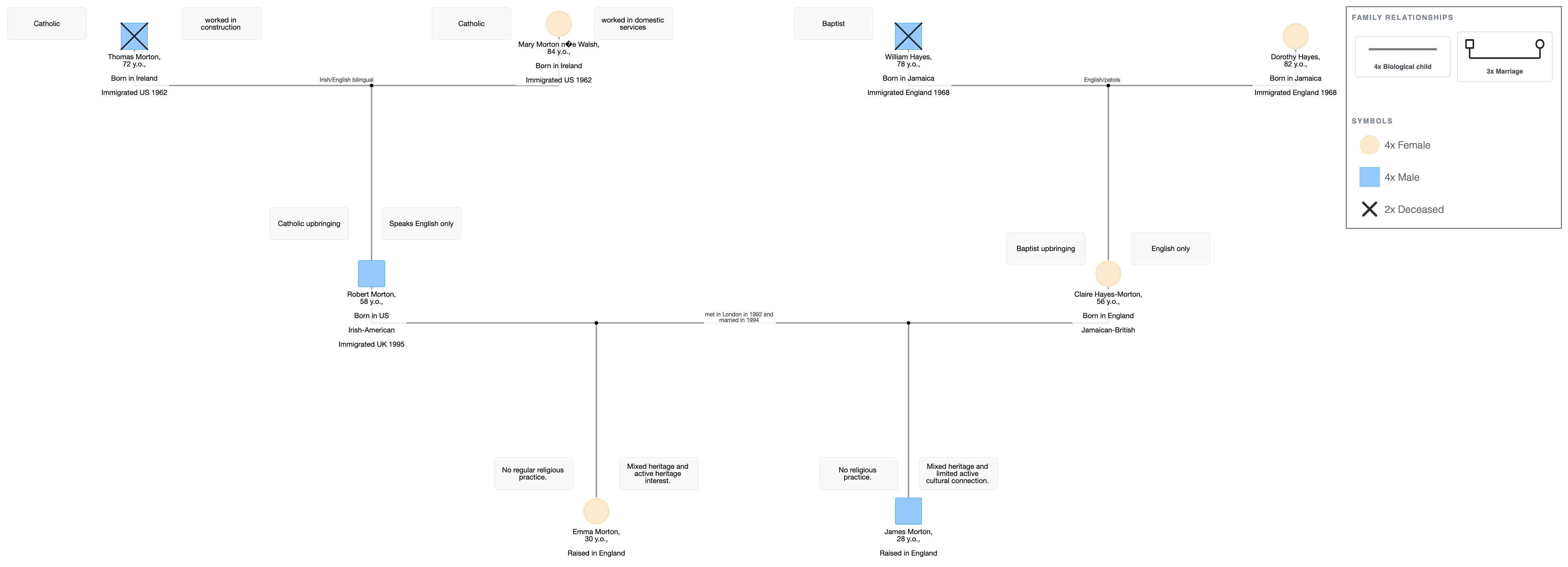
The cultural annotations:
- Thomas Morton — Ireland, b. 1938. Catholic. Irish/English bilingual. Immigrated US 1962. Construction worker.
- Mary Morton — Ireland, b. 1942. Catholic. Irish/English bilingual. Immigrated US 1962.
- William Hayes — Jamaica, b. 1940. Baptist. English/patois. Immigrated England 1968.
- Dorothy Hayes — Jamaica, b. 1944. Baptist. English/patois. Immigrated England 1968.
- Robert Morton — US, b. 1968. Irish-American heritage. Catholic upbringing. English only. Immigrated UK 1995.
- Claire Hayes-Morton — England, b. 1970. Jamaican-British heritage. Baptist upbringing. English only.
- Emma Morton — England, b. 1996. Mixed Irish-American and Jamaican-British heritage. Active heritage interest. No regular religious practice.
- James Morton — England, b. 1998. Mixed heritage. Limited active cultural connection. No religious practice.
What this genogram shows:
- Two separate migration events appear in the same diagram; one from Ireland to the US in 1962, one from Jamaica to England in 1968. Both grandparent couples landed in English-speaking countries and shifted toward English dominance within a generation. The parallel pattern is visible in the diagram.
- Thomas and William, the two grandfathers, are both deceased. Their languages, the Irish-English bilingualism and the Jamaican patois, appear on their symbols and on Dorothy's. In Robert and Claire's generation, both are English only. The language shift happened in one generation on both sides.
- Emma's annotation shows active heritage interest. James's shows limited connection. Two siblings, same parents, but different relationship to the same dual heritage.
- The Baptist tradition appears on William, Dorothy, and Claire's symbol. It does not appear on Emma or James. A therapist doing identity work with either of them can see where the religious connection ended and when.
Cultural Genogram Example
Explore this genogram and adapt it to your needs.
How to Build a Cultural Genogram in EasyGenogram
In EasyGenogram, cultural information is recorded as text annotations beside each person's symbol using the Notes feature or by adding labels directly.
- Build the standard three-generation structure: place grandparents at top, parents in the middle, children at bottom.
- Add cultural annotations beside each person's symbol: country of origin, cultural heritage, language, religion. Use a consistent format across the diagram.
- Note migration events: add the country left, country arrived in, and approximate year beside the relevant person's symbol or on a connecting line.
- Add a date: cultural genograms are used in training and clinical contexts where the date of completion matters.
For a full step-by-step guide to the genogram structure, see how to make a genogram.
FAQ
What is a cultural genogram?
A cultural genogram is a family diagram that maps cultural heritage alongside family structure; ethnic and cultural background, country of origin, migration history, languages spoken, religious affiliations, and what has been maintained or lost across generations. It uses the same genogram structure as a standard family diagram but adds cultural information through text annotations and a consistent notation system. It was developed by Hardy and Laszloffy in 1995 as a tool for training counselors to work with multicultural families.
What does a cultural genogram include?
The standard three-generation structure plus cultural annotations for each person: ethnic or cultural background, country of origin, languages spoken, religious affiliation, and any significant migration events. Some practitioners also note cultural pride and shame patterns, acculturation level, and which cultural practices have been maintained or changed across generations.
How is a cultural genogram different from a standard genogram?
A standard genogram maps family structure, health history, and relationship quality. A cultural genogram adds the cultural layer: heritage, migration, language, religion, and acculturation patterns. The structure is the same; what changes is the information recorded beside each person's symbol. Cultural genograms are used primarily in counselor training, multicultural therapy, and social work with immigrant and refugee families.
What are cultural genogram symbols?
Cultural genograms use standard genogram symbols; squares for males, circles for females, horizontal lines for couple relationships, and vertical lines for parent-child connections. Cultural information is added as text annotations rather than through separate symbols. Some practitioners use color coding or shading to indicate different cultural backgrounds, but any non-standard system must be explained in the key. EasyGenogram supports text annotations and the notes feature for this purpose.
Who uses cultural genograms?
Cultural genograms are used in counselor and social work education as a self-of-therapist training tool, in multicultural counseling to map a client's cultural heritage and its influence on presenting issues, and in social work practice with immigrant and refugee families. They are also used in personal identity work and in immigration counseling to document acculturation patterns across generations.
Sources
- The cultural genogram: Key to training culturally competent family therapists. Journal of Marital and Family Therapy, 21(3), 227–237.
- Genograms: Assessment and Intervention (3rd ed.). W.W. Norton & Company.