Appearance
Genogram in Grief Counseling
Map every loss in a family across generations so a client's current grief becomes readable in context instead of isolated from everything that came before it.
Why Grief Needs Family Context
Grief rarely comes from one death in isolation.
It intersects with earlier losses, with family rules about who's allowed to cry and who's expected to stay composed, and sometimes with an anniversary the client hasn't consciously connected to anything.
A genogram puts all of that on one page instead of leaving it scattered across a client's account of "just" their most recent loss.
The Pemberton Family
Grief Counseling Genogram
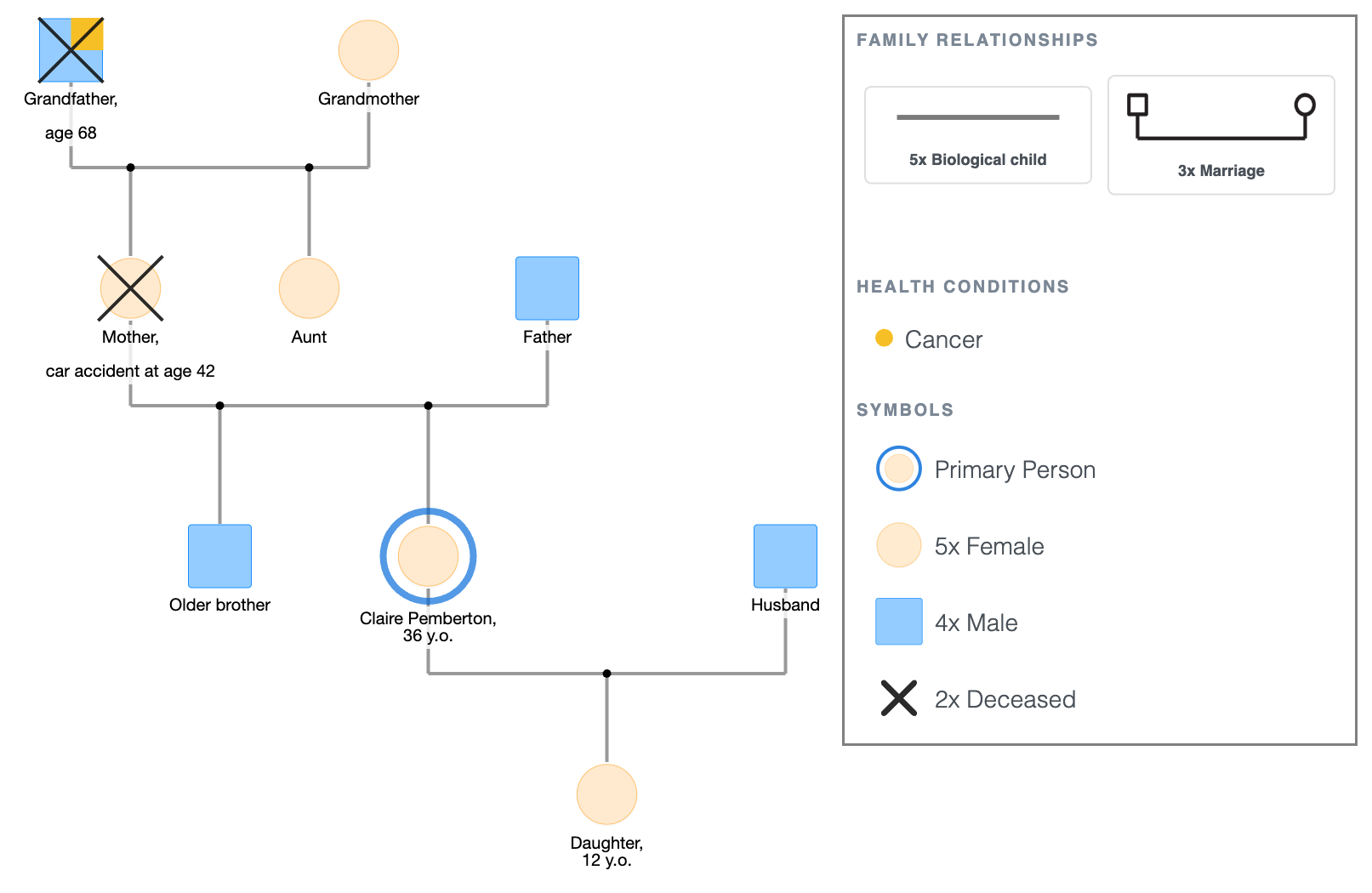
- Gen 1: grandfather (deceased, cancer, age 68).
- Gen 2: mother (deceased, car accident, age 42); father (stoic, rarely discussed the loss); aunt (mother's sister, expressive, maintained family rituals).
- Gen 3: Claire Pemberton, 34, primary person; older brother (became the responsible one after their mother's death).
Claire Pemberton came into counseling not because of a new loss, but because her daughter just turned 12, the same age Claire was when her mother died in a car accident.
Claire hadn't consciously connected the two until she found herself unusually anxious in the weeks around her daughter's birthday.
Building the genogram surfaced a second detail she hadn't fully put together either: her mother's death came about eighteen months after her own father's death from cancer, two significant losses close enough together that the family barely finished processing one before the second arrived.
Reading the Patterns
The eighteen months between the grandfather's death and the mother's death is a loss cluster, more than the family's capacity to grieve at the time.
Claire's father responded to his wife's death by staying "strong and practical," rarely discussing her or the accident, while Claire's aunt was the one who kept photos out, told stories, and kept the anniversary acknowledged each year.
That contrast is a mourning-style rule playing out inside one family; the men held it together quietly, the women carried the visible grief.
Claire's older brother took on a role after their mother's death that hadn't existed before, managing the household schedule, standing in for decisions their father couldn't make.
And Claire's current anxiety around her daughter's twelfth birthday is an anniversary reaction, grief resurfacing not because anything new happened, but because her daughter is now the age Claire was when the loss occurred.
How This Shapes the Grief Work
Naming the anniversary reaction directly, out loud, tends to reduce its intensity simply by making it explainable rather than mysterious.
The genogram also opens a conversation about the family's unspoken rule that grief gets managed quietly, and whether Claire has been following that rule even when it doesn't serve her.
Her aunt, visible on the diagram as the one who processed loss openly, is worth exploring as a resource Claire could lean on now, someone in the family who's already modeled a different way of carrying this.
Build One for a Session
Build the genogram collaboratively rather than presenting a finished diagram.
Mark deaths with an X and include the date, cause, and age at death for each person, since those details are what make patterns like clustering and anniversary reactions visible in the first place.
Ask about mourning style as you go; who could cry, who stayed quiet, what rituals the family kept or dropped.
Follow the client's pace here; some of this material surfaces grief that hasn't been fully processed, and the genogram should support that process, not rush it.
For the full guide, see How to Make a Genogram.
Grief Counseling Genogram
Explore this genogram and adapt it to your needs.
FAQ
What is a genogram for grief?
A grief-focused genogram maps a family's losses across generations, along with the relationships and mourning styles surrounding each one. It helps a client see their current grief as part of a larger family pattern rather than an isolated experience.
What is a genogram in counseling more generally?
A genogram in counseling is a family diagram that goes beyond a family tree, adding relationship quality, health history, and significant life events like deaths or estrangements. It gives a counselor and client a shared visual reference for family patterns relevant to the presenting concern.
What is a genogram and an example of one?
A genogram uses standard symbols, squares for men, circles for women, an X through a symbol for someone deceased, to map a family across three or more generations. Claire Pemberton's genogram is one example; it shows her grandfather's and mother's deaths close together, her father's and aunt's different mourning styles, and her brother's shift into a caretaker role.
What are the goals of grief counseling?
Grief counseling generally aims to help a client process a loss, understand their own grief response without judging it against how others in their life have grieved, and rebuild a sense of stability. A family-context tool like a genogram supports these goals by showing where a client's grief response came from and what other resources or patterns are already present in the family.
How do you mark dates and causes of death on a genogram?
Mark the deceased with an X through their symbol, and note the date of death, cause, and age at death beside it. These details matter clinically, since a premature death, a death close to another loss, or a death at an age the client is now approaching can all be relevant to the client's current grief.
Sources
- Living Beyond Loss: Death in the Family (2nd ed.)
- Genograms: Assessment and Intervention (4th ed.)