Appearance
Genogram for Personal Growth
A personal genogram maps three or more generations of your own family to show the relationship patterns, career choices, communication habits, and health history that shaped you, often without you realizing it. It uses the same structure as a clinical genogram, but you're the one building it, and you're the one it's about.
What a Personal Genogram Maps
Laid out across three generations, a genogram shows more than who's related to whom.
- Relationship patterns: the type of partner you keep choosing, or the emotional distance that repeats from one couple to the next.
- Career and work patterns: family attitudes toward stability, risk, or ambition, passed down without ever being discussed.
- Communication style: whether your family talked through conflict or went silent, whether vulnerability was normal or something to avoid.
- Health history: conditions and habits that run in the family.
- Values: beliefs about money, education, and success you may have adopted without choosing them.
The point isn't just to record these things but to see which ones you're still living inside.
Finding Your Own Pattern
Pick one thread to start with, it could be anything.
Examples:
- how you handle conflict
- the partners you choose
- your relationship with work
- a health pattern you've noticed.
Map two generations above you on that one thread. What did your parents do? What did your grandparents do?
Here’s an editable example:
Genogram for Personal Growth
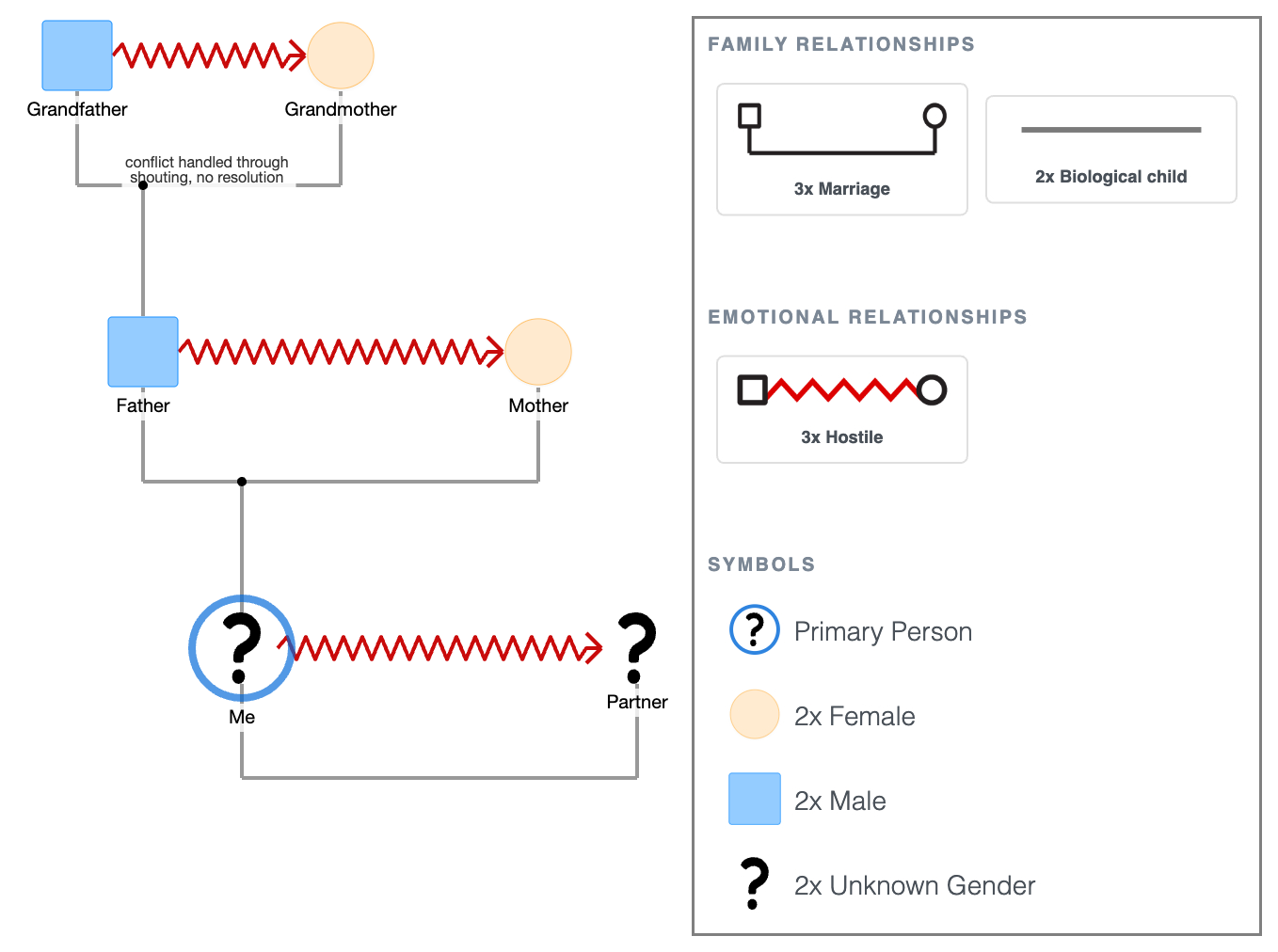
- Grandfather: Hostile relationship line to Grandmother, note: "conflict handled through shouting, no resolution."
- Father: Hostile relationship line to their partner, same pattern one generation later.
- You: primary person, pattern to your partner noted for comparison.
This example uses conflict and hostility because it's a pattern that shows up often.
Replace it with whatever thread you're actually following in your own family, whether a health condition, a communication style, a repeated relationship type, anything that seems to skip a generation or run straight through.
Three data points in a row is what turns a habit into a pattern.
On its own, one relationship reads as a single hard chapter. Next to two generations doing the same thing, it reads differently.
That's what a genogram does.
When a Personal Genogram Isn't Enough
A personal genogram is a reflection tool, not treatment.
It can show you a pattern, but it can't tell you why the pattern started, and it isn't equipped to work through what comes up if the pattern is tied to trauma, addiction, or a diagnosable mental health condition.
If mapping your family surfaces something that feels bigger than a career habit or a communication style, a genogram is a reasonable thing to bring into a session with a therapist. It's not a substitute for one.
Build Your Own Personal Genogram
Write your own name in the center, then add two generations above you, parents and grandparents on both sides if you have the information.
Note repeated events next to each person: job changes, marriages, moves, the roles they held in the family (peacemaker, breadwinner, the one who left).
Mark the emotional tone of your closest relationships using standard relationship lines, Close, Distant, Conflicted, rather than leaving them blank.
Once the diagram is built, step back and look for anything that repeats three times or more across the generations. A pattern that shows up once is a data point, but a pattern that shows up in your grandparents, your parents, and you is worth acting on.
For the full guide, see How to Make a Genogram.
Genogram for Personal Growth
Explore this genogram and adapt it to your needs.
FAQ
What is a personal genogram?
A personal genogram is a family diagram you build about your own family, mapping relationship patterns, career choices, communication styles, and health history across three or more generations. It uses standard genogram notation but is built for self-reflection rather than a clinical assessment.
How many generations should I include?
Three generations, yourself, your parents, and your grandparents, is usually enough to see whether a pattern repeats. Add a fourth generation if you have solid information about your great-grandparents; more generations make patterns more visible but aren't required to start.
Do I need clinical training to make one?
No. The notation is simple enough to learn as you go, and a personal genogram doesn't require a clinical assessment or a practitioner. If a pattern you find feels significant, that's a good reason to bring the finished diagram to a therapist, not a requirement to make one in the first place.
Is a genogram the same as a family tree?
No. A family tree records who is related to whom and when. A genogram maps the dynamics between them, closeness, distance, conflict, repeated roles, which is what makes a pattern like the one above visible in a way a family tree wouldn't show.
What if the process brings up difficult memories?
That happens. Take breaks, and don't feel obligated to finish the diagram in one sitting. If what comes up feels heavier than a career or communication pattern, that's worth bringing to a therapist rather than working through alone.
Sources
- Genograms: Assessment and Intervention (4th ed.)