Appearance
Personal Ecomap
Drawing a personal ecomap takes about fifteen minutes. A personal ecomap shows your connections to the people and systems in your life; where your support is coming from, where the demands are, and where there are gaps. It uses the same structure as a clinical ecomap, but without a practitioner and without a formal assessment context. You draw it for yourself.
What a Personal Ecomap Shows
Center circle: You, or you and your household if you’re mapping a family unit.
Outer circles: the systems in your life:
- Family (inside and outside your household)
- Friends
- Work or employer
- School or education
- Faith or spiritual community
- Healthcare
- Hobbies, clubs, or interest groups
- Community organizations
Include only the connections that are currently meaningful, whether positive or negative.
For a full reference on line types and arrows, see the ecomap symbols guide.
A Personal Ecomap Example
This example uses everyday labels so you can see how your own connections might map.
Replace any label with whatever applies to your life.
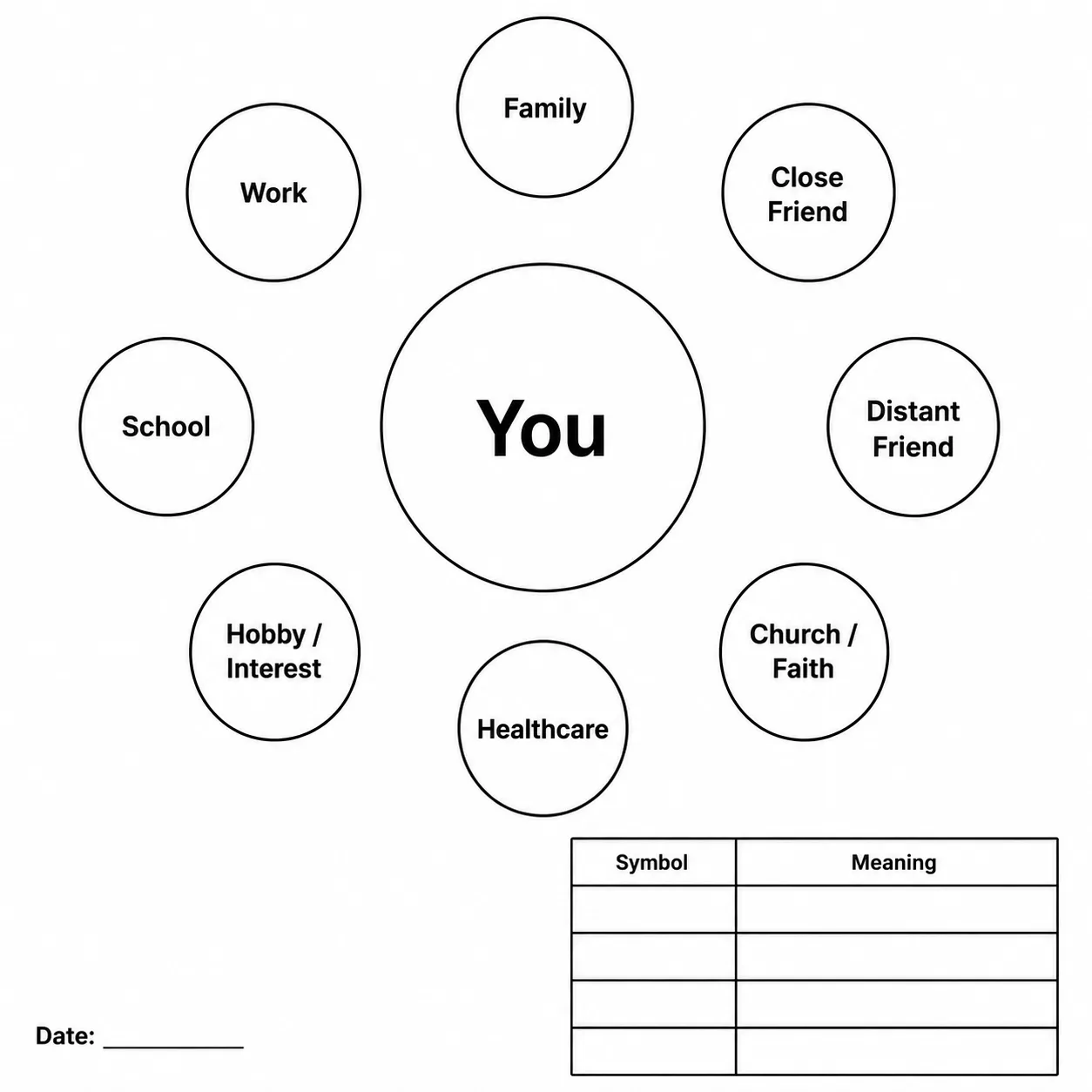
What each circle represents, and what to ask yourself:
- Work - is this connection demanding more than it gives back, or the reverse?
- Family - is this a strong two-way connection, or is the support mostly one-directional?
- Close Friend - who is your primary informal support right now?
- Distant Friend - does this connection have active energy, or has it gone quiet?
- Church / Faith - is this a connection you give to, receive from, or both?
- Healthcare - are you registered and actively using this, or is it a connection in name only?
- Hobby / Interest - is this a newer connection still forming, or an established one?
- School - how is this relationship actually functioning right now?
Once you have answered those questions, draw a line for each connection:
- solid for strong
- dashed for weak
- zigzag for stressful
Also, add arrows showing which way support flows.
What you'll see in the finished diagram is which connections are actually carrying weight in your life, and where the gaps are.
For a blank template to build your own, see the ecomap template page.
How to Create a Personal Ecomap
- Write your name in the center circle: or "Me" or "Us" if mapping a household.
- List your connections: work through the main categories; family, friends, work, school, faith, healthcare, hobbies, community.
- Draw connecting lines: solid for strong, dashed for weak, zigzag for stressful. See the ecomap symbols guide for reference.
- Add directional arrows: mark which connections give to you, which you give to, and which are mutual.
For the full step-by-step process, see how to create an ecomap. If you want the broader concept first, start with the ecomap guide.
FAQ
What is a personal ecomap?
A personal ecomap is a diagram that maps your connections to the people and systems in your life, such as family, friends, work, school, healthcare, faith community, and community organizations. It shows which connections are strong, which are weak or underused, and which are currently placing demands on you.
How do I create my own ecomap?
Write your name in a large circle at the center. Add smaller labeled circles around it for each significant connection in your life. Connect each outer circle to the center with a line and add arrows showing which way support flows.
What should a personal ecomap include?
Whatever connections are currently significant in your life; both supportive and stressful. Common outer circles include family, close friends, work, school, healthcare, faith community, hobbies, and community organizations. Include connections that are placing demands on you as well as the ones that support you.
Can I use a personal ecomap as a student?
Yes. A personal ecomap is well-suited for student assignments that ask you to map your own support network, social ecology, or community connections. It is also used in counseling and social work courses as a self-reflection exercise.
Where do I get a personal ecomap template?
You can get an ecomap template on Qwoach. It is a blank template and free to download.
Sources
- Diagrammatic assessment of family relationships. Social Casework, 59(8), 465–476.