Appearance
Ecomap Symbols
Once you know ecomap symbol conventions, you can read any standard ecomap at a glance.
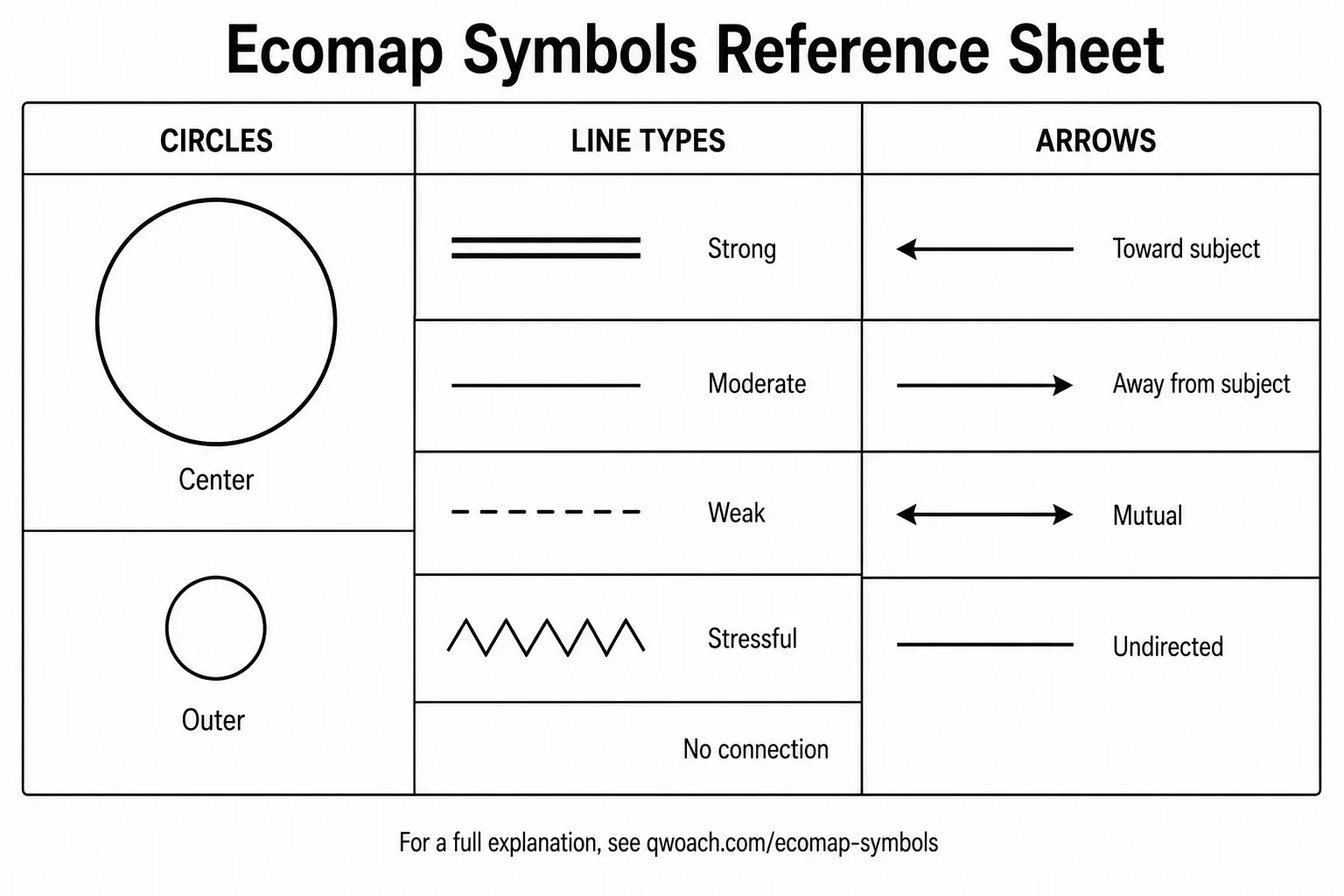
The Circles
- Center circle - large circle in the middle of the diagram. Contains the name of the individual or family being assessed. Everything else in the diagram is organized around this circle.
- Outer circles - smaller circles placed around the center, one per external system. Each is labeled with the name of the system it represents: a school, an employer, a healthcare provider, a family member, a community organization. The outer circles have no hierarchy.
Relationship Line Types
Lines connect each outer circle to the center. The line type shows the quality of the relationship.
- Thick or double solid line: A strong, positive, supportive connection. The relationship is active and the person draws real benefit from it. Use this for close family members, consistent professional support, and community connections that are reliably present.
- Thin solid line: A present but unremarkable connection. The relationship exists and is not stressful, but it is not a primary source of support. Use this for connections that are functional but peripheral.
- Thin dashed line: A weak, fragile, or underused connection. The relationship may be geographically distant, inconsistent, or still in early stages. Use this for contacts who exist but are not meaningfully engaged.
- Zigzag or jagged line: A stressful or conflictual relationship. The connection is creating pressure on the person or family. Use this for difficult employer relationships, ongoing housing disputes, statutory systems generating stress, or family members whose involvement creates tension.
- No line: Some practitioners include an outer circle with no connecting line to acknowledge a system that is known to exist but has no current relationship. An absent parent, a severed connection, a service the person is eligible for but not accessing; all can appear as labeled circles with no line.
Directional Arrows
Arrows on the lines show which way support or energy flows. The line type tells you the quality of the relationship; the arrow tells you the direction.
- Arrow pointing toward the center: The system gives support to the person or family. A school that is actively supporting a child, a caseworker who is providing consistent help, a grandparent who gives childcare; these carry arrows toward the center.
- Arrow pointing away from the center The person or family gives support to that system. This appears when a client is caregiving for an aging parent, financially supporting a sibling, or carrying more of the relational weight in a connection than they receive back.
- Arrows at both ends: The relationship is mutual and reciprocal. Both parties give and receive. Use this for genuinely balanced connections, such as that of a close friend, a faith community where the person both attends and contributes, a therapist relationship with strong working alliance.
- No arrow: The direction of support is unclear, not yet established, or not relevant to the assessment. Early-stage connections and formal institutional relationships sometimes carry no arrow until the direction becomes clear.
Building a Key
Every ecomap needs a key.
Place it in a corner of the diagram; bottom right is standard.
Include one entry for each line type and arrow direction used in the diagram.
A reader who has not seen the notation before should be able to interpret the diagram from the key alone without asking for explanation.
At minimum, a key should include:
- Thick solid line = Strong connection
- Thin dashed line = Weak connection
- Zigzag line = Stressful relationship
- Arrow toward center = Support flows to the family
- Double-headed arrow = Mutual support
If you use a thin solid line or a no-line circle in the diagram, add those to the key as well.
See completed ecomaps in the ecomap example article. If you want a blank diagram that already includes the standard structure, use the ecomap template.
FAQ
What are the symbols used in an ecomap?
An ecomap uses two types of symbols: circles and lines. The center circle represents the person or family. Outer circles represent external systems; schools, employers, healthcare providers, extended family, and community organizations. Lines connecting the outer circles to the center show the quality of each relationship: thick solid for strong, thin dashed for weak, zigzag for stressful. Arrows on the lines show which way support flows.
What do the lines mean in an ecomap?
Each line type represents a different relationship quality. A thick or double solid line means the connection is strong and supportive. A thin dashed line means the connection is weak, fragile, or underused. A zigzag or jagged line means the relationship is stressful or conflictual. A thin solid line without weight variation indicates a present but unremarkable connection. All line types should appear in a key on the finished diagram.
What does the arrow mean in an ecomap?
Arrows show the direction of support or energy flow. An arrow pointing toward the center means the system gives support to the person or family. An arrow pointing away from the center means the person or family gives support to that system. Arrows at both ends indicate a mutual, reciprocal relationship. A line with no arrow means the direction is unclear or not yet established.
What is an ecomap key?
A key is a legend placed on the diagram listing every symbol and line type used and what each one means. It allows anyone reading the ecomap to interpret it without prior knowledge of the notation. A completed ecomap without a key is technically incomplete.
What is the difference between ecomap symbols and genogram symbols?
Ecomap and genogram symbols serve different purposes and do not overlap. Genogram symbols represent people (squares for males, circles for females) and the relationships between family members across generations. Ecomap symbols represent external systems and the quality of connections between a person and those systems. An ecomap does not use genogram person shapes.
Sources
- Diagrammatic assessment of family relationships. Social Casework, 59(8), 465–476.