Appearance
Ecomap Examples: Social Work, Family, and Nursing
An ecomap shows the connections between a person or family and the world around them; which systems are supportive, which are stressful, and where the gaps are.
These three examples show what a completed ecomap looks like in a social work case review, a family caregiving situation, and a nursing assessment.
If you need a focused walkthrough for one use case rather than all three at once, start with the ecomap example for social work, the family ecomap examples, the ecomap nursing guide, or the clinical ecomap guide.
Example 1 - Social Work Ecomap: The Harper Family
Karen Harper is 32, a single mother with two children: Jade, 8, and Tyler, 5.
A child protection referral was made by Tyler's school three months ago.
A social worker is completing an ecomap at the case review to assess the family's current support network.
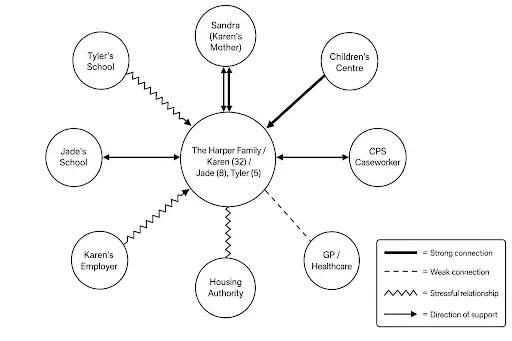
The connections:
- Karen's mother, Sandra: strong, mutual. Sandra provides regular childcare and is Karen's closest support. Double-headed arrow, thick solid line.
- Tyler's school: stressful. The school made the original referral. The relationship with Karen is tense. Zigzag line, arrow pointing toward center.
- Jade's school: mutual. Jade is settled and the school relationship is positive. Solid line, double-headed arrow.
- Children's Centre: strong, toward center. A new connection was established during the case. Thick solid line, arrow pointing toward center.
- CPS caseworker: mutual. The relationship has improved since initial contact. Solid line, double-headed arrow.
- Karen's employer: stressful. Shift work hours create gaps in childcare that have contributed to the referral concerns. Zigzag line, arrow pointing toward center.
- Housing authority: stressful. The family is in overcrowded housing. A repair dispute is ongoing. Zigzag line, no arrow.
- GP/healthcare: weak. The family is registered but rarely accesses primary care. Dashed line, no arrow.
What this ecomap shows:
- Sandra is the strongest connection in the diagram. She is a single shape with a mutual arrow, this shows that the family's primary protective factor runs through one person. That is both significant and a risk: if Sandra becomes unavailable, the support structure shifts considerably.
- Tyler's school and Karen's employer both send stressful lines toward the center simultaneously. Karen is receiving pressure from two external systems at once, alongside managing two young children without a co-parent. The diagram shows the cumulative load.
- The Children's Centre appears with a strong line but no mutual arrow yet; it is giving to the family, but the relationship is still early. A social worker reviewing the ecomap at the next case review would look for that arrow to become bidirectional as Karen's engagement deepens.
- The GP line is the quietest line in the diagram. It shows two children under eight with limited primary care access.
Example 2 - Family Ecomap: The Coleman Family
Robert Coleman is 64 and his wife Jean is 62. Robert's mother Dorothy, 88, has early dementia and lives alone. Jean has become the primary coordinator of Dorothy's care over the past year. The couple are completing an ecomap together as part of a support group exercise.
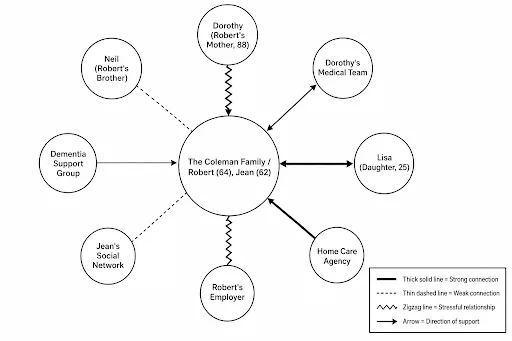
The connections:
- Dorothy: stressful-strong, toward the center. Dorothy's care needs are significant and the relationship is intense in both directions. Thick zigzag line, arrow pointing toward center.
- Robert's brother, Neil: weak. Neil lives far away and has minimal involvement in Dorothy's care. Dashed line, no arrow.
- Adult daughter, Lisa: strong, mutual. Lisa supports her parents emotionally and visits regularly. Thick solid line, double-headed arrow.
- Dorothy's medical team/GP: mutual. The relationship with Dorothy's care team is reliable and consistent. Solid line, double-headed arrow.
- Home care agency: strong, toward the center. Hired four months ago; a significant source of practical support. Thick solid line, arrow toward center.
- Robert's employer: stressful. Robert has taken unplanned leave twice since Dorothy's diagnosis. Zigzag line, arrow toward center.
- Jean's social network: weak. Jean has stepped back from her book club and friendships since Dorothy's needs increased. Dashed line, no arrow.
- Dementia support group: toward the center, still forming. The couple joined recently. Thin solid line, arrow toward center.
What this ecomap shows:
- Dorothy appears at the edge of the diagram but her line is the thickest and most loaded. She is not in the center (the Coleman family is) but the diagram makes clear that her needs are the gravitational force the whole system is organized around.
- Jean's social network is a dashed line. That absence means that Jean has lost her friends because the time to foster those relationships went elsewhere. This shows the sometimes adverse cost of caregiving.
- Neil appears with a dashed line and no arrow. Robert and Jean are managing Dorothy's care with limited sibling support.
- Lisa and the home care agency both have strong lines. The family has two solid points of support. The dementia support group is thin but present; something to develop.
Example 3 - Nursing Ecomap: David Cross, 54
David Cross is 54 and was diagnosed with stage 2 colorectal cancer six weeks ago. He is currently in hospital for his second chemotherapy cycle. His nurse is completing an ecomap as part of a holistic patient assessment to identify the support systems around his treatment and recovery.
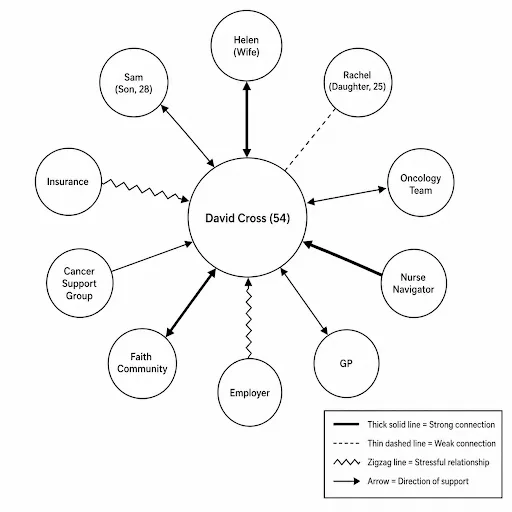
The connections:
- Helen (wife): strong, mutual. Helen has attended every hospital appointment. Thick solid line, double-headed arrow.
- Sam (son, 28): mutual, toward center. Sam lives locally and visits regularly. Solid line, double-headed arrow.
- Rachel (daughter, 25): weak. Rachel lives abroad. Contact has been limited since the diagnosis. Dashed line, no arrow.
- Oncology team: mutual. David has a good relationship with his specialist. Solid line, double-headed arrow.
- Nurse navigator: strong, toward center. Primary day-to-day clinical contact. Thick solid line, arrow toward center.
- GP: mutual. Ongoing coordination with the specialist team. Solid line, double-headed arrow.
- Employer: stressful. Sick leave entitlement is unclear and David is worried about his position. Zigzag line, arrow toward center.
- Faith community: strong, mutual. David's church has been a consistent presence. Thick solid line, double-headed arrow.
- Cancer support group: toward the center, still forming. David attended once. Thin solid line, arrow toward center.
- Insurance: stressful. Coverage disputes over some treatment costs. Zigzag line, arrow toward center.
What this ecomap shows:
- Helen and Sam sit close to the center with strong mutual lines. David has two solid domestic support connections. That is protective for treatment adherence and emotional wellbeing, and a patient with strong family engagement recovers differently from one who is managing alone.
- The employer and insurance lines both carry zigzag stress toward the center. David is managing two financial and professional stressors alongside active treatment. Neither is clinical, but both are affecting his recovery environment.
- Rachel's dashed line sits opposite Sam’s solid one on the same diagram. This shows two adult children with two very different levels of presence.
- The faith community has a strong mutual line. It is one of the few systems in the diagram where energy flows in both directions with no stress marker. For a patient managing significant illness, that kind of unconditional reciprocal connection is worth noting in an assessment.
For the nursing-specific interpretation and workflow behind this kind of diagram, see ecomap nursing.
What These Examples Have in Common
All three use the same symbols and line types; the format does not change between a social work case, a family situation, and a nursing assessment. What changes is who sits in the center and which external systems are relevant to that person's life.
In each example, the most useful information came from the lines that were either absent or unexpected, like the dashed GP line in a family with young children, the social network in a caregiver, the financial stressors sitting alongside a cancer diagnosis.
An ecomap makes those things visible in a single diagram rather than requiring them to surface through conversation.
How to Build Your Own Ecomap
- Draw a large circle in the center; this is the person or family.
- Add smaller circles around it for each external system.
- Connect each outer circle to the center with a line; solid for strong, dashed for weak, zigzag for stressful. For a full reference of line types and what each one means, see ecomap symbols.
- Add arrows to show which direction support flows.
- Include a key listing every symbol used.
For a step-by-step guide to creating an ecomap from scratch, see the ecomap guide. If you want a ready-made starting point, use the ecomap template.
FAQ
What is an example of an ecomap?
An ecomap shows a person or family at the center of a diagram, surrounded by the external systems they are connected to, such as schools, employers, healthcare providers, extended family, community organizations.
What does an ecomap example for social work look like?
A social work ecomap places the client or family at the center and maps the systems involved in their case, like caseworkers, schools, housing authorities, extended family, employers, and community resources.
What is a family ecomap example?
A family ecomap places the family unit at the center and maps all the external systems they are currently connected to. The Coleman family example on this page shows a couple managing an aging parent's care, with their support network and stress points mapped across the diagram.
Can I use an ecomap example for a nursing assignment?
Yes. The David Cross example on this page shows what a nursing ecomap looks like in a clinical assessment context; mapping a patient's support systems, medical team, and external stressors during treatment.
What is the difference between an ecomap and a genogram?
A genogram shows a family's internal structure across generations, such as who is related to whom, health history, and relationship quality between family members. An ecomap shows a person's or family's connections to the external world, such as which outside systems are supportive, stressful, or absent. The two diagrams are often used together in clinical practice.
Sources
- Diagrammatic assessment of family relationships. Social Casework, 59(8), 465–476.
- Genograms: Assessment and Intervention (3rd ed.). W.W. Norton & Company.