Appearance
Ecomap Example for Social Work
These three completed ecomaps show what a social work ecomap looks like across three common practice scenarios: a child in kinship care, an adult mental health case, and a family assessment following a domestic abuse referral.
Example 1 - Child Welfare
Marcus is 7 years old and was placed with his paternal great-aunt, Mrs. Webb, eight months ago following a child protection referral. His younger sister is in a separate foster placement. His social worker completed this ecomap at the six-month review.
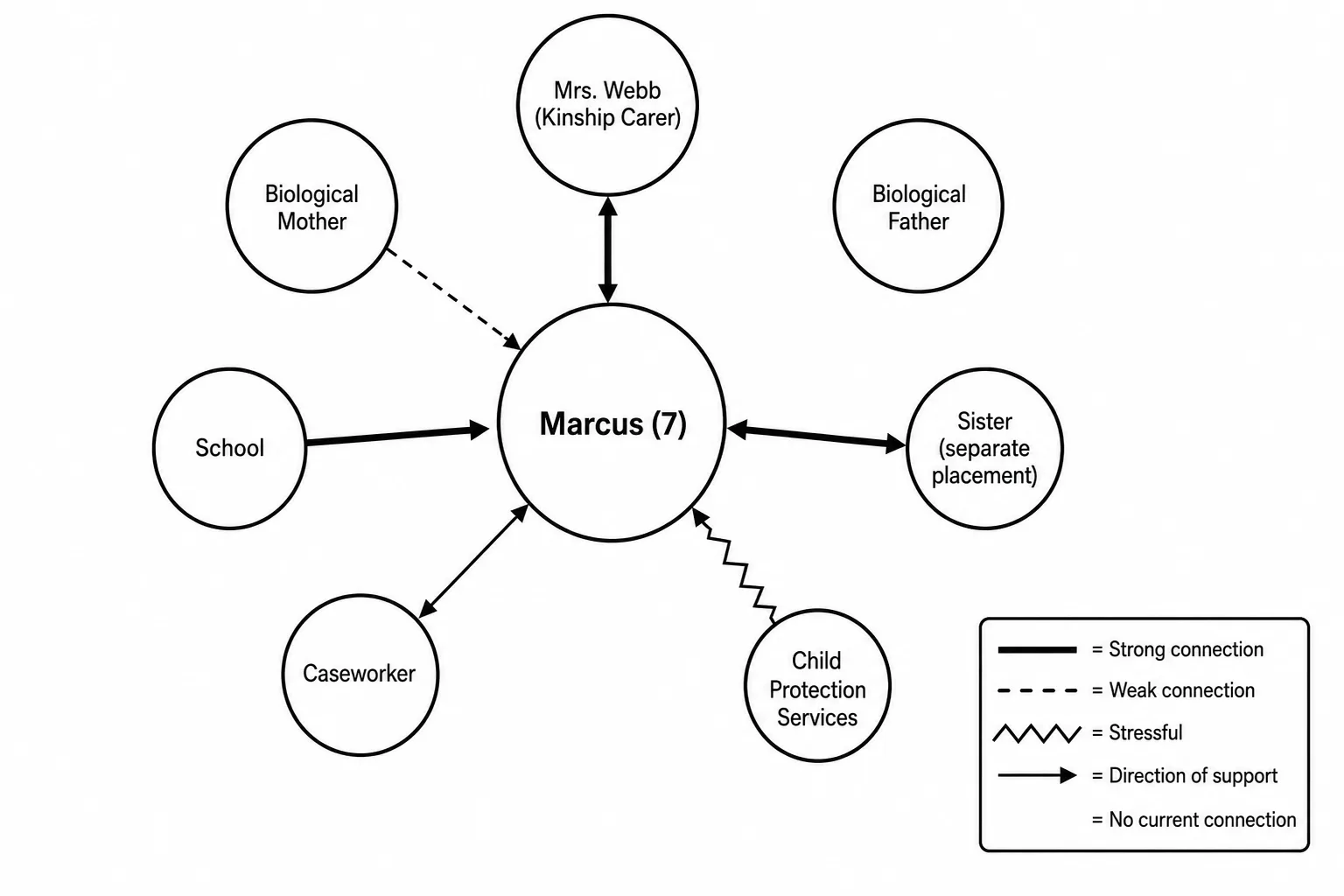
The connections:
- Mrs. Webb (kinship carer) - strong and mutual. The placement has been stable. Mrs. Webb has requested long-term kinship approval.
- Biological mother - dashed with the arrow pointing toward the center. Supervised monthly contact is taking place but is inconsistent.
- Biological father - no connection drawn. No contact since the referral.
- Sister (separate foster placement) - strong and mutual. Sibling contact is maintained through the local authority.
- School - strong with the arrow pointing toward the center. Marcus has settled well. The school flagged the original referral.
- Caseworker - mutual. Fortnightly visits, good working relationship with Mrs. Webb.
- Child protection services - stressful, arrow toward center. The case is still open and under active review.
What this ecomap shows:
- Marcus has two strong mutual connections; Mrs. Webb and his sister. Both are stable. The placement and the sibling contact are the two things that are working.
- His mother appears with a dashed line and an inconsistent contact record. His father has no line at all. The diagram shows this degree of parental absence.
- The school and the child protection services are both sending energy toward the center. One is supportive; one is carrying the weight of the ongoing case, with Marcus sitting at the intersection of both.
For a focused breakdown of what to include in this kind of child welfare diagram, see ecomap for foster care.
Example 2 - Mental Health Social Work
Diane is 43 and has a diagnosis of recurrent depression and anxiety. She lives alone in temporary housing following the breakdown of a long-term relationship two years ago. Her community mental health team completed this ecomap at her care plan review.
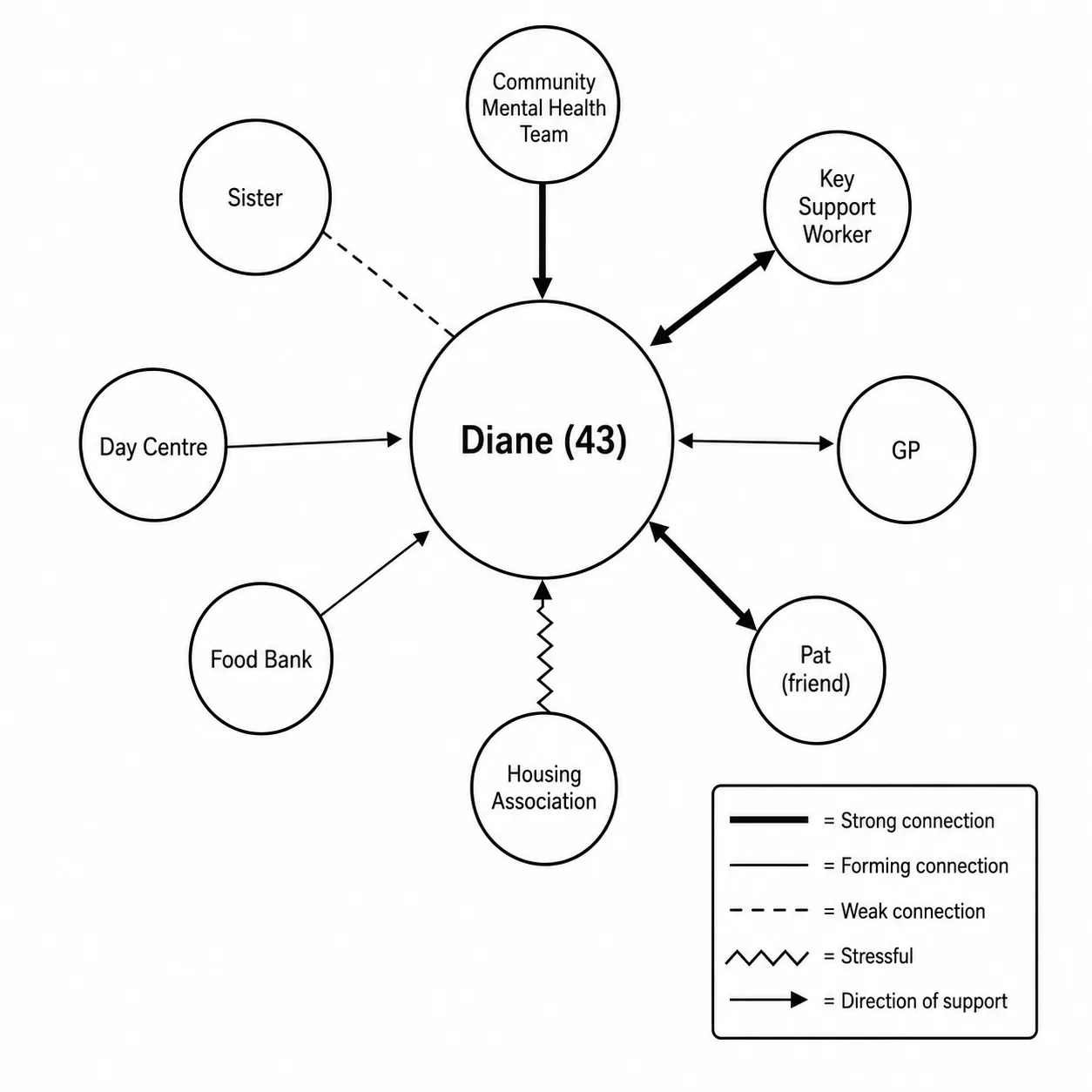
The connections:
- Community mental health team - strong, arrow toward center. Diane attends appointments consistently.
- Key support worker - strong, mutual. The most reliable two-way connection in the diagram.
- GP - mutual but thin. Diane attends irregularly; the line is solid but not thick.
- Housing association - stressful, arrow toward center. Ongoing rent arrears dispute.
- Estranged sister - dashed, no arrow. Contact has been minimal since the relationship ended.
- Pat (friend) - strong, mutual. The only informal support connection in the diagram.
- Food bank - thin solid, arrow toward center. Used monthly since moving to temporary accommodation.
- Day centre - thin solid, arrow toward center. Diane started attending six weeks ago.
What this ecomap shows:
- Diane's support network runs almost entirely through professional and formal connections. Her key support worker and the mental health team carry most of the weight. Pat is the only informal mutual connection.
- The food bank and day centre both have thin solid lines. Both are relatively new. Neither has arrows pointing away from the center yet, which means Diane is receiving from both but not yet reciprocating, which is consistent with the early stages of rebuilding social connection.
- The housing association stressor sits alongside the mental health team support in the same diagram. Diane is managing an active stressor at the same time as engaging with treatment.
For a focused walkthrough of this practice area, see ecomap for mental health.
Example 3 - Family Assessment
Claire Barton is 36, with two children: Mia, 8, and Liam, 5. Following a domestic abuse disclosure at Mia's school, a social work referral was made. Claire has separated from Tom, the children's father, who remains in the area. This ecomap was completed at the initial family assessment.
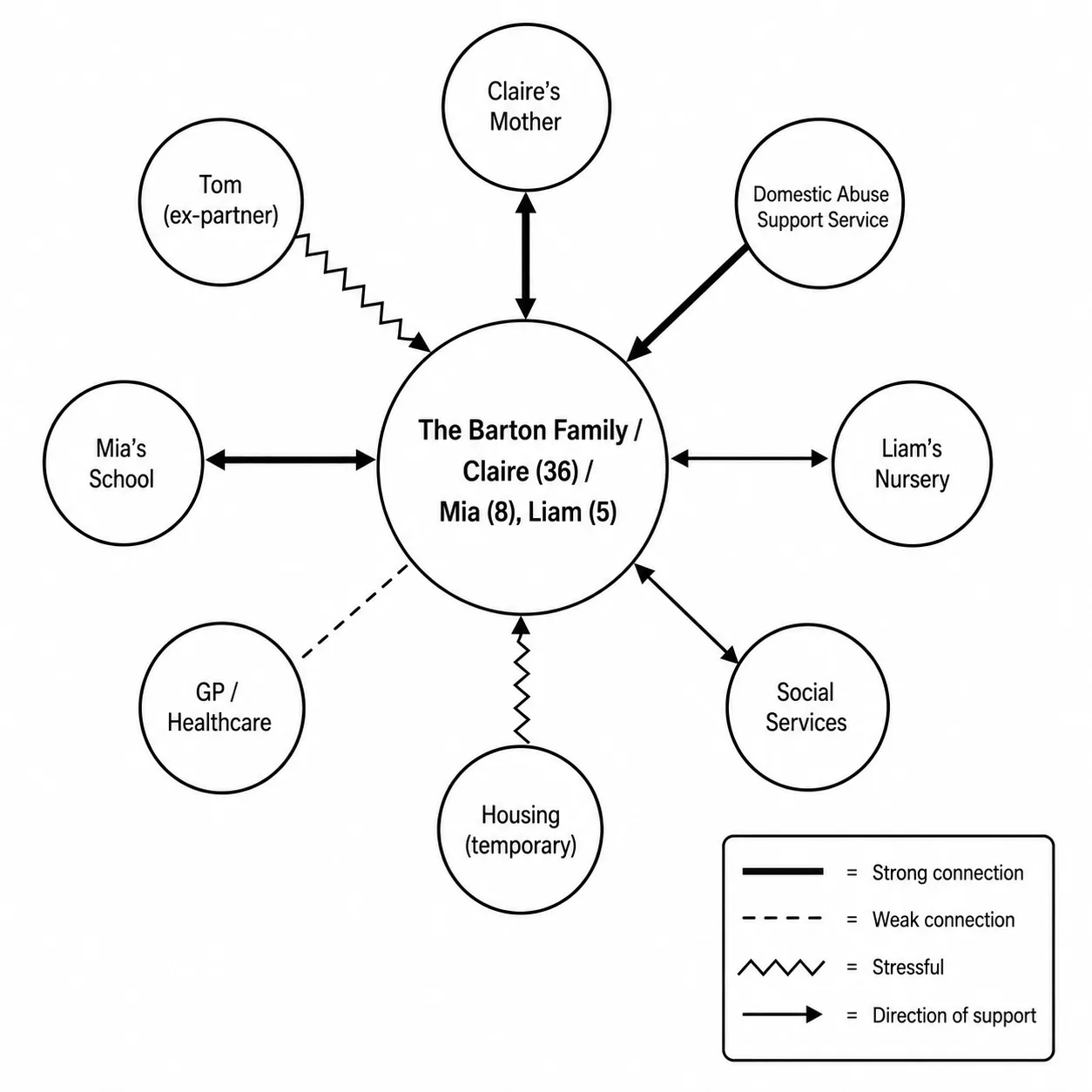
The connections:
- Claire's mother - strong, mutual. The closest support. Claire has been staying with her mother on some nights.
- Tom (ex-partner) - stressful, arrow toward center. An ongoing contact dispute is creating active pressure on the family.
- Domestic abuse support service - strong, arrow toward center. Claire was referred at the point of disclosure and is engaging consistently.
- Mia's school - strong, mutual. The school made the original referral and is maintaining supportive contact.
- Liam's nursery - mutual. Stable, no concerns.
- Housing (temporary accommodation) - stressful, arrow toward center. The family moved following the separation. The current placement is short-term.
- GP/healthcare - dashed, no arrow. Claire has not accessed primary care since the move.
- Social services - mutual. Case is open. The working relationship with Claire is currently cooperative.
What this ecomap shows:
- Tom appears at the edge of the diagram with a stressful line pointing toward the center. He is no longer in the household, but his presence is still active in the family's environment.
- Claire's mother and the domestic abuse service are the two strongest connections. Both are giving to the family. The diagram shows that Claire's informal and formal supports are aligned.
- The GP line is dashed with no arrow. A mother and two young children not accessing primary care following a significant family disruption is a gap.
- Housing is stressful. Tom is stressful. Both lines point toward the center simultaneously. The combined load is on the family and visible in the diagram as a structural fact.
For a full guide to building social work ecomaps, see the ecomap in social work guide. If you need a blank starting point for supervision, coursework, or intake documentation, use the ecomap template.
How to Build a Social Work Ecomap
- Place the client or family at the center - individual or household, with names.
- Identify the external systems - work through formal services, informal supports, and community connections.
- Draw connecting lines - solid for strong, dashed for weak, zigzag for stressful. For a full reference of line types, see the ecomap symbols guide.
- Add directional arrows - mark which way support flows on each connection.
- Include a key and a date - the date anchors the ecomap as a snapshot at a specific point in the case.
FAQ
How do you make an ecomap for social work?
Place the client or family in a large circle at the center. Add smaller circles for each significant external system and connect each outer circle to the center with a line showing the relationship quality.
What is an ecomap used for in social work?
Social workers use ecomaps to map a client's current support network, identify gaps in resources, and make the environmental context of a case visible before or during assessment. They are used at intake, during case review, and in direct work with clients as a tool for building awareness of their own connections.
What does a social work ecomap look like?
A social work ecomap has a large circle in the center containing the client or family's name, surrounded by smaller labeled circles representing external systems. Lines connect each outer circle to the center, and arrows on each line show the direction of support.
Can I use a social work ecomap example for a student assignment?
Yes. All three examples on this page show completed social work ecomaps across different practice scenarios. They can be used as references for assignment work. If your brief requires you to complete an ecomap of your own client or a case scenario, use these as a reference for format, connection types, and annotation style.
Where can I find a free ecomap example for social work?
The three examples on this page are free to reference.
Sources
- Diagrammatic assessment of family relationships. Social Casework, 59(8), 465–476.
- The Ecology of Human Development. Harvard University Press.