Appearance
Ecomap for Foster Care
At a case review, a caseworker needs a quick picture of where the child's stability is coming from, which biological family connections are still active, and what the service network is actually doing. A foster care ecomap puts all of that in one diagram before the meeting starts.
What an Ecomap for Foster Care Shows
- Placement stability: how strong the connection between the child and the foster or kinship carer is, and whether it is mutual.
- Biological family connection quality: whether contact with parents and siblings is active, supervised, inconsistent, or absent.
- Kinship options: extended biological family members who appear on the diagram as early-stage connections that could develop into placement options.
- Formal system stressors: which formal systems are creating pressure rather than providing support.
- Service network: whether therapeutic and community connections are present, active, or underused.
For a full guide to symbols and how to draw an ecomap, see the ecomap guide.
What to Include
The child: always at the center. One child per ecomap where possible; a shared household ecomap loses the specificity of each child's individual connections.
Placement:
- Foster family or kinship carer.
- Other household members in the placement.
Biological family:
- Biological mother and father, with contact arrangement noted in the line type.
- Siblings, including those placed separately.
- Extended family members with existing or potential connections.
Formal systems:
- Caseworker
- Child protection services
- Court or guardian ad litem
- CASA volunteer where present
School and community:
- School, often one of the most stable connections for a child in care.
- Extracurricular activities, sports teams, mentors.
- Peer connections where significant.
Services:
- Therapist or counselor
- Healthcare provider
- Any specialist services
A Completed Foster Care Ecomap Example
The Marcus ecomap in the ecomap example for social work article shows a 7-year-old in kinship placement with his great-aunt following a child protection referral.
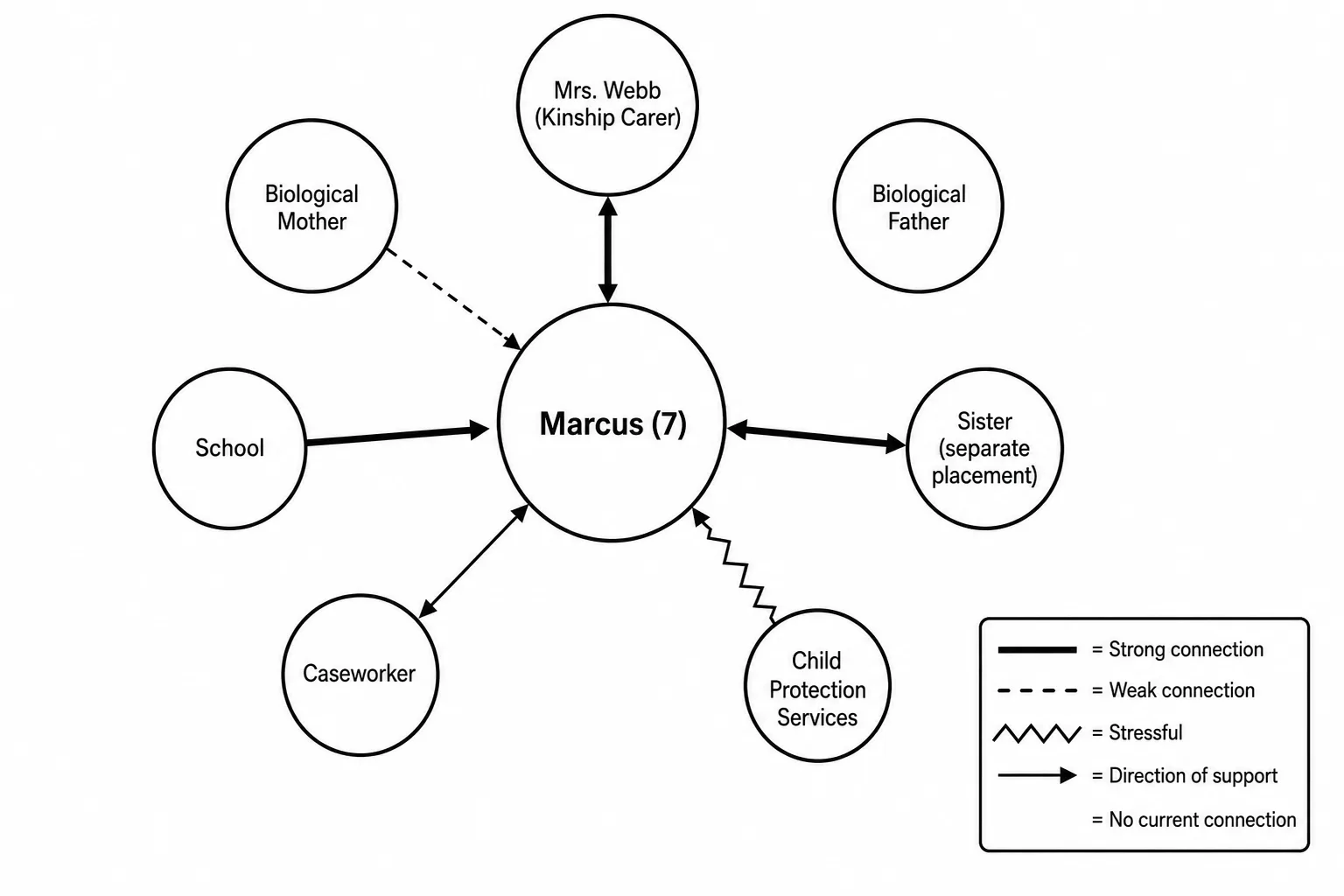
His diagram maps Mrs. Webb as the strongest mutual connection, his biological mother with a dashed line and inconsistent supervised contact, his father with no line at all, his sister in a separate foster placement with a strong mutual connection, his school, his caseworker, and child protection services with a stressful line still open at case review.
The diagram shows two stable connections; the placement and the sibling, against a background of formal system involvement and limited biological parent engagement.
How to Create a Foster Care Ecomap
- Place the child at the center: one child per diagram where possible.
- Map the placement first: the foster or kinship household is the primary stability anchor.
- Map the biological family: all members, with contact arrangement reflected in the line type. No contact = no line, but the circle can still be present to acknowledge the connection.
- Map the formal systems: caseworker, court, services. Use zigzag lines for systems generating stress.
- Add directional arrows, a key, and the date: for a full reference of line types, see the ecomap symbols guide
For the full step-by-step process, see how to create an ecomap. You can also create one with this blank template.
FAQ
What is an ecomap in foster care?
A foster care ecomap is a diagram that maps all the systems surrounding a child in care; the foster or kinship placement, biological family connections, caseworker, court, school, and services. It shows the quality of each connection using line types and directional arrows, making visible which systems are stable, which are stressful, and where the child's support network has gaps. It is used by caseworkers and social workers as part of a child welfare assessment.
What should be included in a foster care ecomap?
The child at the center, with outer circles for the foster or kinship placement, biological parents and siblings (including those placed separately), extended family, the caseworker and statutory services, school, therapeutic and community services, and any other adults with meaningful connections to the child. Include biological family members even when contact is absent or supervised.
Where can I find a free foster care ecomap template?
You can find an ecomap template on Qwoach. It is a blank template and free to download.
What does a foster care ecomap look like?
A foster care ecomap has the child in a large center circle, surrounded by smaller labeled circles representing each system in their life. A thick solid line connects the child to a stable foster carer; a dashed line connects them to a biological parent with inconsistent contact; a circle with no line acknowledges a parent who has no current connection. Arrows show the direction of support. A key and date complete the diagram.
How is an ecomap used in child welfare?
In child welfare, caseworkers use ecomaps at intake and case review to map a child's full support network, identify gaps in resources, and surface kinship connections that could develop into placement options. The diagram is updated over time to track whether connections have strengthened or weakened. It is often used alongside a genogram; the genogram maps the family's history and structure, the ecomap maps the child's current environment.
Sources
- Diagrammatic assessment of family relationships. Social Casework, 59(8), 465–476.
- Family-centered practice. U.S. Department of Health and Human Services.