Appearance
Ecomap in Social Work
An ecomap, sometimes written as ecogram, is a diagram social workers use to map a client's connections to the external world: their support systems, the systems placing demands on them, and the gaps where support is absent or underused. It answers a specific question that a genogram cannot: what is this person's relationship to their environment right now?
What an Ecomap Does in Social Work
Social work is built around the person-in-environment perspective; a client's situation cannot be understood in isolation from the systems surrounding them.
The ecomap makes that perspective visible by placing the client or family at the center and mapping:
- Who they are connected to: family outside the household, schools, employers, healthcare providers, housing authorities, faith communities, social services, community organizations, etc.
- The quality of each connection: whether it is strong, weak, or stressful.
- The direction of support: whether resources flow toward the client, away from them, or both ways.
For a full reference on symbols and how to read a completed ecomap, see the ecomap guide.
How Social Workers Use Ecomaps in Practice
An ecomap is most useful when it is completed with the client.
The process of drawing it together; deciding which systems to include, choosing the line types, marking where the arrows point, is often as clinically useful as the finished diagram.
Clients frequently identify connections they had not previously considered significant, or recognize patterns in their support network that were not visible until they saw them on paper.
In practice, social workers use ecomaps in three main ways:
- At intake: to quickly establish the client's current environment before assessment or intervention planning begins. A completed ecomap at intake gives a practitioner a picture of the family's situation that would otherwise take several sessions to build through conversation alone.
- During case review: to track changes in a client's support network over time. An ecomap completed at the start of a case and again at 30 or 90 days shows concretely whether connections have strengthened, weakened, or changed direction.
- In direct work with clients: as a tool for building self-awareness. A client who has drawn their own ecomap and can see their support network laid out has a different kind of ownership over that picture than one who has had it described to them.
Ecomap in Social Work by Practice Area
Social workers use ecomaps across a range of practice settings. The format stays the same, but what changes is who sits at the center and which external systems are relevant to that client's situation.
- Child welfare: maps the child's full system including biological family, foster placement, siblings, caseworker, and kinship connections under assessment. For that use case, see ecomap for foster care.
- Mental health: identifies isolation and fragile support networks; shows stressors sitting alongside therapeutic connections. For that use case, see ecomap for mental health.
- School social work: maps the systems around a child: home, school, peer group, and wider community.
- Elderly care: maps the caregiving network, identifying where care is concentrated and where arrows point outward rather than toward the older adult.
- Family assessment: maps the household's relationship to its wider environment at the point of referral.
See the ecomap example page for a completed social work ecomap with full annotations.
Using Ecomaps and Genograms Together
Social workers frequently use an ecomap and a genogram together at intake. See ecomap and genogram for the side-by-side comparison.
- The genogram maps the family's internal structure and history, i.e., who is in the family, how they are related, and what patterns have persisted across generations.
- The ecomap maps the family's current environment, i.e., what external systems they are connected to and how those connections are functioning right now.
The two tools answer different questions.
- The genogram asks: what is the history of this family?
- The ecomap asks: what is the current ecology around this family?
- Used together, they give a practitioner both the historical and the environmental context for assessment.
For a guide to using genograms in social work, see the genogram for social work assessment article.
A Social Work Ecomap Example
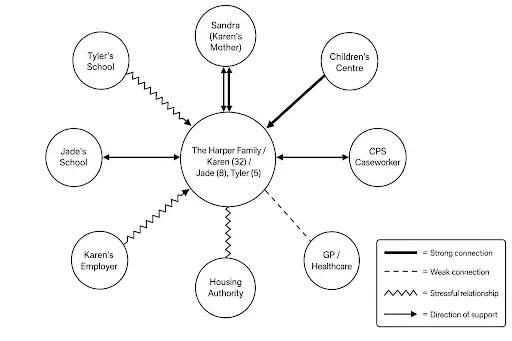
The Harper family ecomap shows a single mother with two young children at a child protection case review.
Her mother provides strong mutual support, but two formal systems; Tyler's school and her employer, send stressful lines toward the center simultaneously; her GP connection is a dashed line despite two young children in the household.
Each connection is annotated to show what it reveals about the family's situation and where intervention is most needed.
See the full example in the ecomap example article.
How to Create a Social Work Ecomap
- Complete it with the client where possible: the conversation that happens during the drawing is part of the assessment. Ask the client to name the systems that matter to them rather than building the map without their input.
- Place the client or family unit at the center: include everyone in the household in the center circle.
- Identify the external systems: work through the main areas like the extended family, friends, schools, employers, healthcare, housing, formal services, faith community, community organizations, etc.
- Draw the connecting lines: solid for strong, dashed for weak, zigzag for stressful. For a full reference of line types, see ecomap symbols.
- Add directional arrows: mark which way support flows on each connection.
- Include a key and the date: ecomaps are snapshots. The date anchors the diagram to a specific point in the case.
For a full step-by-step guide, see the ecomap guide. If you need a ready-made diagram to start from, use the ecomap template.
FAQ
What is an ecomap in social work?
An ecomap is a visual assessment tool that maps a client's or family's connections to the external systems in their life. Social workers use it to assess a client's environment, identify gaps in support, and plan interventions. It was developed by Ann Hartman in the 1970s specifically for social work practice.
How do you draw an ecomap in social work?
Place the client or family in a large circle at the center. Add smaller circles around it for each significant external system. Connect each outer circle to the center with the relevant line and add arrows to show which way support flows. Complete the diagram with the client where possible, include a key, and date the diagram.
What is the purpose of an ecomap in social work?
An ecomap makes the person-in-environment perspective concrete. It shows where a client's support comes from, where the stressors are, and where connections are absent or underused; all in a single diagram.
What are the different types of ecomaps in social work?
The format is the same across all contexts, but what changes is who sits at the center and which external systems are relevant. In child welfare, the diagram includes biological family, foster placement, and formal case systems. In mental health, it maps therapeutic and community support alongside stressors. In school social work, it centers on the child's immediate environment. In elderly care, it maps the caregiving network around an older adult.
How is an ecomap different from a genogram in social work?
A genogram maps the family's internal structure and history across generations while an ecomap maps the family's current environment. Social workers often use both tools together at intake.
Sources
- Diagrammatic assessment of family relationships. Social Casework, 59(8), 465–476.
- The Ecology of Human Development. Harvard University Press.
- Benefits of using an ecomap in social work. VCU Online Social Work.