Appearance
Ecomap for Mental Health
Mental health outcomes are shaped as much by environment as by symptoms. The ecomap is the tool for mapping that environment; which systems are supporting a client, which are depleting them, and where the gaps are.
What an Ecomap Shows in Mental Health
- Isolation patterns: a client with one professional connection and no informal support has a fragile network that is visible in the diagram before it surfaces in session.
- Treatment network strength: which clinical connections are active, which are thin, and where gaps in care exist.
- Stressors running alongside treatment: financial pressure, housing instability, or conflictual relationships appearing in the same diagram as therapeutic supports.
- Energy flow: which systems give to the client and which take, shown through directional arrows.
For a full guide to symbols and how to draw an ecomap, see the ecomap guide.
What to Include
Treatment network
The formal clinical systems involved in the client's care:
- Therapist or counselor
- Psychiatrist or prescriber
- Group therapy or peer support
- Case manager or social worker
- Crisis resources
Protective social ties
The informal connections that buffer stress and support recovery:
- Family members providing support
- Close friends
- Partner or significant other
- Faith community
- Hobbies or recreational groups
Stressors
The systems currently placing demands on the client:
- Financial pressure or employment instability
- Housing insecurity
- Workplace conflict
- Isolated living situation
- Conflictual family relationships
- Chronic illness or physical health demands
Draw all three categories, as a mental health ecomap that only shows positive connections does not give an accurate picture of the client's situation.
A Completed Mental Health Ecomap Example
The Diane example in the ecomap example for social work article shows a 43-year-old woman with recurrent depression and anxiety living alone in temporary housing.
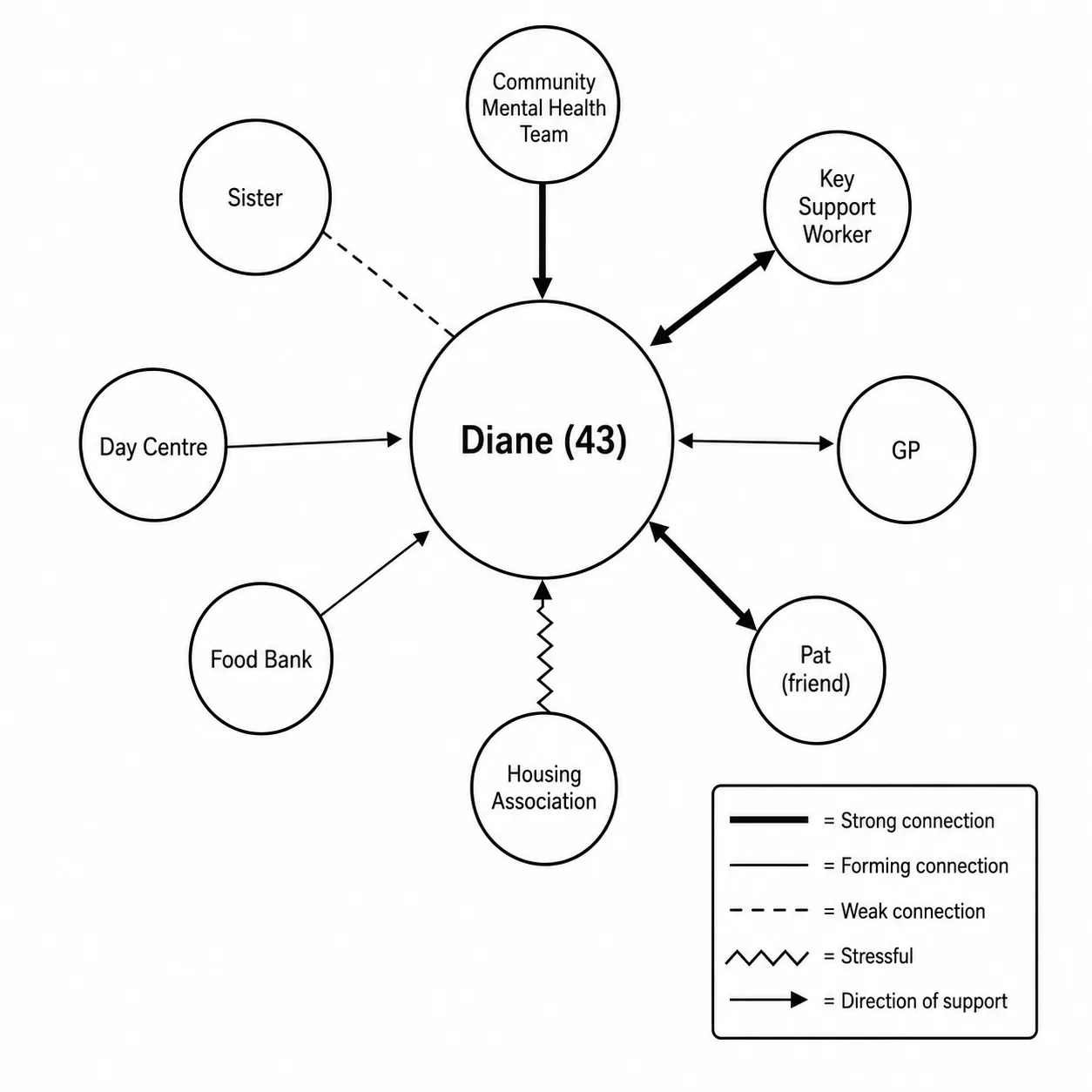
Her ecomap maps her community mental health team and key support worker as the two strongest connections; both professional. Her one strong but informal mutual connection is a single friend, Pat. Her housing association appears with a stressful line. Her sister has a dashed line with no arrow. A food bank and day centre both have thin lines, still forming.
The diagram shows a client whose support network runs almost entirely through professional relationships, with one informal connection and two quiet gaps; a fragile family connection and an underused social network.
How to Create a Mental Health Ecomap
- Place the client at the center: individual or family unit.
- Map the treatment network: all formal clinical connections currently active.
- Map the protective social ties: informal supports, community connections.
- Map the stressors: use zigzag lines for conflictual or draining connections.
- Add directional arrows and a key: mark the flow of support on each line; include a key and date.
For the full step-by-step process, see how to create an ecomap.
You can also create one with a blank template.
FAQ
What is an ecomap in mental health?
A mental health ecomap is a diagram that maps the systems surrounding a client; their treatment network, informal support connections, and environmental stressors. It is used in therapy, counseling, and psychiatric assessment to make the client's social and environmental context visible before treatment planning. It shows which systems are supporting the client, which are placing demands on them, and where the gaps in their support network are.
What should be included in a mental health ecomap?
Three categories of systems: the treatment network (therapist, prescriber, peer support, case manager, crisis resources), protective social ties (family, friends, faith community, recreational connections), and stressors (financial pressure, housing instability, workplace conflict, conflictual relationships). Include all three; a diagram that only shows supportive connections misses the stressors that directly affect treatment outcomes.
Where can I find a free mental health ecomap template?
You can find an ecomap template on Qwoach. The template is free to download and includes a center circle, outer circles, a key, and a date field for you to fill in the labels and line types for the specific client.
How do I create an ecomap for mental health?
Place the client in a large circle at the center. Add outer circles for the treatment network, social supports, and stressors. Connect each outer circle to the center with a line, e.g., solid for strong, dashed for weak, zigzag for stressful, and add arrows showing the direction of support. Add a key and the date.
What are the different types of ecomaps used in mental health?
The format is the same across mental health contexts; what changes is which systems are most relevant. An outpatient therapy ecomap emphasizes the treatment network and social support. An inpatient or crisis ecomap focuses on immediate support and safety planning. A community mental health ecomap maps the full range of formal services and community connections. All use the same symbols and line types.
Sources
- Diagrammatic assessment of family relationships. Social Casework, 59(8), 465–476.
- The Ecology of Human Development. Harvard University Press.