Appearance
Family Ecomap
A family ecomap is a diagram that maps a family's connections to the world around them; who supports them, what's placing pressure on them, and where the gaps are. It shows the family's current environment as a snapshot, using circles and lines to represent each connection and its quality.
What a Family Ecomap Shows
The family sits at the center of the diagram. Surrounding circles represent each external system the family is connected to. Connecting lines show the nature of each relationship.
What goes in the center:
- The family unit: all household members, with names.
What goes in the outer circles:
- Extended family outside the household
- Schools and childcare
- Employers and workplaces
- Healthcare providers
- Faith communities
- Friends and neighbors
- Social services and community organizations
- Housing and financial systems
What the lines show:
- Thick solid line: strong, positive connection.
- Thin dashed line: weak or underused connection.
- Zigzag line: stressful or conflictual relationship.
- Arrows: direction of support (toward the family, away from it, or mutual)
For a full reference of symbols and line types, see ecomap symbols.
When a Family Ecomap Is Used
- Family therapy intake: to map a family's support network before sessions begin, giving the therapist a picture of the environment the family is operating in.
- Nursing family health assessment: to identify the social and community factors affecting a patient's health and recovery. For that workflow, see ecomap nursing.
- Social work assessment: at referral or intake to establish what resources the family already has and where the stressors sit. See the ecomap social work guide for the practice-specific detail.
- School counseling: to map a child's home and community environment alongside their school connections
- Personal or self-directed use: families completing an ecomap together to build awareness of their own support network and identify where they might need more connection
A Family Ecomap Example: The Coleman Family
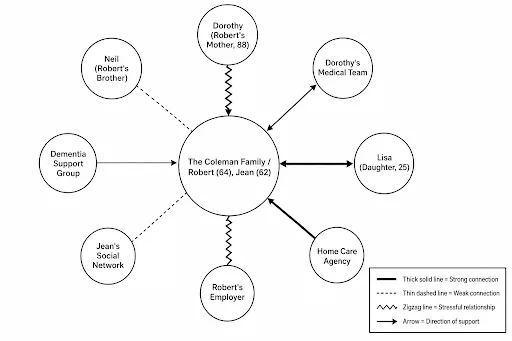
Robert and Jean Coleman are in their 60s and have been managing the care of Robert's mother Dorothy, 88, who has early dementia.
Their ecomap shows Dorothy's care as the dominant connection (a thick zigzag line carrying a heavy load toward the center) alongside a strong mutual connection with their daughter Lisa, a home care agency providing practical support, and a dementia support group that is still in the early stages of forming. Jean's social network appears as a dashed line: present but depleted since the caregiving began.
For the full explanation, see the ecomap example article.
How to Create a Family Ecomap
- Draw a large circle in the center: write the family members' names inside.
- Add outer circles: one for each significant external system the family is connected to.
- Draw connecting lines: solid for strong, dashed for weak, zigzag for stressful.
- Add directional arrows: show which way support flows on each connection.
- Include a key and a date: ecomaps are snapshots; the date anchors them to a specific point in time.
For a full step-by-step guide, see the ecomap guide. If you want a blank layout before building your own, use the ecomap template.
FAQ
What is a family ecomap?
A family ecomap is a diagram that places a family at the center and maps all the significant external systems in their life, e.g., schools, employers, healthcare providers, extended family, community organizations, and social services. It was developed by social worker Ann Hartman in 1978 and is widely used in social work, family therapy, nursing, and school counseling.
What is the difference between an ecomap and a genogram?
A genogram maps the family's internal structure and history across generations while the genogram looks inward and backward; the ecomap looks outward and at the present. The two are often used together at intake.
What are ecomaps used for?
Ecomaps are used to assess a family's support network, identify gaps in resources, and make the person-in-environment relationship visible. In clinical settings they are used at intake, during case review, and to track how a family's connections change over time. Families also use them independently in counseling or therapy to build self-awareness about their own support systems.
What is an ecomap in family medicine?
In family medicine, an ecomap is used as part of a holistic family health assessment to identify the social and environmental factors affecting a patient's health. It maps the patient's or family's connections to healthcare providers, community supports, employment, and other systems that influence health outcomes and treatment adherence. It is often used alongside a family genogram to give a complete picture of both the family's history and their current environment.
What does a family ecomap example look like?
A completed family ecomap has a large circle in the center containing the family members' names, surrounded by smaller labeled circles representing external systems. Thick solid lines connect the family to strong supportive relationships; thin dashed lines connect them to weak or underused ones; zigzag lines connect them to stressful systems. Arrows on each line show the direction of support.
Sources
- Diagrammatic assessment of family relationships. Social Casework, 59(8), 465–476.
- The Ecology of Human Development. Harvard University Press.