Appearance
Ecomap in Nursing: A Guide for Students and Practitioners
A nursing ecomap maps the environmental systems around a patient; who supports them, placing demands on them, and what resources are available or absent. It is a standard component of family health assessments in nursing programs and a practical tool in community health and discharge planning.
What an Ecomap Shows in Nursing
Nurses use ecomaps to make the social context of a patient's health visible before care planning begins.
- Healthcare access: which providers the patient is connected to, whether that connection is strong or fragile, and whether transportation or insurance gaps exist.
- Social support: who provides practical and emotional support, and whether those relationships are reciprocal or one-sided.
- Community resources: connections to community organizations, faith communities, and formal services.
- Environmental stressors: employment pressures, housing instability, financial strain, or conflictual relationships that affect recovery.
- Caregiver relationships: who will be present after discharge and whether that relationship is supportive.
The Calgary Family Assessment Model (CFAM), widely used in nursing education, includes the ecomap as a standard tool alongside the genogram for building a complete picture of a family's structure and environment.
For a full guide to ecomap symbols and how to draw one, see the ecomap guide.
What to Include in a Nursing Ecomap
The outer circles in a nursing ecomap represent the systems most relevant to the patient's health and recovery:
- Healthcare team: primary care physician, specialist, nurse navigator, pharmacist, etc.
- Family support: household members, caregivers, close family outside the household.
- Community services: home care agencies, meal delivery, transportation services.
- Employment and finances: employer relationship, financial stability, insurance status.
- Faith and community: faith community, support groups, community organizations.
- Stressors: any system placing active pressure on the patient, e.g., housing disputes, conflictual relationships, financial strain.
Include only the systems that are currently significant. An ecomap with six well-chosen outer circles is more useful than one with twelve.
A Completed Nursing Ecomap Example
The David Cross ecomap in the ecomap example article shows a 54-year-old patient managing colorectal cancer during active chemotherapy.
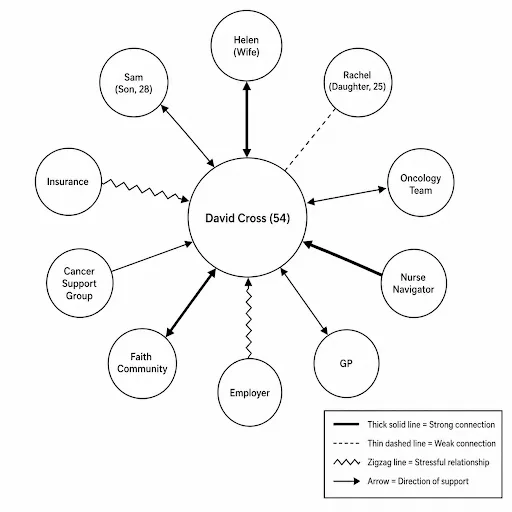
What it shows:
- Helen has a strong mutual connection; the most active reciprocal relationship in the diagram.
- Sam has a strong line pointing toward David.
- Rachel has a thin dashed line with no arrow.
- His clinical team (oncology, nurse navigator, and GP) all have solid lines pointing toward him.
- The faith community carries a strong mutual line.
- The employer and insurance both carry zigzag lines toward the center; two simultaneous stressors during active treatment.
- The cancer support group is a thin line, still forming.
The diagram shows a patient with solid clinical support and one strong informal mutual connection, two financial and institutional stressors running alongside treatment, and one distant adult child. That combination shapes the care plan before any clinical notes are written.
Ecomap and Genogram Together in Nursing
Most nursing family health assessments require both tools.
The genogram maps health history across generations; which conditions appear on which side of the family and what hereditary risks are present.
The ecomap maps the patient's current environment; what support is available and what is placing demands on them.
For a full guide to using both tools together, see the ecomap and genogram article.
How to Complete a Nursing Ecomap
For the full step-by-step process, see how to create an ecomap. For nursing assignments:
- Place the patient or family at the center - include all household members.
- Identify the relevant external systems - work through healthcare, family support, community, employment, and any formal services.
- Draw connecting lines - solid for strong, dashed for weak, zigzag for stressful. For a full reference, see the ecomap symbols guide.
- Add directional arrows - show which way support or demand flows on each connection.
- Add a key and the date - required for any submitted nursing assignment or clinical record.
FAQ
What is the purpose of an ecomap in nursing?
A nursing ecomap maps the environmental systems surrounding a patient. It makes the social determinants of health visible before care planning begins, showing what support the patient has available and where the gaps or pressures are. In community health nursing and discharge planning, it is used to assess what the patient is returning to after treatment.
How do you make an ecomap in nursing?
Place the patient or family in a large circle at the center. Add smaller circles for each significant external system. Connect each outer circle to the center with a line showing the relationship quality: solid for strong, dashed for weak, zigzag for stressful. Add directional arrows, a key, and the date.
What are the different types of ecomaps in nursing?
The format is the same across nursing contexts; what changes is who sits at the center and which systems are most relevant. A community health ecomap maps a patient's connections to community resources and social services. A family health assessment ecomap maps the entire household's environment. A discharge planning ecomap focuses on the support network the patient is returning to. In nursing education, the Calgary Family Assessment Model uses the ecomap as a standard family assessment tool.
What should a nursing ecomap include?
At minimum, the patient or family in the center circle, outer circles for each significant external system, connecting lines with appropriate styles, directional arrows, a key, and a date. For nursing assessments, the most important systems to include are the healthcare team, family and informal support network, community resources, employment and financial situation, and any active stressors.
What is the difference between an ecomap and a genogram in nursing?
A genogram maps the family's health history across generations while an ecomap maps the patient's current environment; which external systems they are connected to and how those connections are functioning right now. Most nursing family health assessment assignments require both: the genogram provides the historical and hereditary context; the ecomap provides the environmental and social context.
Sources
- Diagrammatic assessment of family relationships. Social Casework, 59(8), 465–476.
- Nurses and Families: A Guide to Family Assessment and Intervention (6th ed.). F.A. Davis Company.