Appearance
3 Family Ecomap Examples
These three completed ecomaps show what a family ecomap looks like across three common family structures; nuclear, single-parent household, and a multigenerational family living together.
Example 1 - Nuclear Family
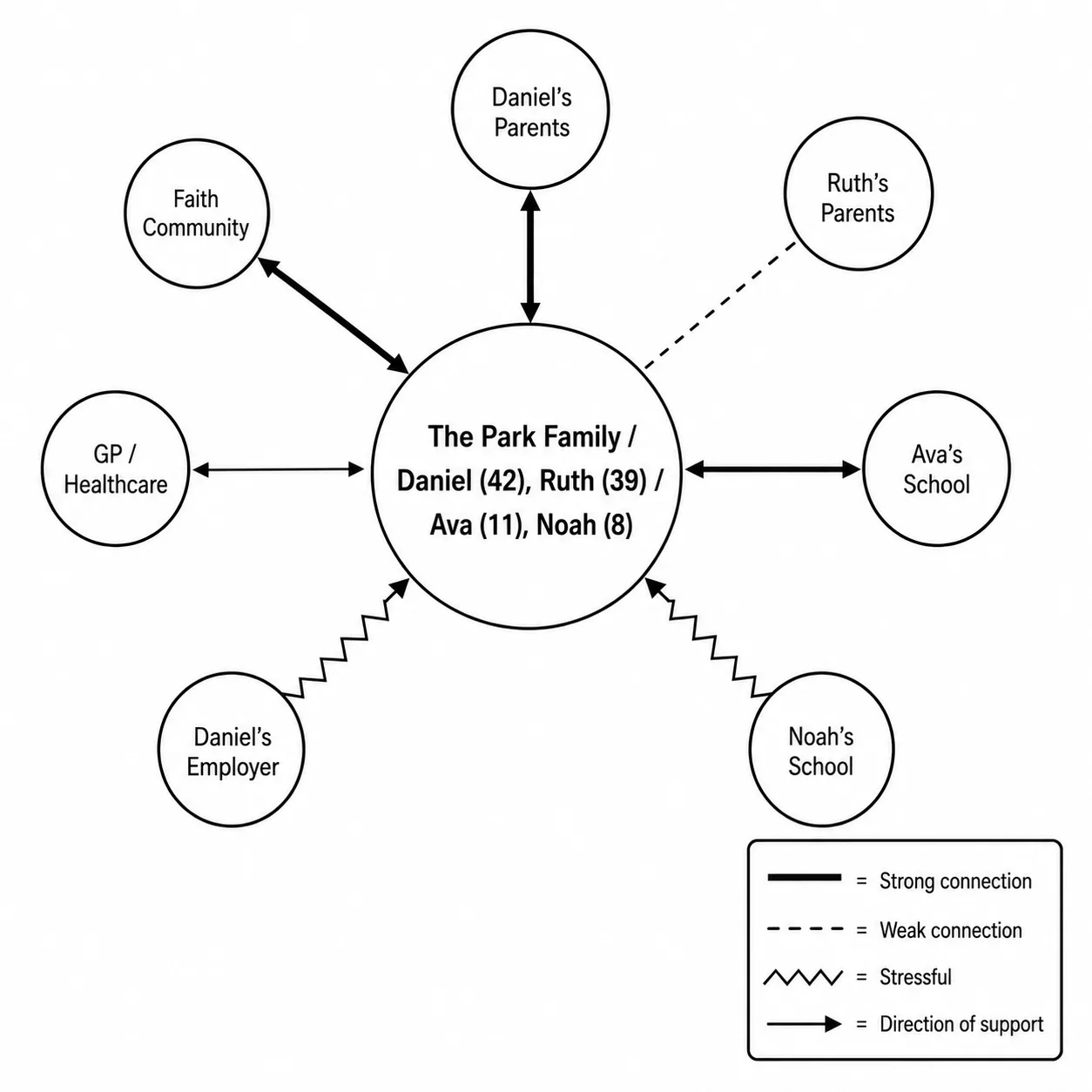
The Park family consists of Daniel, 42, and his wife Ruth, 39, with two children: Ava, 11, and Noah, 8. Daniel works full-time; Ruth works part-time and manages most of the household and school logistics.
The connections:
- Daniel's parents - mutual, strong. They live nearby and help regularly with childcare.
- Ruth's parents - dashed, no arrow. Ruth's parents are overseas; contact is limited to occasional video calls.
- Ava's school - mutual. Ava is settled and the school relationship is positive.
- Noah's school - stressful, toward center. Noah has recently been flagged for behavioral concerns.
- Daniel's employer - stressful, toward center. Demanding hours with limited flexibility.
- GP/healthcare - mutual, thin. The family is registered and attends when needed, but it is not a frequent connection.
- Faith community - mutual, strong. The family attends regularly and Ruth is involved in a parents' group there.
What this ecomap shows:
- Daniel's parents and the faith community are the two strongest mutual connections outside the household. Both give and receive. Ruth's parents are on the diagram but distant.
- Noah's school and Daniel's employer both send stressful lines toward the center simultaneously. A behavioral concern at school alongside inflexible work hours creates pressure as the parent who is available is being pulled in two directions at once.
Example 2 - Single-Parent Family
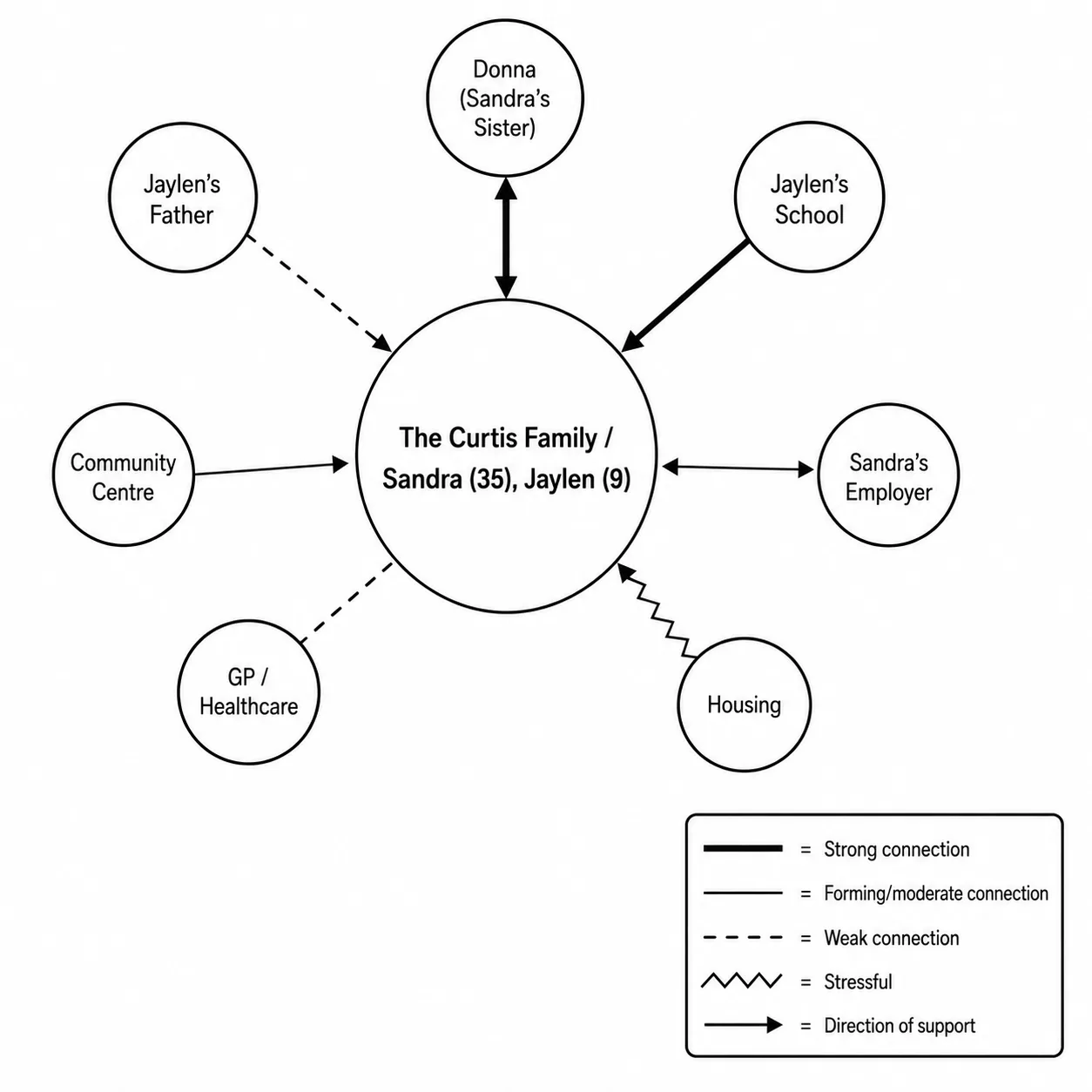
Sandra Curtis is 35 and a single mother to Jaylen, 9. She separated from Jaylen's father two years ago. He has minimal contact. Sandra works part-time and relies heavily on her sister Donna for childcare support.
The connections:
- Donna (Sandra's sister) - strong, mutual. The primary informal support. Provides childcare three days a week.
- Jaylen's father - dashed, arrow pointing toward center. Sporadic contact for occasional child support payments and infrequent visits.
- Jaylen's school - strong, toward center. A stable connection; Jaylen is doing well.
- Sandra's employer - mutual, thin. Part-time hours work around school pickups, but there is no flexibility for illness.
- Housing - stressful, toward center. Sandra is in a private rental with an upcoming rent review she is worried about.
- GP/healthcare - dashed, no arrow. Sandra has not had a GP appointment for herself in over a year, though Jaylen is registered.
- Community centre - thin solid, toward center. Jaylen attends an after-school program twice a week.
What this ecomap shows:
- Donna carries the weight of informal support in this diagram. The entire informal support network runs through one person. If Donna's availability changes, Sandra has very little else to draw on.
- Jaylen's father is present on the diagram but his line is dashed and points only intermittently toward the center.
- Sandra's own GP line is dashed with no arrow. She is maintaining Jaylen's healthcare access while not accessing her own. That pattern appears clearly in the diagram.
Example 3 - Multigenerational Household
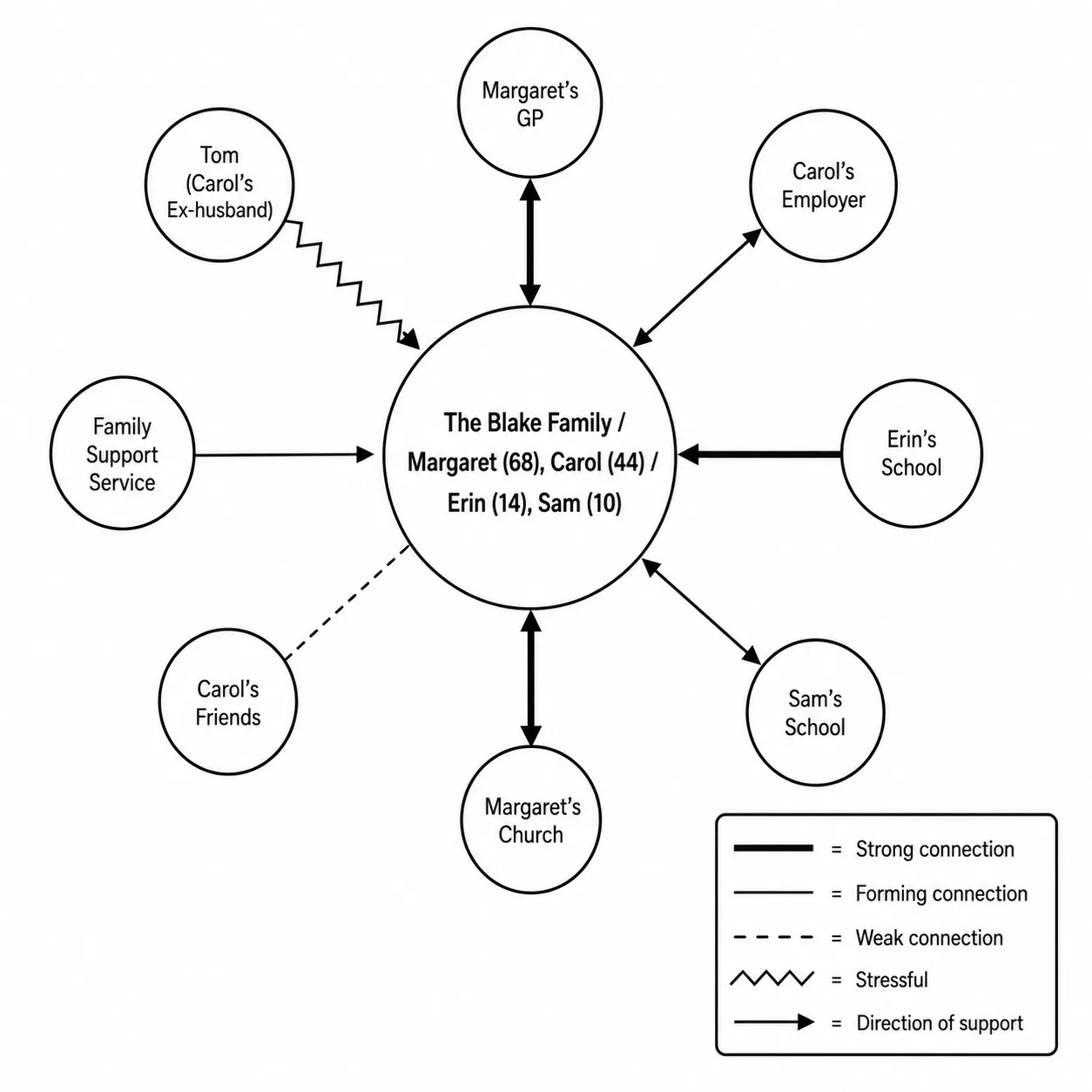
Margaret Blake is 68 and lives with her daughter Carol, 44, and Carol's two children: Erin, 14, and Sam, 10. Carol separated from her husband three years ago. The household has been sharing finances and household responsibilities since then.
The connections:
- Carol's ex-husband (Tom) - stressful, toward center. An ongoing custody disagreement creates intermittent pressure on the household.
- Margaret's GP - mutual, strong. Margaret has regular appointments and a well-managed health condition.
- Carol's employer - mutual. Full-time work; the income is essential to the household.
- Erin's school - strong, toward center. Erin is in secondary school and settled.
- Sam's school - mutual. No concerns noted.
- Margaret's church - strong, mutual. A consistent connection for Margaret; she attends weekly.
- Carol's friends - dashed, no arrow. Carol has maintained limited contact with her social network since the separation.
- Family support service - thin solid, toward center. Carol was referred following the separation; she attended four sessions and then stopped.
What this ecomap shows:
- The household has three people with different connection needs appearing in the same center circle. Margaret has her own strong connections (church, GP) that are hers, not the household's. But Carol's connections are work-focused. The children's connections run through their schools. The ecomap shows a household that functions but has distinct internal layers.
- Carol's social network is a dashed line. The family support service is a thin line with no arrow pointing away from the center; Carol was receiving support but not reciprocating engagement, and she stopped attending. Both lines mark the social withdrawal that followed the separation.
- Tom appears with a stressful line pointing toward the center. He is not in the household but his presence is active in it.
For a full guide to building and reading ecomaps, see the ecomap guide. If you want a blank starting point before adapting one of these examples, use the ecomap template.
How to Build a Family Ecomap
- Draw a large circle at the center - write the family members' names inside.
- Add outer circles - one for each significant external system.
- Draw connecting lines - solid for strong, dashed for weak, zigzag for stressful. For a full reference of line types, see the ecomap symbols guide.
- Add directional arrows - mark which way support flows on each connection.
- Add a key and a date - ecomaps are snapshots; the date anchors the diagram to a specific point in time.
FAQ
What is a family ecomap example?
A family ecomap example is a completed diagram showing a family at the center, connected to the external systems in their life. Lines show whether each connection is strong, weak, or stressful, and arrows show which direction support flows.
How do I draw a family ecomap?
Place the family in a large circle at the center. Add smaller labeled circles around it for each significant external system. Connect each outer circle to the center with a line. Include a key listing every symbol used and add the date.
What should a family ecomap include?
At minimum, the family members in the center circle, outer circles for each significant external system, connecting lines showing relationship quality, directional arrows, and a key. Common outer circles include extended family, schools, employers, healthcare providers, faith communities, housing, and any formal services involved with the family. Include only the systems that are currently significant rather than every possible connection.
Can I use a family ecomap example for a student assignment?
Yes. The examples on this page show three completed family ecomaps across different family structures. Use them as a reference for format, connection types, and annotation.
What is the difference between a family ecomap and a family genogram?
A family genogram maps the internal structure of the family across generations; who is related to whom, health history, and the quality of relationships between family members. A family ecomap maps the family's external environment; which outside systems they are connected to and how those connections are functioning right now. Genograms look inward and across time; ecomaps look outward at the present. The two are often used together in clinical and educational settings.
Sources
- Diagrammatic assessment of family relationships. Social Casework, 59(8), 465–476.
- The Ecology of Human Development. Harvard University Press.