Appearance
Clinical Ecomap
A clinical ecomap is the same diagram as a standard ecomap used in a formal care or assessment setting. What changes is what the context requires.
What Makes an Ecomap "Clinical"
The diagram is identical to any other ecomap, but the clinical context adds four requirements:
- Standardized notation: Hartman's original conventions so that any clinician reading the diagram can interpret it without asking. Improvised symbols or unlabeled lines are not appropriate in a clinical record.
- Part of the formal record: a clinical ecomap is dated and filed alongside other assessment documents. It is not a worksheet or a conversation tool that gets discarded after the session.
- Longitudinal use: a clinical ecomap completed once has limited value. Its value increases when completed at intake and then repeated at defined intervals; typically 30, 60, and 90 days, so the team can see whether the client's support network is building or contracting.
- PHI handling: client data on the diagram is protected health information. It should be stored and shared in line with the same data handling requirements as other clinical documentation.
Clinical Settings Where Ecomaps Are Used
- Social work intake: mapping a client's full support network and stressor landscape before assessment or case planning begins.
- Behavioral health and mental health: assessing isolation patterns, treatment network strength, and environmental stressors alongside therapeutic supports.
- Community and public health nursing: mapping the systems around a patient that affect health outcomes and recovery environment.
- Family medicine: used alongside the family genogram to give the physician a picture of both the family's health history and their current social context.
- Hospital social work: discharge planning, mapping what the patient is returning to after inpatient treatment.
- Case management: tracking whether a client's resource connections are strengthening or eroding over time.
Completed Clinical Ecomap Examples
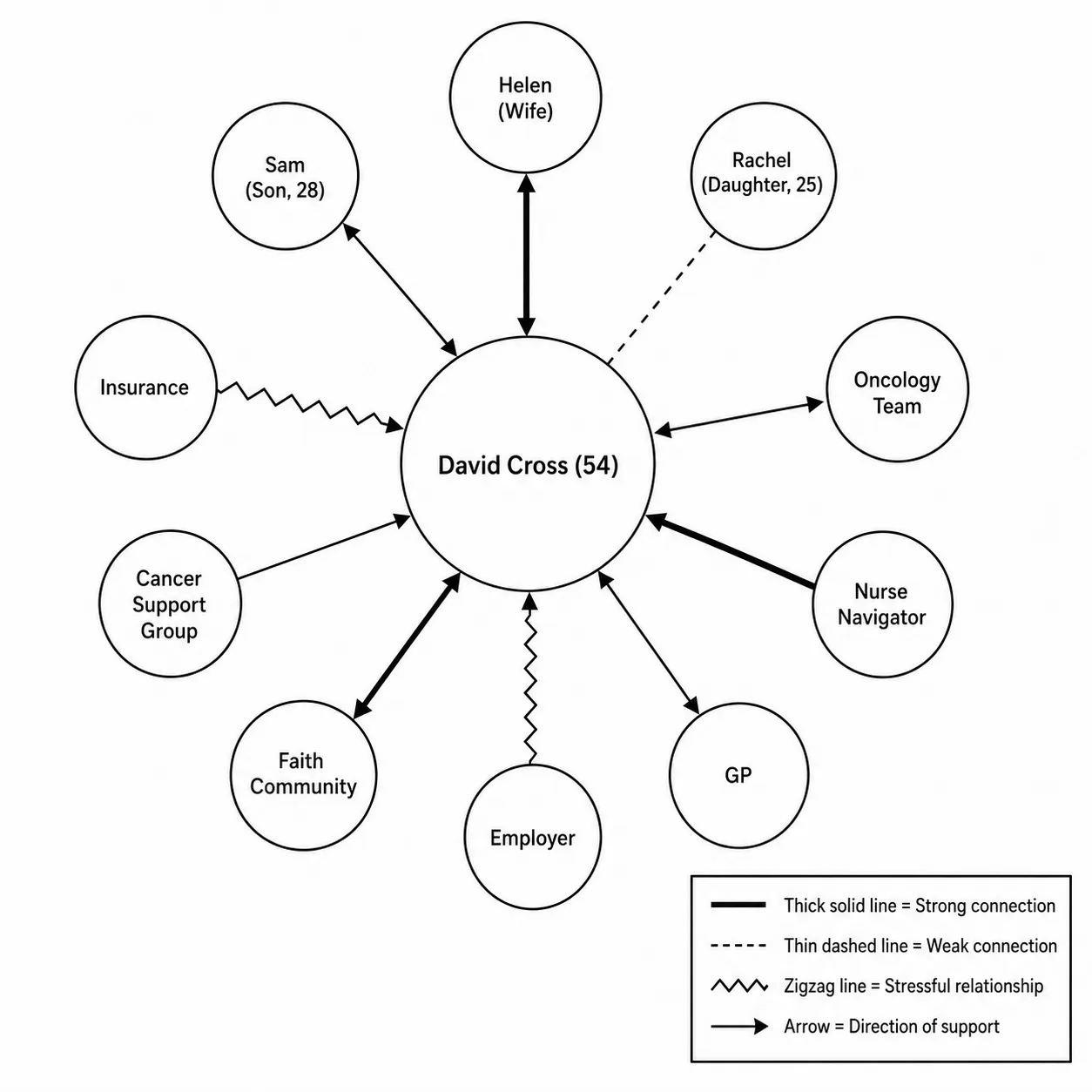
The David Cross ecomap in the ecomap example article shows a nursing assessment for a 54-year-old patient in active cancer treatment. It maps his oncology team, nurse navigator, GP, wife, adult children, faith community, cancer support group, employer, and insurance, with two simultaneous stressors alongside a strong clinical team and one primary informal connection.
The James Reid ecomap in the ecomap for addiction recovery article shows a 60-day recovery review for a client in outpatient treatment. It maps his full recovery support system alongside former using peers and a difficult family connection; the two sides of the recovery environment in the same diagram.
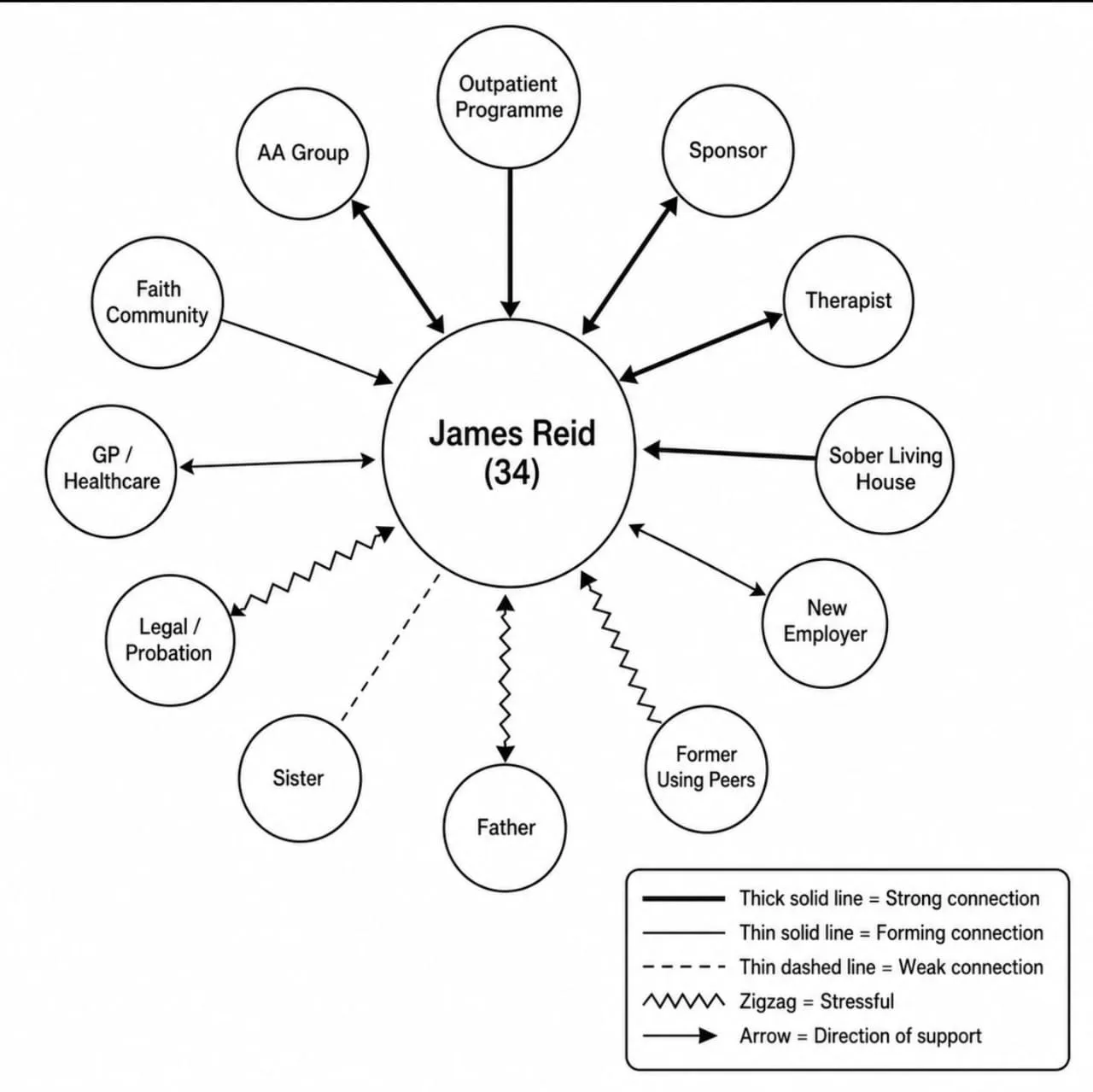
Both follow standard Hartman notation and are formatted for clinical record use.
How to Create a Clinical Ecomap
- Place the client at the center - individual or family unit, with names.
- Identify all significant external systems - include stressors and gaps, not only supportive connections.
- Draw connecting lines using standard notation - solid for strong, dashed for weak, zigzag for stressful. For the full reference, see the ecomap symbols guide.
- Add directional arrows, a key, and the date - all three are required for a document entering the clinical record.
For the full step-by-step process, see how to create an ecomap. You can create one using this blank template.
FAQ
What is a clinical ecomap?
A clinical ecomap is an ecomap completed as part of a formal clinical or care management assessment. The diagram uses the same structure as any ecomap but it is completed using standardized Hartman notation, dated, filed in the clinical record, and updated at defined intervals to track changes in the client's support network over time.
How is a clinical ecomap different from a standard ecomap?
The diagram is identical. What differs is the context, as a clinical ecomap uses standardized notation, is part of the formal client record, is dated for longitudinal tracking, and requires appropriate PHI handling. A standard or personal ecomap may use informal labels or improvised notation; a clinical ecomap cannot.
What settings use clinical ecomaps?
Social work intake, behavioral health, community nursing, family medicine, hospital social work, and case management. In any clinical setting where understanding a client's social environment is part of assessment or care planning, the ecomap is a relevant tool.
How often should a clinical ecomap be updated?
At minimum, at intake and at 30, 60, and 90 days. In longer-term case management or treatment, quarterly updates are common. Each version should be dated and retained alongside the previous ones; the comparison between versions is where the most clinically useful information often sits.
Where can I find a free clinical ecomap template?
You can find a free ecomap template on Qwoach. It is a blank template and free to download. ::: :::sources title: Diagrammatic assessment of family relationships. Social Casework, 59(8), 465–476. author: Hartman, A. year: 1978 title: Eco-maps: A systems tool for family physicians. Journal of Family Practice, 24(4), 405–408. author: Jenson, K. year: 1987