Appearance
Ecomap for Addiction Recovery
Addiction counseling assignments and clinical placements often require an ecomap that captures both a client's support network and their risk environment. A recovery ecomap maps both in the same diagram using the same symbols as a standard ecomap.
What an Ecomap Shows in Addiction Recovery
- Recovery capital: the strength and breadth of formal and informal supports actively contributing to sobriety.
- Stress and trigger landscape: the connections placing demands on the client or creating relapse risk.
- Gaps in sober network: connections that should exist but don't yet, such as a sponsor, peer support, stable housing, etc.
- Protective factors: the connections that are holding even when others are under strain.
Two Categories to Map
Recovery support systems
- Mutual aid group (AA, NA, SMART Recovery)
- Sponsor or recovery mentor
- Outpatient or residential treatment program
- Therapist or counselor
- Prescriber for MAT (medication-assisted treatment) where applicable
- Sober peers
- Stable housing
- Employment or vocational support
- Faith or spiritual community
Stress and trigger landscape
- Former using peers; still in contact or recently separated
- Conflicted or enabling family relationships
- Legal involvement; probation, court appearances, outstanding charges
- Financial pressure
- Unstable housing
- Untreated co-occurring mental health conditions
- Workplaces or environments associated with prior use
A Completed Recovery Ecomap Example
James Reid is 34 and 60 days into early recovery following a residential detox. He is now attending an intensive outpatient programme three days a week. His counselor completed this ecomap at the 60-day review.
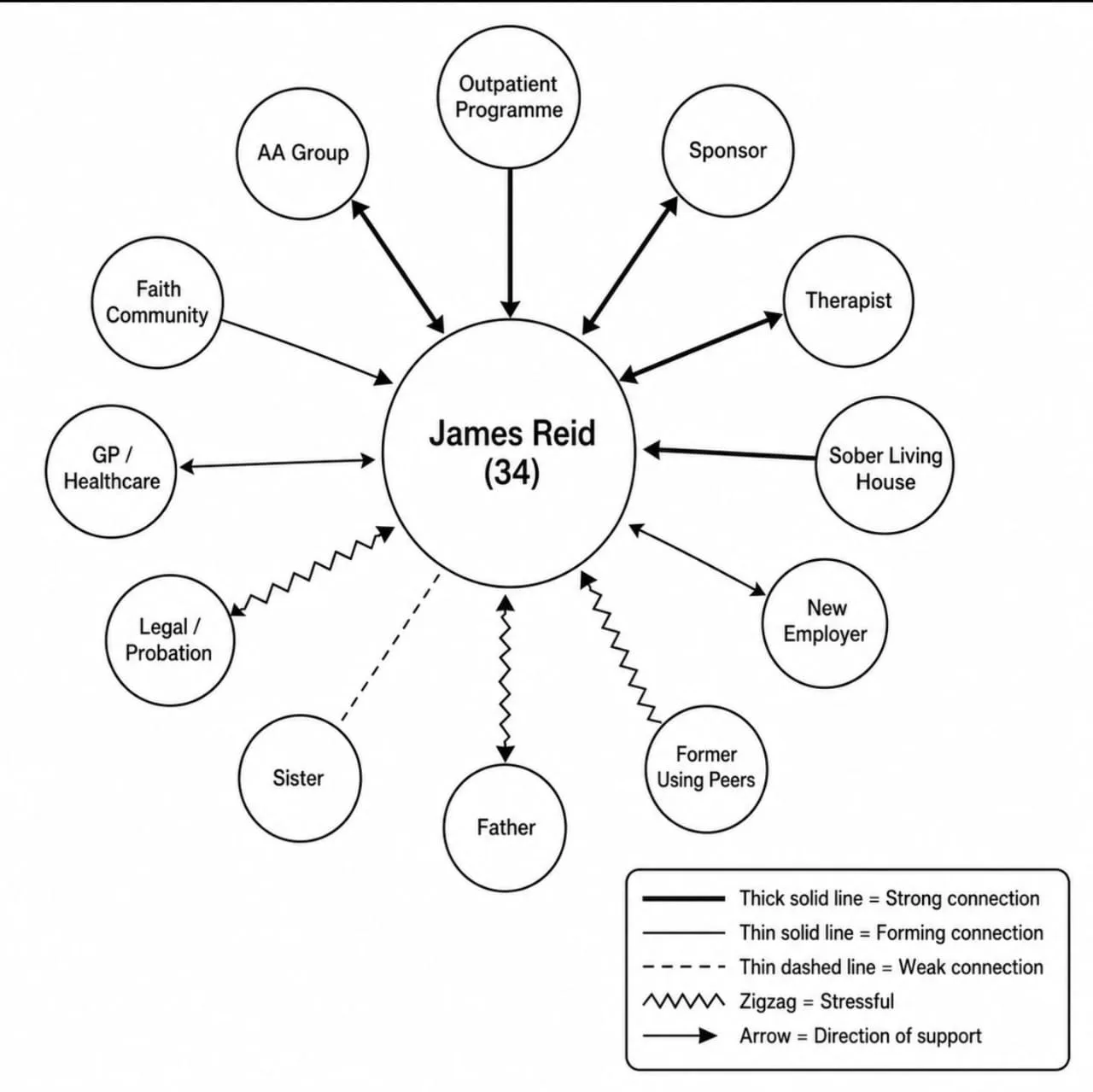
The connections:
- Outpatient programme: strong, toward center. Consistent attendance. The primary formal support.
- AA group: strong, mutual. James attends four meetings a week and has built relationships within the group.
- Sponsor: strong, mutual. Daily contact. The strongest individual connection in the diagram.
- Therapist: strong, mutual. Weekly sessions ongoing.
- Sober living house: strong, toward center. Stable housing since discharge from residential.
- New employer: thin solid, mutual. Two weeks into a part-time role. Still forming.
- Former using peers: stressful, toward center. Two former contacts still initiating contact. James has not fully separated from these connections.
- Father: stressful, mutual. An active but difficult relationship. History of conflict during active addiction. Currently in contact but the relationship is under strain.
- Sister: dashed, no arrow. Minimal contact since James entered recovery. The connection exists but carries no active energy in either direction.
- Legal/probation: stressful on both ends. James has a probation check-in monthly. The obligation is a stressor.
- GP/healthcare: thin solid, mutual. Registered and attended once. The connection is present but not yet embedded.
- Faith community: thin solid, toward center. James started attending a church six weeks ago. Still forming.
What this ecomap shows:
- The recovery support side of the diagram is well-developed for 60 days; four solid connections (programme, AA, sponsor, therapist) and stable housing. The network exists and is active.
- Two former using peers appear with stressful lines toward the center. They sit in the same diagram as the sponsor and the AA group. The relapse risk is there.
- The father line is stressful and mutual; energy moving in both directions in a difficult relationship. That is different from the sister's dashed line with no arrow. Both are under strain; they are under strain in different ways.
- The new employer is a thin solid line. At two weeks it is still forming. At the 90-day review, a counselor would look for whether that line has thickened or disappeared.
For a full guide to building and reading ecomaps, see the ecomap guide. For clinical documentation and repeat review cadence, see clinical ecomap.
Using the Ecomap Over Time
A recovery ecomap completed at intake and again at 30, 60, and 90 days shows whether recovery capital is building or contracting. What to look for between versions:
- Lines thickening: a thin forming connection becoming a solid mutual line indicates the relationship has become active.
- Stressful lines that have not changed: a former using peer still carrying a zigzag at 90 days is a clinical concern that the diagram makes visible without requiring the client to raise it.
- New outer circles appearing: a faith community, a new employer, or a sober peer added between reviews indicates the network is expanding.
- Lines that have disappeared: a connection that was present at 30 days and absent at 90 may indicate a severed relationship worth discussing.
How to Create a Recovery Ecomap
- Place the client at the center - individual or household.
- Map the recovery support systems first - mutual aid, sponsor, treatment, therapist, housing, employment.
- Map the stress and trigger landscape - former using connections, difficult family relationships, legal involvement, financial pressure.
- Add directional arrows, a key, and the date - for line type reference, see the ecomap symbols guide.
For the full step-by-step process, see how to create an ecomap. You can also use this blank ecomap template.
FAQ
What is an ecomap in addiction recovery?
A recovery ecomap is a diagram that maps a client's support systems and stress factors in the same picture. It gives a counselor a complete view of the client's recovery environment at a specific point in time. It is used at intake and updated at regular intervals to track how recovery capital is changing.
What should be included in a recovery ecomap?
Two categories of connections, which are; recovery support systems (mutual aid group, sponsor, treatment programme, therapist, prescriber where applicable, sober peers, stable housing, employment) and the stress and trigger landscape (former using peers, conflicted or enabling family relationships, legal involvement, financial pressure, untreated co-occurring conditions).
How is an ecomap used in substance abuse treatment?
In addiction treatment, ecomaps are used at intake assessment to establish the client's current support network and risk environment, and then repeated at regular intervals — typically 30, 60, and 90 days — to track whether recovery capital is building. They help clinicians identify where to direct intervention: strengthening a weak connection, addressing a stressor, or supporting the client in separating from a former using relationship.
How often should a recovery ecomap be updated?
At minimum; at intake and at the 30, 60, and 90-day marks. In longer-term treatment, quarterly reviews are common. Each update should be dated and filed alongside the previous versions; the comparison between them is where the clinically useful information often sits.
What is recovery capital and how does an ecomap measure it?
Recovery capital refers to the resources a person has available to support sobriety, such as social, community, physical, and human. An ecomap measures it visually; the number and strength of solid mutual lines on the recovery support side of the diagram is a picture of recovery capital at a specific point in time. A diagram with four strong mutual connections and stable housing shows more recovery capital than one with a single professional connection and no informal support.
Sources
- Diagrammatic assessment of family relationships. Social Casework, 59(8), 465–476.
- Peer-based addiction recovery support: History, theory, practice, and scientific evaluation. Great Lakes Addiction Technology Transfer Center.