Appearance
Ecomap History
The ecomap was developed by Ann Hartman, a social work professor at the University of Michigan, in 1975. She published the method three years later in Social Casework. The notation she established in that 1978 paper (circles, line styles, directional arrows) is still the standard today.
The Problem Hartman Was Solving
Social work in the 1970s operated under what the field called the person-in-environment perspective: a client's situation could not be understood apart from the systems surrounding them. Case files were supposed to capture that picture.
The problem was that case files were narrative. A worker could read several pages about a family and still not have a clear view of who was supporting them, what was placing demands on them, or where the gaps were. The narrative format required the reader to construct the relational picture themselves.
Hartman was teaching child welfare students to apply the person-in-environment framework and finding that the narrative case note wasn't making it visible or actionable. So she designed a diagram.
Diagrammatic Assessment of Family Relationships
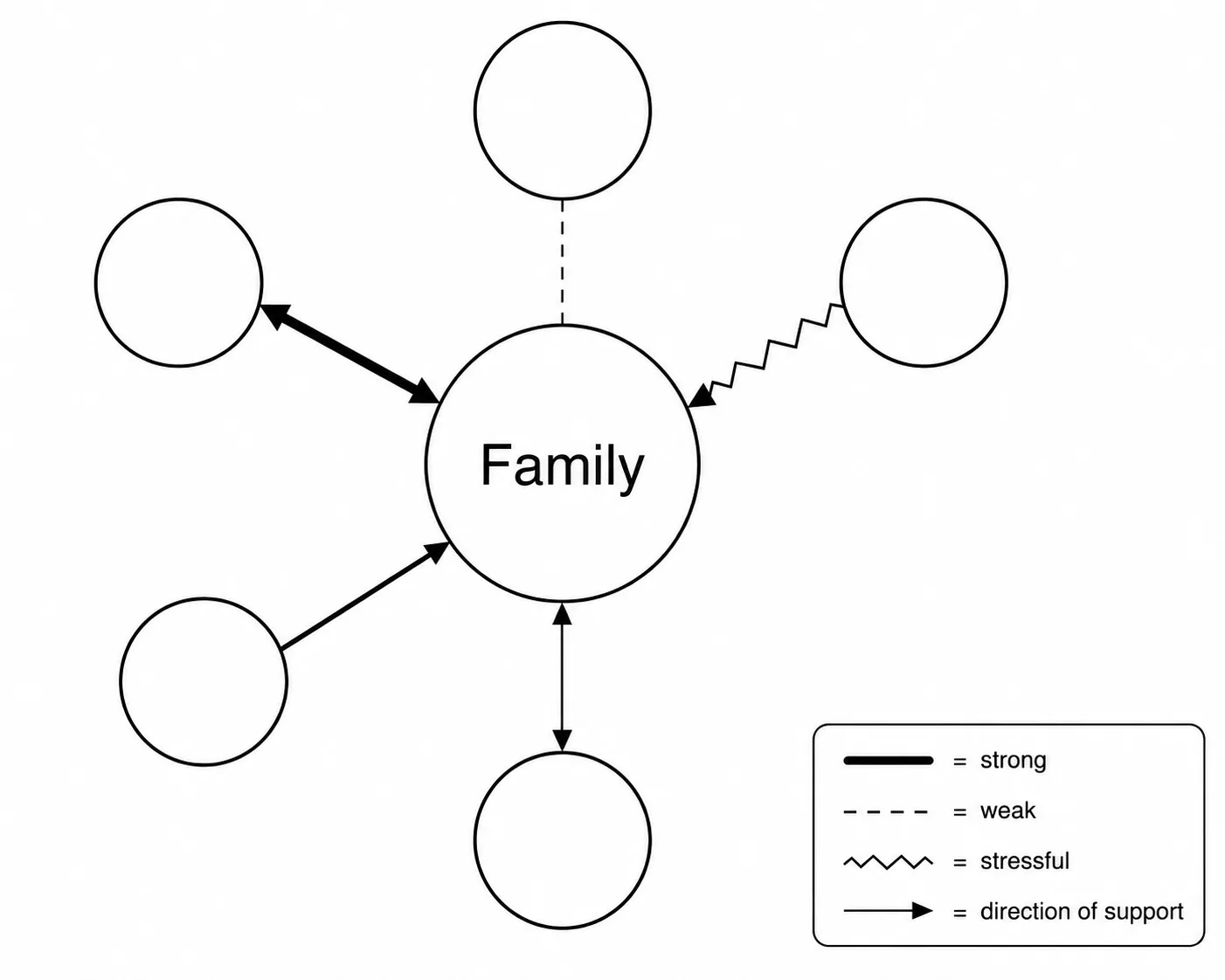
Hartman published the method in Social Casework in 1978. The article established the notation that is still in use:
- A large circle at the center for the individual or family.
- Smaller circles around the outside for each external system.
- Solid lines for strong connections.
- Dashed lines for weak or fragile ones.
- Zigzag lines for stressful relationships.
- Arrows to show which way support flows.
The same paper introduced the genogram to clinical social work practice alongside the ecomap.
Hartman presented the two tools as a pair; the genogram for the family's internal history across generations, the ecomap for the family's current environment.
Why the Ecomap Design Has Lasted
The notation from 1978 has not changed. Several choices made it practically durable:
- Line weight instead of color: case files in the 1970s were photocopied in black and white. A thick solid line and a dashed line survive photocopying. Color-coded lines would not have.
- A small symbol set: the whole system can be explained in two minutes. A tool that requires a reference sheet is a tool practitioners stop using in busy agency settings.
- Drawn with the client: Hartman designed the ecomap to be completed in session alongside the client. A client who has drawn their own ecomap has a different relationship to what it shows than one who had it completed for them in a back office.
- No training required to read it: any colleague picking up a file with a dated ecomap can interpret it without asking. That made it useful as a record, not just as a clinical moment.
What the Ecomap Changed
A typical 1970s child welfare case note might read:
"Mrs. C. is a 34-year-old single mother of three. She has some support from her mother who lives nearby, though the relationship is complicated. Her employer has been flexible about her hours but this may change. She has contact with a school social worker and a community health nurse. Relations with the children's father are poor."
The same information as an ecomap shows:
- a strong but stressful line to the maternal grandmother
- a thin mutual line to the employer with visible fragility
- solid lines to the school social worker and health nurse,
- and a zigzag line to the father.
A caseworker reading the diagram sees at a glance where the stability is, where the pressure sits, and what to ask about at the next visit, while the narrative note requires the reader to build that picture themselves.
How the Ecomap Spread
Child welfare agencies adopted the ecomap first; Hartman had developed it there, and the context made its value obvious. A diagram showing a child's full system in one page was useful in case reviews, court documentation, and care planning.
Through the late 1980s and 1990s, it moved into nursing and healthcare. Nursing adopted it as part of family health assessment, where a patient's home environment was directly relevant to treatment and discharge planning. Family medicine programs began pairing it with the genogram.
By the early 2000s it was standard across nursing and social work education in the United States, United Kingdom, Australia, and New Zealand.
Where It Stands Today
The ecomap remains standard practice in social work, nursing, behavioral health, family medicine, and case management. The notation has not changed since 1978.
Digital tools have made it easier to build, update, and archive ecomaps in clinical settings. The diagram is the same.
For a guide to using the ecomap in current practice, see the ecomap guide. For its role in current formal record-keeping, see clinical ecomap.
FAQ
When was the ecomap developed?
Ann Hartman developed the ecomap in 1975 at the University of Michigan. She published the method in *Social Casework* in 1978, in a paper titled "Diagrammatic Assessment of Family Relationships." The notation established in that paper is still the standard used in clinical practice today.
Who created the ecomap?
Ann Hartman, a social work professor and researcher at the University of Michigan. She developed the ecomap as a practical tool for child welfare workers who needed a way to make a client's social environment visible in a single diagram. She introduced it alongside the genogram in her 1978 paper.
What was the ecomap originally designed for?
Child welfare practice. Hartman was working with social workers who needed to assess the full system around a family in a format that was faster and clearer than a narrative case note. The tool spread beyond child welfare into nursing, mental health, addiction treatment, and healthcare.
How did the ecomap become a clinical standard?
Child welfare agencies adopted it first, then nursing and healthcare education picked it up through the 1980s and 1990s. The design choices Hartman made with standardized notation, no specialist training required to read it, drawn in session with the client, made it practical enough for agencies to keep using rather than replacing.
What is the difference between an ecomap and a genogram?
A genogram maps the family's internal structure and history across generations, while an ecomap maps the family's current external environment. Hartman introduced both tools in the same 1978 paper.
Sources
- Diagrammatic assessment of family relationships. Social Casework, 59(8), 465–476.
- The Ecology of Human Development. Harvard University Press.