Appearance
Family History Genogram
A family history genogram maps lineage, occupations, migration, and major life events across generations, turning scattered documents, photos, and half-remembered family stories into a single visual record.
Why a Genogram Works for Family History Research
A standard family tree records who was born to whom.
A genogram adds more to the same structure; what people did for work, where and when they moved, marriages that came before the ones a family remembers, and the relationships that shaped how the family actually functioned.
For genealogy research specifically, that extra layer is often where the more interesting patterns sit, not just names and dates, but what changed from one generation to the next and why.
The Whitcombe Family
Family History Genogram
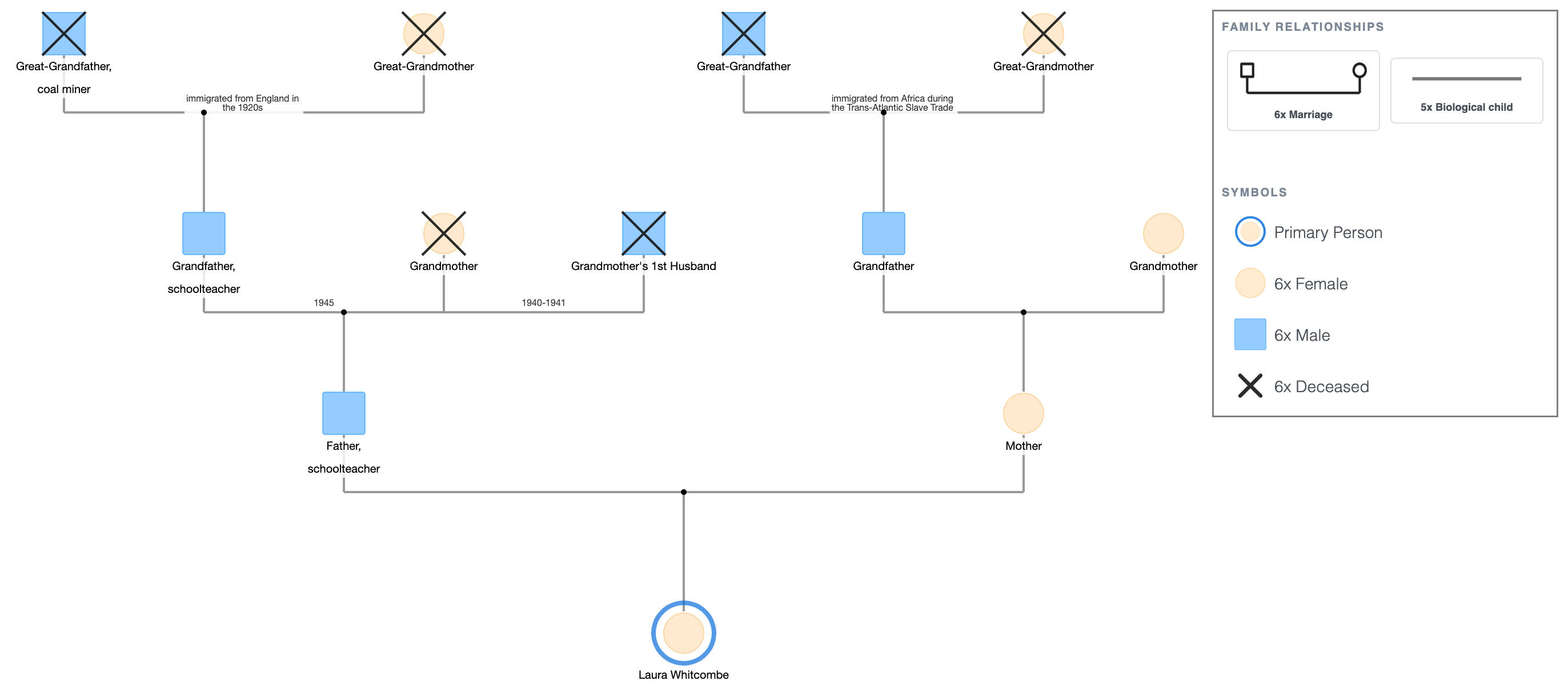
- Great-grandparents: immigrated from England in the 1920s; great-grandfather worked as a coal miner.
- Grandfather: schoolteacher (occupational shift from mining).
- Grandmother: brief first marriage and early widowhood, uncovered through research, never discussed in the family.
- Parents: father continued teaching; mother's side introduces a separate immigration line.
- Laura Whitcombe: primary person, researching the family history.
Laura Whitcombe started building this genogram after inheriting a box of letters and photographs following her grandmother's death.
She knew the basic outline of her family, a mining town in England, an eventual move to teaching, but the details had never been organized in one place.
Working through old records and family stories, she started filling in the diagram generation by generation.
What the Genogram Revealed
The occupational pattern was the first thing that stood out once it was laid out visually: her great-grandfather had worked in the mines his entire life, the same trade his own father had held, and then her grandfather broke from it entirely to become a schoolteacher, a shift big enough that it shaped the family's trajectory for two more generations.
Her mother's side, once added to the same diagram, introduced a completely separate immigration story, a different origin merging into the family only at Laura's parents' generation.
The most striking find came from a marriage record Laura hadn't expected: her grandmother, who the family had always assumed married only once, had actually been briefly married before, widowed young, and never spoke of it again.
Nothing in family conversation had ever hinted at this.
It surfaced only because the genogram prompted Laura to check a record she otherwise wouldn't have gone looking for.
The genogram also made clear what she still didn't know, gaps in the diagram that pointed directly to which records to search for next.
Build One for Your Own Family History
Start with what you know and work backward, generation by generation, rather than trying to fill in every branch at once.
Note occupation, migration, and major life events for each person as you confirm them, and mark anything uncertain or disputed rather than guessing.
Genealogy research often turns up conflicting information between relatives' memories and official records; note both rather than picking one version prematurely.
Export the diagram as you go so it stays a usable reference rather than a pile of scattered notes.
For the full guide, see How to Make a Genogram.
Family History Genogram
Explore this genogram and adapt it to your needs.
FAQ
Is there a template for a family history genogram?
Yes. Start from a blank three- or four-generation structure and fill in names, occupations, and life events as you confirm them through research. The structure works the same whether you're documenting two generations or six.
What if family members remember an event differently than official records show?
Note both versions rather than resolving the discrepancy immediately. A disagreement between family memory and a written record, like Laura's grandmother's undiscussed first marriage, is often meaningful information in its own right.
Can a genogram maker generate a family history genogram automatically?
Some tools can build a basic structure from a list of names and relationships, but occupation, migration, and life event details still need to be added and verified manually, since that's usually the research-heavy part of the project.
How is a family history genogram different from a medical family history genogram?
A medical family history genogram focuses on hereditary health conditions across generations. A family history genogram for genealogy purposes focuses on lineage, occupation, migration, and life events instead, though the same diagram structure supports either angle.
What's the best way to show a fact that isn't fully confirmed?
Mark it clearly as unconfirmed or disputed rather than presenting it as settled fact. Genealogy research often involves conflicting records or family accounts, and the diagram should reflect that uncertainty honestly rather than smoothing it over.
Sources
- Genograms: Assessment and Intervention (4th ed.)