Appearance
Family Health History Genogram
Map every hereditary thread running through a family at once, not just one condition, and keep them distinct enough on the diagram that a doctor or the person building it can trace each one separately.
The Sutcliffe Family
Family Health History Genogram
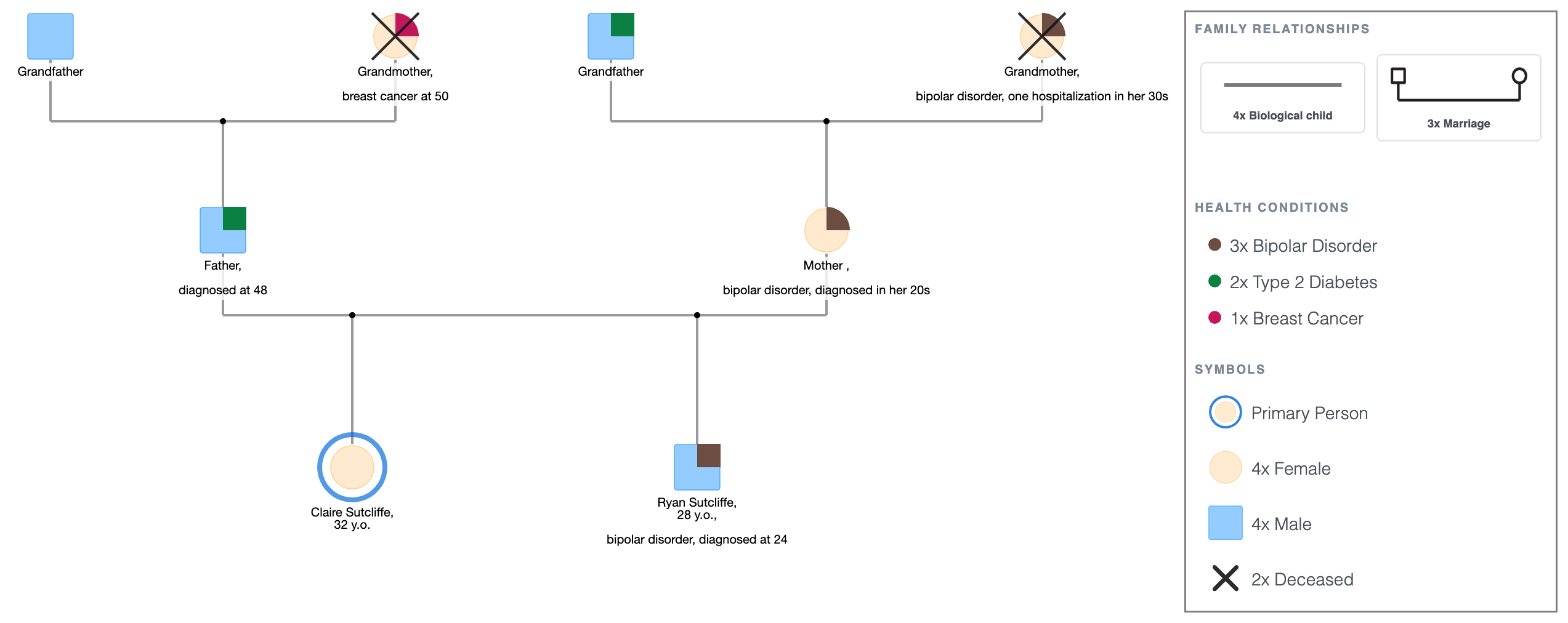
- Paternal: grandmother (deceased, breast cancer at 50); grandfather (no significant history).
- Maternal: grandmother (bipolar disorder, one hospitalization in her 30s); grandfather (type 2 diabetes).
- Gen 2: father (type 2 diabetes, diagnosed at 48); mother (bipolar disorder, diagnosed in her 20s).
- Gen 3: Claire Sutcliffe (32, primary person, no diagnoses); Ryan Sutcliffe (28, bipolar disorder, diagnosed at 24).
Claire Sutcliffe is 32 and started building this genogram after her brother Ryan's bipolar diagnosis made her want the full picture, not just his side of it.
Once she had all four grandparents mapped, three separate threads showed up: her paternal grandmother's breast cancer, her maternal grandfather's type 2 diabetes, which her own father now also carries, and her maternal grandmother's bipolar disorder, which surfaced again in Ryan one generation later.
None of the three threads relate to each other.
That's precisely why they needed to be on the same diagram rather than three separate ones, since Claire's own risk picture depends on seeing all three at once, not on treating each side of the family as a separate concern.
How to Interview Relatives for This
Start with the questions that are easiest to answer factually:
- who's had what condition
- at what age, and
- if a relative has passed, what the cause of death was and at what age.
Cardiovascular and metabolic conditions like Claire's father's diabetes are usually the easiest starting point since they're rarely private information.
Mental health and substance use questions need a different approach.
Asking "did anyone in the family ever struggle with their mental health" tends to get further than asking about a specific diagnosis by name, especially with older relatives who may not have used clinical terms for what they experienced.
Claire learned about her maternal grandmother's hospitalization by asking her mother what "having a hard time" meant in family stories she'd heard growing up, not by asking about bipolar disorder directly.
Some relatives won't want to discuss certain topics at all. Note that as a gap rather than pushing, an unwillingness to discuss something is itself worth recording.
Build Yours
Start with yourself and go back two generations.
Gather conditions, age at diagnosis, and cause of death for each relative, using the interview approach above for anything sensitive.
Enter each condition through the Health Conditions panel, sorted by category, and mark yourself as the primary person.
Export as PDF once it's complete, and update it as new information comes up. A family health history genogram is rarely finished on the first pass.
For the full guide, see How to Make a Genogram.
Family Health History Genogram
Explore this genogram and adapt it to your needs.
FAQ
How is this different from a genogram built around one condition, like a cancer history?
A single-condition genogram follows one pattern to its logical conclusion. This kind of genogram holds multiple unrelated conditions on the same diagram, which is closer to what most real families actually look like.
What if relatives disagree about the details of what happened?
Note the discrepancy rather than picking one version. Two conflicting accounts of the same event, like an unclear cause of death, are useful information on their own and worth a note rather than a guess.
Should I ask about conditions that don't seem related to anything else in the family?
Yes. A condition with no obvious connection to anything else might still turn out to matter later, especially if a relative you haven't interviewed yet turns out to share it.
How do I ask about a family member's death without it feeling intrusive?
Frame it around information rather than grief: asking for the cause and approximate age is usually easier for people to answer than asking them to describe what happened. Give relatives room to share more if they want to, but don't require it.
Is there a limit to how many conditions I should track on one genogram?
Not really, but clarity matters more than completeness. If a diagram starts to feel unreadable, prioritize conditions with a clear hereditary component and note anything else in a separate list rather than crowding the diagram itself.
Sources
- Creating a family health history interview protocol for use with diverse populations
- Genograms: Assessment and Intervention (4th ed.)