Appearance
Genetic Counseling Genogram
Map how a hereditary condition moves through a family across generations, marking who's affected, who's a carrier, and who's untested.
What Makes a Genetic Counseling Genogram Different
A general medical genogram documents a broad range of conditions across a family.
A genetic counseling genogram narrows in on one hereditary condition and tracks its transmission, specifically:
- who carries it without symptoms
- who's affected, and
- how the pattern, autosomal dominant, autosomal recessive, or X-linked, shows up across the diagram.
The person seeking counseling is marked as the primary person on the diagram, sometimes called the proband, and every other symbol is read in relation to them.
Carrier status gets recorded through the Health Conditions panel alongside the condition itself, noted separately from an active diagnosis.
The Ashworth Family
The Ashworth Family Genogram
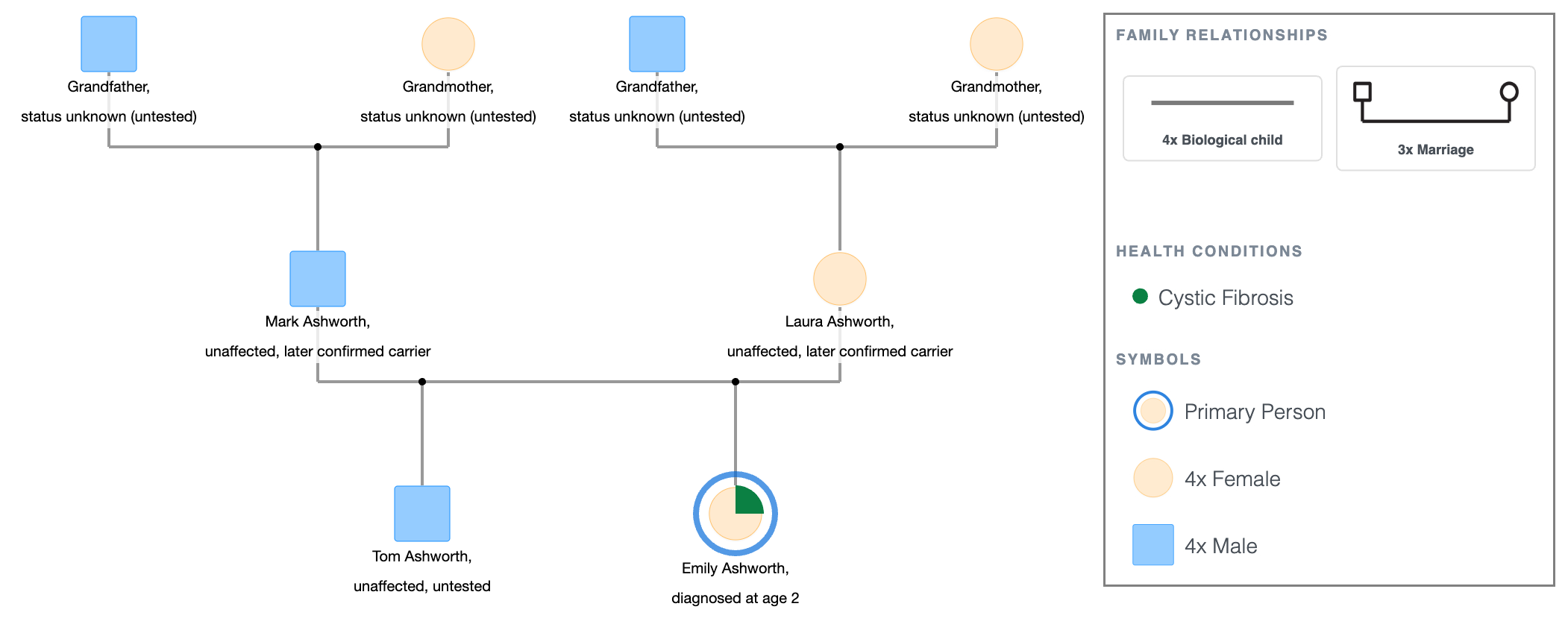
- Gen 1 paternal and maternal grandparents: no known cystic fibrosis history, carrier status untested.
- Gen 2: Mark Ashworth & Laura Ashworth - both unaffected, both later confirmed carriers.
- Gen 3: Emily Ashworth (primary person/proband, diagnosed with cystic fibrosis at age 2); Tom Ashworth (unaffected, untested).
Emily Ashworth was diagnosed with cystic fibrosis at two.
Neither Mark nor Laura had any family history they knew of, no one on either side had ever been diagnosed with CF, which is part of why the diagnosis caught them off guard.
Genetic testing after Emily's diagnosis confirmed that both Mark and Laura carry one copy of the CFTR mutation. Neither of them has the condition.
Their son Tom, Emily's older brother, hasn't been tested.
Reading the Inheritance Pattern
Cystic fibrosis is autosomal recessive, which means a child needs two copies of the mutated gene, one from each parent, to be affected.
Carrying just one copy, like Mark and Laura each do, doesn't cause the condition.
That's why the Ashworth genogram shows no CF anywhere in the grandparents' generation.
The mutation was likely present on one or both sides for at least a generation without ever producing a visible case, since a single carrier parent paired with a non-carrier partner has no chance of having an affected child.
With two carrier parents, each child has a 25% chance of being affected, a 50% chance of being an unaffected carrier like Mark and Laura, and a 25% chance of carrying no copies at all.
Emily's diagnosis is one outcome of that 25%.
Tom's status, whether he's a carrier, unaffected entirely, or something the family hasn't considered, isn't visible on the diagram yet because he hasn't been tested.
What This Means for the Family
The genogram turns Emily's diagnosis into a set of concrete next questions instead of an isolated event.
Tom is a candidate for carrier testing, both to understand his own reproductive risk later and because a negative result would rule out one branch of concern for the family.
Mark and Laura's own siblings and their children fall into the same carrier-risk pool, since the mutation entered the family from somewhere in the grandparents' generation.
And if Mark and Laura are considering more children, the 25% recurrence risk is now a known number instead of an unknown one.
None of this changes what already happened to Emily. It changes what the rest of the family decides to do next, which is the actual purpose of building the genogram in the first place.
Build One for a Session
Start with the person seeking counseling and mark them as the primary person.
Add two generations back on both sides, and use the Health Conditions panel to record the condition being tracked, noting carrier status separately from an active diagnosis for each person as testing results come in.
Leave anyone untested blank rather than guessing, an untested status is itself useful clinical information.
Export as PDF once the pattern is documented, for the chart or for a referral to another provider.
For the full guide, see How to Make a Genogram.
The Ashworth Family Genogram
Explore this genogram and adapt it to your needs.
FAQ
How is a genetic counseling genogram different from the BRCA-focused template on this site?
Same notation, different pattern. The Genetic Counseling Genogram Template on Qwoach shows an autosomal dominant pattern, where the condition appears in every generation. The Ashworth family shows an autosomal recessive pattern, where it can skip generations entirely until two carriers have a child together.
Can a genogram tell you whether an untested family member is a carrier?
Not directly. It can show the probability based on the inheritance pattern and who else in the family is affected or confirmed as a carrier, but only genetic testing confirms an individual's actual status.
Why didn't cystic fibrosis show up anywhere in the grandparents' generation?
Because it's recessive. A single carrier parent paired with a non-carrier doesn't produce an affected child, so the mutation can pass through a generation invisibly until it happens to meet another carrier.
Should extended family, like aunts, uncles, or cousins, be tested too?
That's a conversation for a genetic counselor based on the specific family structure, but they are part of the same carrier-risk pool as Mark and Laura, since the mutation traces back to one or both of their own parents.
Does a genogram like this replace formal genetic testing?
No. It organizes what's known and flags who else might be worth testing, but it doesn't confirm anyone's genetic status on its own. Testing is still what confirms carrier or affected status for each individual.
Sources
- Genogram: tool for exploring and improving biomedical and psychosocial family information
- Genograms: Assessment and Intervention (4th ed.)