Appearance
Genogram in Family Medicine
A genogram turns family history from a checkbox on an intake form into a structured picture a physician can actually act on, mapping hereditary conditions, age at diagnosis, and lifestyle risk factors across at least three generations during a routine visit.
Why Family Medicine Uses a Genogram
Family medicine has used genograms since the 1970s and 80s, when the standard family therapy genogram was adapted for medical settings.
McGoldrick, Gerson, and Petry's medical genogram framework builds on that adaptation with health-specific notation: hereditary conditions, ages at diagnosis, causes of death, and risk behaviors, laid out so a physician can spot disease clustering within a specific family line at a glance instead of piecing it together from a written history form.
What Family Physicians Map
A medical genogram in EasyGenogram uses the Health Conditions panel on each person's symbol to record the category (cardiovascular, metabolic, cancer, mental health), the name of the condition, and notes for age at diagnosis or cause of death.
Physicians typically capture hereditary conditions like cancer, cardiovascular disease, and diabetes; age at diagnosis, since early onset signals higher hereditary risk; cause and age of death for deceased relatives; and lifestyle risk factors like smoking or alcohol use that interact with genetic predisposition.
Mental health history and reproductive history round out the picture, since both are commonly underreported on a standard intake form.
The Harrison Family
The Harrison Family Genogram
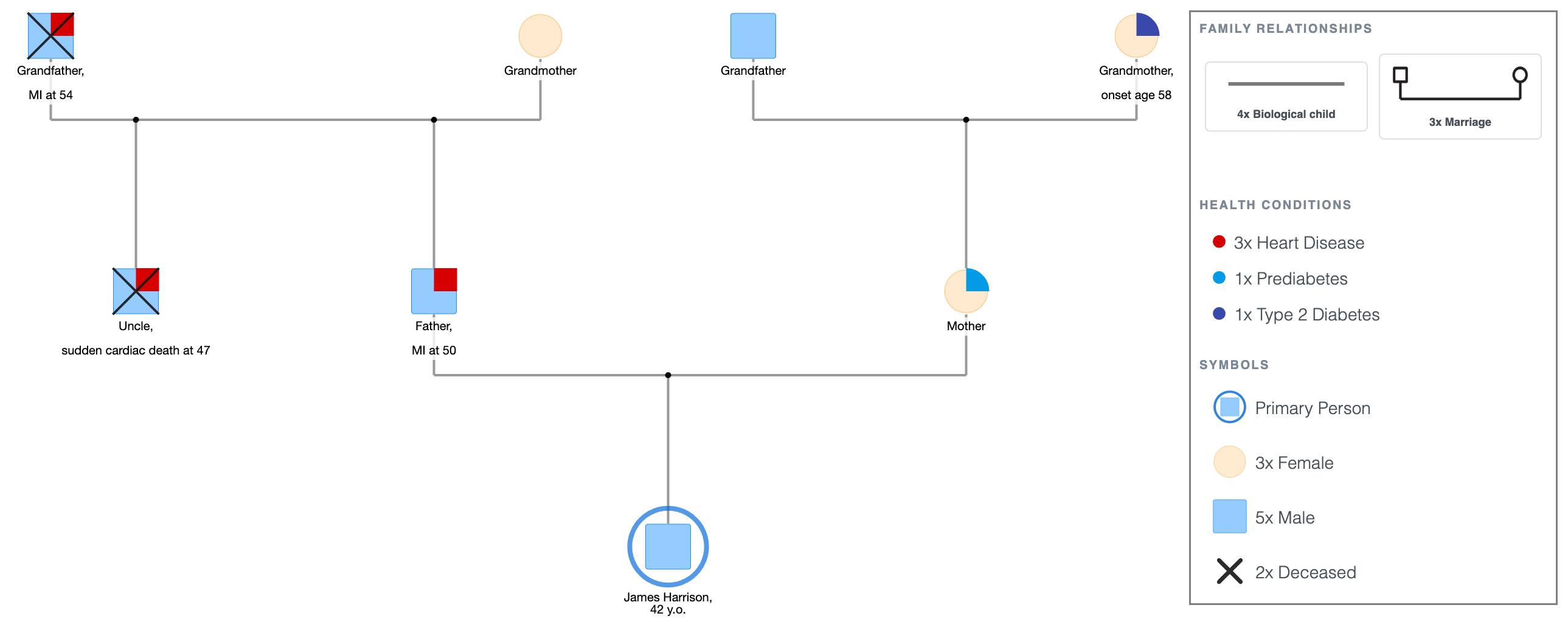
- Paternal: grandfather (deceased, MI at 54); father (MI at 50); uncle (deceased, sudden cardiac death at 47).
- Maternal: grandmother (type 2 diabetes, onset age 58); mother (prediabetes).
- Patient: James Harrison, 42.
James Harrison came in for a routine annual physical.
His BMI was mildly elevated, his blood pressure borderline, and he described himself as generally healthy. His intake form had "heart disease" checked under family history, with no further detail.
When his physician spent ten minutes building a three-generation genogram instead of relying on the form, the pattern was harder to miss.
James's father had a heart attack at 50.
His paternal grandfather died of one at 54.
His paternal uncle died suddenly of cardiac arrest at 47.
On his mother's side, his grandmother was diagnosed with type 2 diabetes at 58, and his mother now shows signs of prediabetes.
Partway through the conversation, James mentioned that his father had smoked heavily until his heart attack.
Asked directly, James admitted he smoked "socially," a few cigarettes most weekends, something he hadn't listed on his intake form because he didn't think of himself as a smoker.
How This Changed the Care Plan
A checkbox for "heart disease" doesn't tell a physician whether that's a single relative or three generations of early cardiac death on one side of the family.
The genogram did.
James's physician ordered a lipid panel and a fasting glucose test he wouldn't otherwise have prioritized at this visit, discussed smoking cessation in specific terms rather than a general note to "cut back," and moved his follow-up to three months instead of the standard twelve.
None of that came from a new symptom. It came from seeing three generations mapped in one place instead of a single checked box.
Build One During an Intake
Add a structured family health history to your intake process, first- and second-degree relatives, conditions, age at diagnosis, and cause of death where relevant.
Build the genogram in EasyGenogram during the visit itself; add each person, then use the Health Conditions panel to record conditions by category as the patient describes them.
Patients often remember more once they see the diagram taking shape, which is part of why James's smoking came up.
Export as PDF for the chart once the visit is done.
For the full guide, see How to Make a Genogram.
The Harrison Family Genogram
Explore this genogram and adapt it to your needs.
FAQ
How long does building a medical genogram take during a visit?
A basic three-generation genogram usually takes ten to fifteen minutes during a new patient visit or annual physical, less if the patient has already filled out a family health history questionnaire beforehand.
What's the difference between a family health history and a genogram?
A family health history is a list of conditions that run in the family. A genogram adds structure; who had what condition, at what age, and how they're related, which is what makes clustering patterns, like early cardiac death on one side of a family, visible in a way a list isn't.
Should a medical genogram include lifestyle factors like smoking, not just diagnoses?
Yes. Lifestyle risk factors interact with hereditary risk, and asking about a relative's smoking or alcohol use often surfaces the patient's own habits, the way James's father's smoking history led to a more accurate picture of his own.
Does a medical genogram replace a standard intake questionnaire?
No, it builds on one. Most physicians still collect a structured family health history on intake paperwork, then use the genogram to organize that information visually and catch patterns a linear list would miss.
Can a medical genogram include mental health or reproductive history, not just physical conditions?
Yes. Mental health conditions, miscarriages, and pregnancy complications all carry hereditary components and are commonly left off standard forms, so they're worth including on the same diagram as physical health conditions.
Sources
- Genograms. Practical tools for family physicians
- Genograms: Assessment and Intervention (4th ed.)