Appearance
Genogram for Health History
Map the conditions, causes of death, and age of onset across your family for three or more generations, turning a list of scattered facts into a diagram that makes hereditary patterns visible at a glance.
Why Map Your Own Health History
Most people know a handful of facts about their family's health; a grandparent who had cancer, a parent with diabetes.
What's harder to see without writing it down is how those facts connect, whether a condition is showing up on one side of the family or both, and whether it's arriving earlier in each generation.
A genogram puts everyone on the same diagram so that comparison is visible instead of scattered across memory and old conversations.
The Pearce Family
Genogram for Health History
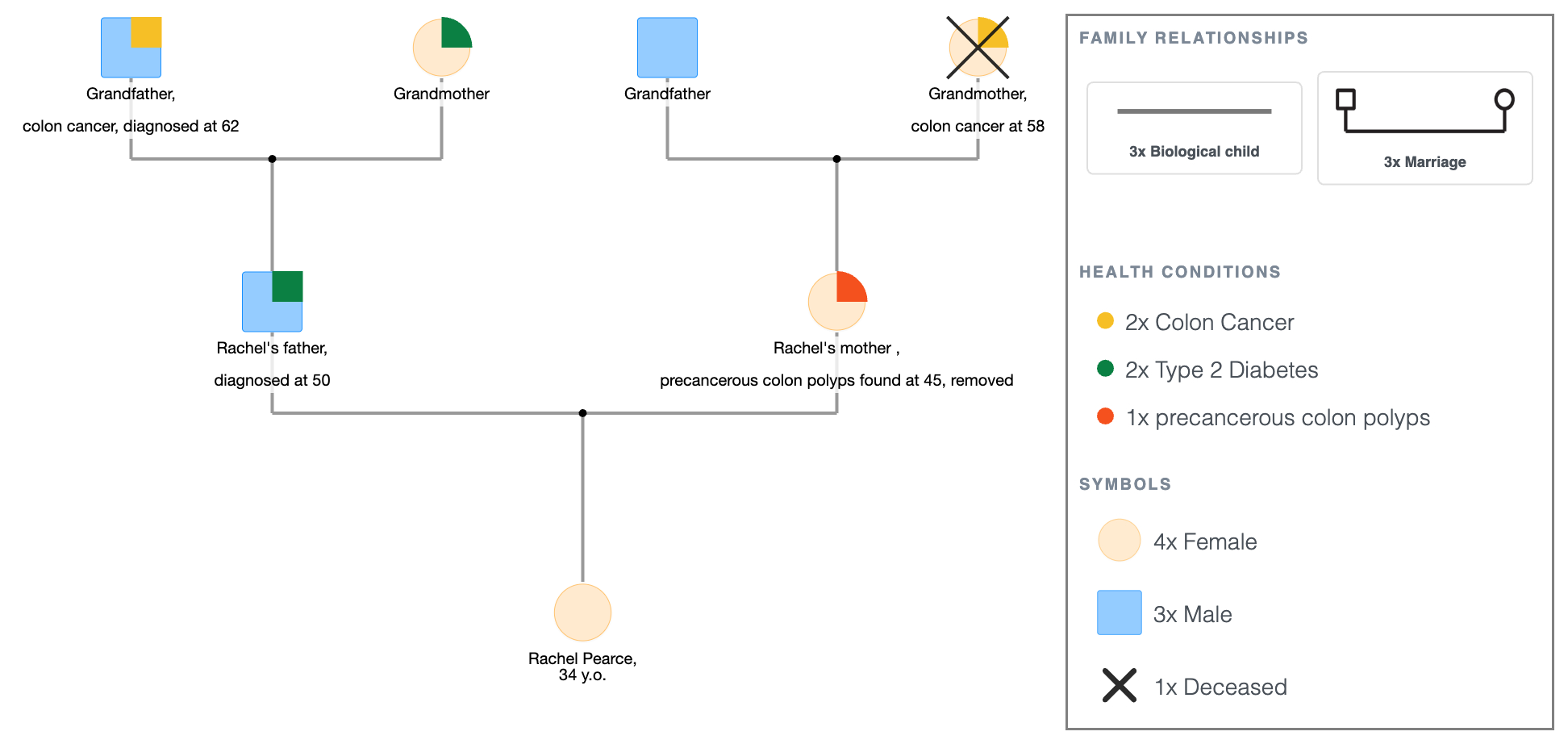
- Maternal: grandmother (deceased, colon cancer at 58); grandfather.
- Paternal: grandmother (type 2 diabetes); grandfather (colon cancer, diagnosed at 62).
- Gen 2: Rachel's mother (precancerous colon polyps found at 45, removed); Rachel's father (type 2 diabetes, diagnosed at 50).
- Gen 3: Rachel Pearce, 34, primary person, no diagnoses yet.
Rachel Pearce is 34 and has no health conditions of her own.
At a routine physical, her doctor asked a few questions about colon cancer in the family that she couldn't fully answer.
She knew her maternal grandmother had died of it, but wasn't sure about anyone else.
Building the genogram filled in the rest: her paternal grandfather also had colon cancer, and her mother had precancerous polyps removed at 45, younger than she expected.
Reading the Red Flags
Colon cancer showing up on both sides of Rachel's family, not just her mother's, is the kind of pattern that's easy to miss without a diagram and hard to miss once it's drawn.
Two unrelated branches producing the same condition suggests something more than coincidence.
Her mother's polyps at 45 add a second flag; an earlier-than-typical finding in the generation directly above Rachel's own.
Neither fact alone would necessarily prompt a conversation.
Together, on the same page, they're the kind of pattern doctors specifically ask about, and the kind that's genuinely difficult to reconstruct from memory during a fifteen-minute appointment.
What to Bring to Your Doctor
Standard colon cancer screening guidelines start around age 45 for average risk.
Rachel's diagram gives her doctor a reason to discuss starting earlier, since screening age recommendations often move up when a first-degree relative had polyps before 50, and move up further with a second branch of the family also affected.
Her father's type 2 diabetes, diagnosed at 50, is worth mentioning too, even though it's a separate thread from the cancer pattern.
A genogram doesn't diagnose anything on its own.
It gives a doctor the same complete picture in one glance that would otherwise take several visits' worth of half-remembered detail to piece together.
Build Your Own
Start with yourself and add two generations back: parents, then grandparents.
For each person, note major conditions, age at diagnosis where you know it, and cause of death if they've passed.
Use the Health Conditions panel in EasyGenogram to record each condition by category as you go.
If you don't have an exact age, write an approximate range, "mid-40s" is more useful than leaving it blank.
Mark yourself as the primary person, and export as PDF once it's built so you can bring it to your next appointment.
For the full guide, see How to Make a Genogram.
Genogram for Health History
Explore this genogram and adapt it to your needs.
FAQ
How many generations should I include if I'm just doing this for myself?
Three is the standard, showing grandparents, parents, and you. That's usually enough to spot whether a condition is repeating and on which side of the family.
What if I don't know exact ages or diagnosis dates for older relatives?
Write down what you do know, even an approximate decade, "her 60s," "sometime in his 50s." An estimated age is still useful. Leaving it blank tells a doctor nothing.
Should I include conditions that don't seem hereditary, like a broken bone or a one-time infection?
No, focus on conditions with genetic or hereditary components like cancer, heart disease, diabetes, mental health conditions, autoimmune disorders. A one-time injury doesn't add useful information to this kind of diagram.
Is a family health history genogram the same thing as genetic testing?
No. It organizes what you already know about your family's health and can suggest whether testing or earlier screening might be worth discussing, but it doesn't replace an actual genetic test or medical evaluation.
What if I'm adopted or don't have access to my biological family's history?
Document what you do know, even partial information from limited contact is worth including. For those with no access at all, that gap itself is worth mentioning to a doctor, since it changes how they'll approach your risk assessment.
Sources
- Genetic Family History: The Three-Generation Pedigree
- Genograms: Assessment and Intervention (4th ed.)