Appearance
Genogram and Ecomap in Nursing: Using Both for Family Assessment
Community health nurses use a genogram and an ecomap together for a complete family assessment, one mapping health history across generations, the other mapping the patient's current support and stressors.
See both built for the same case, and where their findings connect.
What Each Tool Shows in Nursing
The genogram maps family structure and health history back three generations, hereditary conditions, causes of death, relationship quality between family members.
For a full breakdown, see the Nursing Genogram Template and Genogram for Nursing Students.
The ecomap maps the patient's current environment: healthcare access, social support, community resources, and stressors. For the full guide, see Ecomap in Nursing.
Used separately, each tool answers a different question.
Used together on the same patient, they often connect in ways that change the assessment.
The Castillo Family Genogram
The Castillo Family Genogram
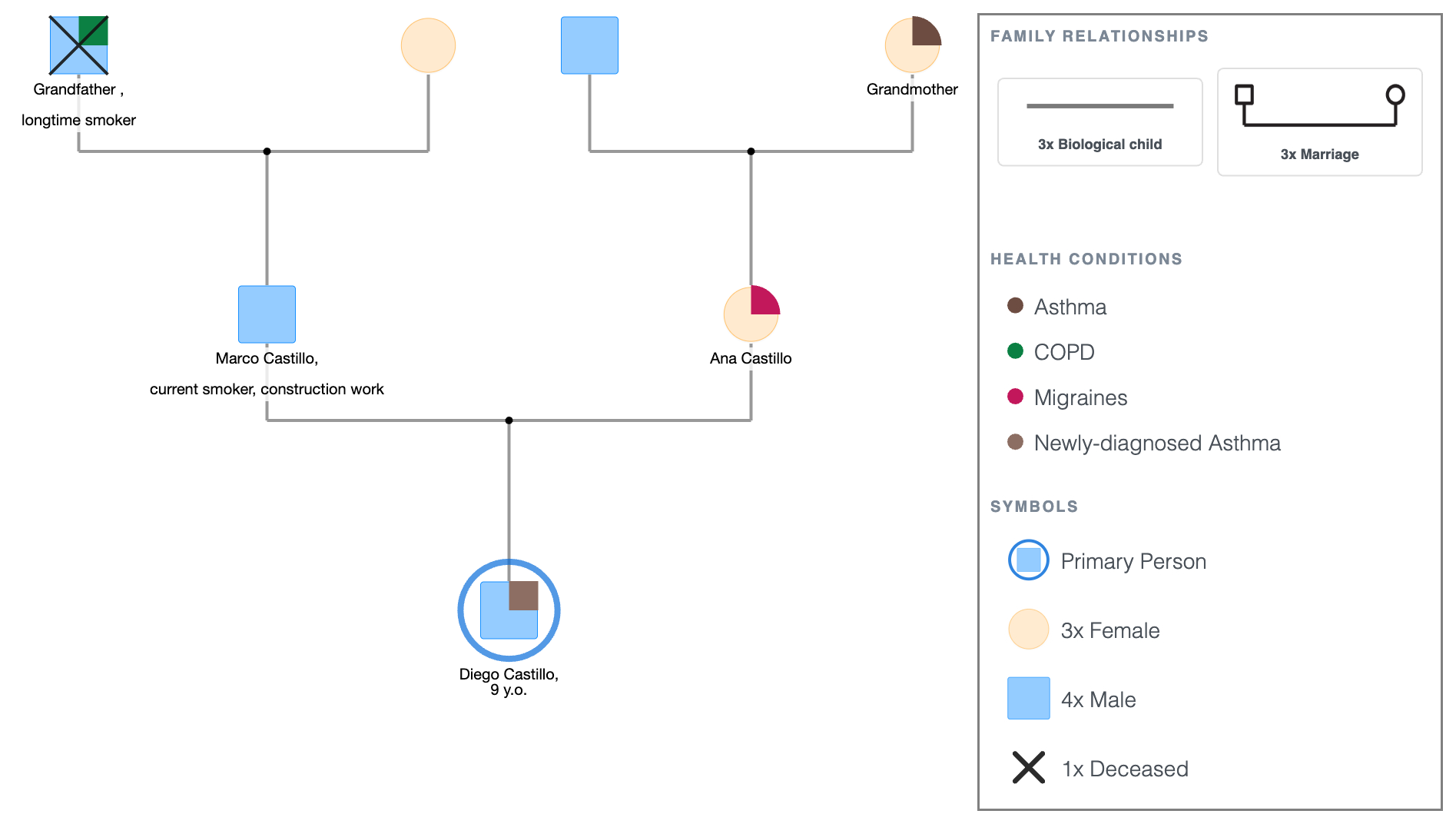
- Paternal: grandfather (deceased, COPD, longtime smoker).
- Father: Marco Castillo - current smoker, construction work.
- Maternal: grandmother - asthma history.
- Mother: Ana Castillo - migraines.
- Patient: Diego Castillo, 9 - newly diagnosed asthma
Diego Castillo is nine and was referred for a home visit after an ER visit for an asthma flare led to a new diagnosis.
His genogram shows a respiratory pattern on both sides: his paternal grandfather had COPD after decades of smoking, and his maternal grandmother has her own asthma history.
His father, Marco, still smokes, mostly outside on the porch, he says, though the habit has been part of the household as long as Diego's been alive.
The Castillo Family Ecomap
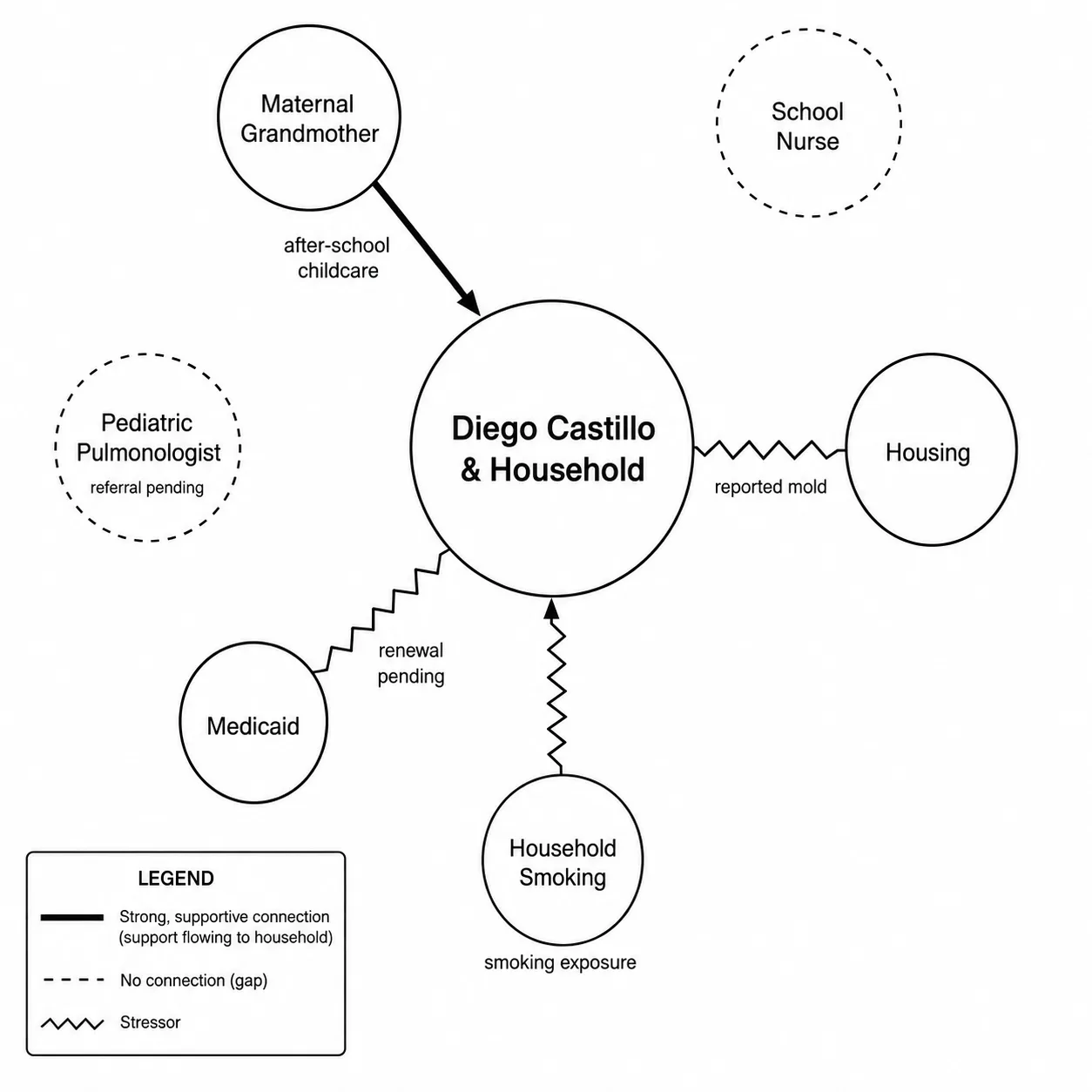
- Center: Diego Castillo and household.
- Grandmother (maternal): strong support line, provides after-school childcare.
- School nurse: no connection established, gap.
- Pediatric pulmonologist: referral pending, gap.
- Housing: stressor line, reported mold in the apartment.
- Medicaid: stressor line, renewal pending.
- Household smoking: internal stressor line.
Diego's ecomap fills in what the genogram alone can't.
His grandmother lives nearby and provides strong, reliable childcare.
There's no connection yet to a school nurse who could help manage his asthma action plan during the school day, and the pulmonologist referral is still pending.
The family's apartment has a reported mold issue, and their Medicaid renewal is due, both flagged as active stressors.
Where the Two Diagrams Connect
Marco's smoking shows up on both diagrams, and that overlap is the clearest reason nursing assessments use genogram and ecomap together instead of picking one.
On the genogram, it's a family health history data point tied to his own father's COPD.
On the ecomap, it's a current household exposure actively affecting Diego's asthma control today.
Looked at separately, one diagram shows a risk factor from the past and the other shows a stressor in the present.
Looked at together, they describe the same ongoing exposure from two angles, which is exactly the kind of finding that changes what the nurse recommends: not just "monitor for family history of respiratory disease," but "address active smoke exposure in the home this patient returns to every day."
Why Nursing Uses Both Together
The Calgary Family Assessment Model, widely taught in nursing programs, includes both the genogram and ecomap as standard components of a family assessment, one for structure and history, one for current context.
A discharge plan, a home visit note, or a community health assessment built on the genogram alone would miss the mold and the pending referral.
Built on the ecomap alone, it would miss why respiratory issues keep surfacing in this family in the first place.
Build Both for an Assessment
Start with the genogram: three generations, standard relationship lines, and medical conditions entered through the Health Conditions panel.
Then build the ecomap around the same patient, using solid lines for strong connections, dashed for weak or fragile ones, and jagged lines for stressors, with arrows showing which way support or strain is flowing.
Read both together before writing the assessment; look specifically for anything that shows up in both, that overlap is often the most clinically useful finding.
Export both as PDF for the chart.
For the full guide, see How to Make a Genogram.
The Castillo Family Genogram
Explore this genogram and adapt it to your needs.
FAQ
Do I need to build the genogram and ecomap at the same visit?
Not necessarily. Many nurses build the genogram at intake, when family history is being gathered anyway, and complete the ecomap once the patient's current living situation and support network are clearer, sometimes a separate home visit.
What if the genogram and ecomap don't show any overlapping findings?
That's fine and common. The Castillo example has a clean overlap because the smoking exposure ties both diagrams together, but most cases won't line up that neatly. Each diagram is still worth doing on its own.
Which tool should a nursing student use for a self-genogram assignment?
A self-genogram assignment is usually genogram-only, since it's focused on family history and notation practice rather than a specific patient's current environment. The ecomap gets introduced later, once assignments shift to case-based or patient assessments.
Can one nurse realistically complete both during a single home visit?
Yes, though it usually takes two conversations; one gathering family history for the genogram, another asking about current supports and stressors for the ecomap. Many nurses build a rough version during the visit and finalize both afterward.
Is there a standard notation for showing overlap between a genogram and ecomap finding, like Marco's smoking?
Not a single universal symbol. Most nurses note it in the assessment narrative, referencing both diagrams, since the genogram and ecomap use separate notation systems and aren't designed to merge into one shared symbol set.
Sources
- Diagrammatic assessment of family relationships
- Genograms: Assessment and Intervention (4th ed.)
- Nurses and Families: A Guide to Family Assessment and Intervention (6th ed.)