Appearance
Genogram for Nursing Students
Map hereditary health risk and family support patterns across three generations to strengthen a nursing family health assessment.
Why Nursing Students Use a Genogram
Family and community health nursing courses assign a three-generation genogram because a single diagnosis doesn't explain much on its own.
Two things become visible once a family's history is mapped out:
- hereditary risk patterns that predict what to screen for, and
- the relational structure that determines whether a patient actually has support after discharge.
Nursing genograms use the same McGoldrick-Gerson notation as other clinical genograms, but nursing programs expect both layers, medical and relational, not medical history alone.
The Alvarez Family
Genogram for Nursing Students Example
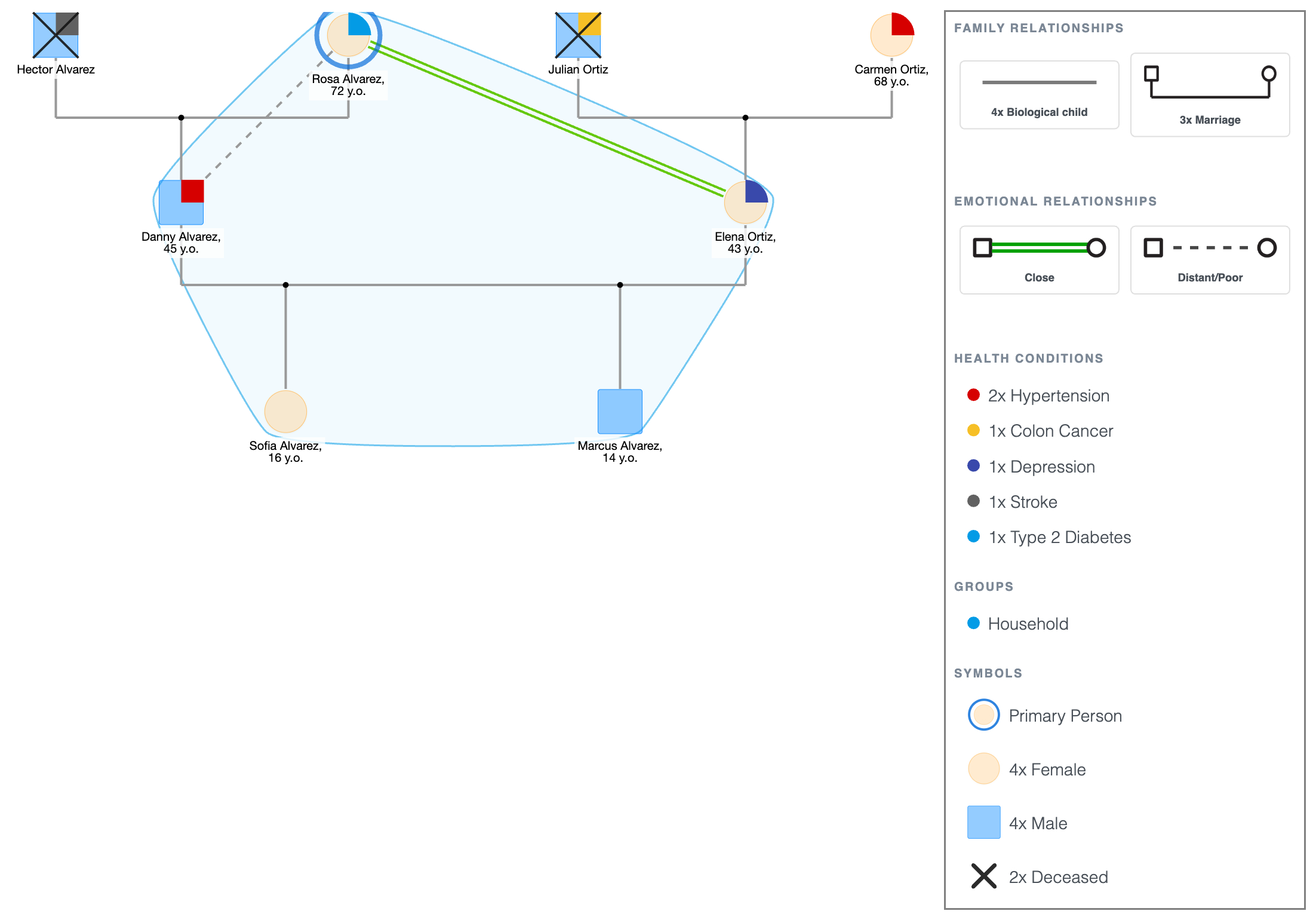
- Gen 1 paternal: Hector Alvarez (deceased, stroke) & Rosa Alvarez (72, type 2 diabetes).
- Gen 1 maternal: Julian Ortiz (deceased, colon cancer) & Carmen Ortiz (68, hypertension).
- Gen 2: Danny Alvarez (45, hypertension) married to Elena Ortiz (43, depression history).
- Gen 1/2 relational: Close line between Rosa and Elena; Distant/Poor line between Danny and Rosa.
- Gen 3: Sofia Alvarez (16) and Marcus Alvarez (12).
Priya Nair, a nursing student on a community health rotation, is doing a home health visit for Rosa Alvarez, who moved in with her son Danny's family after a fall last year.
The assignment calls for a genogram covering three generations with health history.
Priya's first pass just gets the family structure and conditions down.
The second pass, going back through with questions about who does what for Rosa day to day, is where the more useful picture shows up.
What the Hereditary Pattern Shows
Rosa's diabetes sits on a paternal line that also includes her late husband Hector's stroke, both cardiovascular and metabolic risk markers entered in the Health Conditions panel on Rosa and Hector's symbols.
On Elena's side, her father Julian's colon cancer and her mother Carmen's hypertension mark a different risk profile entirely.
Danny, sitting at the intersection of the paternal cardiovascular line, already carries a hypertension marker of his own at 45.
All these tell Priya what to flag for screening in Sofia and Marcus before either condition shows symptoms, and it tells a future provider what Danny's own risk profile looks like even though he's not the patient today.
What the Relational Layer Shows
The medical history only answers half of what the assignment is asking for.
Rosa's genogram also carries a Close line to Elena, her daughter-in-law, who handles Rosa's medication schedule, meals, and most of her appointments.
The line between Rosa and her own son Danny is marked Distant/Poor; he works two jobs and has little day-to-day involvement in her care.
That's a relational fact with direct clinical weight.
Elena is functioning as Rosa's primary caregiver while also managing her own depression history and two kids, and Rosa's actual support system is one person, not the household of four it might look like on paper.
Why This Changes the Care Plan
Put the two layers together and the assessment shifts.
A diabetes management plan for Rosa that assumes shared family support doesn't match what the genogram shows.
Elena is carrying caregiving largely alone, which raises her own risk given her depression history, and any plan that doesn't account for that is likely to fail at the first sign of caregiver burnout.
This is the kind of finding a chart alone won't surface, and it's specifically what a nursing genogram is built to catch.
How This Fits Into Coursework
Some programs start with a self-genogram, mapping your own family, before moving to case-based assignments like Rosa's.
Both follow the same three-generation standard and the same expectation that you document household composition, health history, and relational patterns together, which is the family and community health competency most BSN and MSN programs are assessing.
The Alvarez genogram is built the way a real assignment would be: patient at the center, three generations back, medical and relational findings recorded on the same diagram.
Build One for Your Assignment
Start with your assigned patient or family and add two generations back.
Enter conditions through the Health Conditions panel on each person's symbol so they land in the correct quadrant, then go back through and add relationship lines, Close, Distant/Poor, Fused, for caregiving and household dynamics.
Include a legend and the date before exporting; most instructors expect both. Export as PDF or PNG for submission.
For the full guide, see How to Make a Genogram.
Genogram for Nursing Students Example
Explore this genogram and adapt it to your needs.
FAQ
Does a nursing genogram need to include relational information, or just medical history?
Both. A medical genogram used by a physician or genetic counselor may focus on diagnoses alone. A nursing genogram is expected to also show household composition and relationship quality, since nursing assessment is built around the family's capacity for care, not just its disease history.
How many generations does a nursing genogram assignment usually require?
Three is the standard; showing grandparents, parents, and the patient's generation. Some assignments extend further if a hereditary condition is being traced, but three generations covers most family and community health nursing coursework.
What if I don't have a complete health history for older generations?
Mark what's known and leave the rest blank rather than guessing. Gaps are common in real intake, and an honest gap is more clinically useful than an assumed condition.
Can I use a self-genogram assignment for a course that asks for a patient genogram later?
The structure carries over, but check with your instructor first. Self-genograms are usually meant to build comfort with the notation before you're asked to build one from a patient interview, where you're working with someone else's account of their family instead of your own.
Do I need special software, or can I draw a nursing genogram by hand?
Either is usually accepted, but software like EasyGenogram with a dedicated medical conditions field keeps the four-quadrant notation consistent and avoids the mislabeling that's common in hand-drawn or general design-tool versions.
Sources
- The root of it all: genograms as a nursing assessment tool
- Nurses and Families: A Guide to Family Assessment and Intervention (6th ed.)
- Genograms: Assessment and Intervention (4th ed.)