Appearance
Genogram for Occupational Therapy
An occupational genogram maps work roles, leisure activities, and self-care patterns across a client's family alongside the standard structure, revealing how occupational identity, not just physical function, has been shaped by generations of family history.
What an Occupational Genogram Adds
A standard genogram covers family structure and health history. An occupational genogram layers a different question on top:
- Work: what each generation did for a living.
- Leisure: how each generation spent unstructured time.
- Meaning: how the family defined a productive, meaningful life.
This concept, sometimes called the occupational transmission genogram, comes out of occupational science literature specifically because a client's resistance to a treatment goal often has less to do with the goal itself and more to do with what that goal represents to their sense of identity.
The Sheldon Family
Occupational Therapy Genogram Example
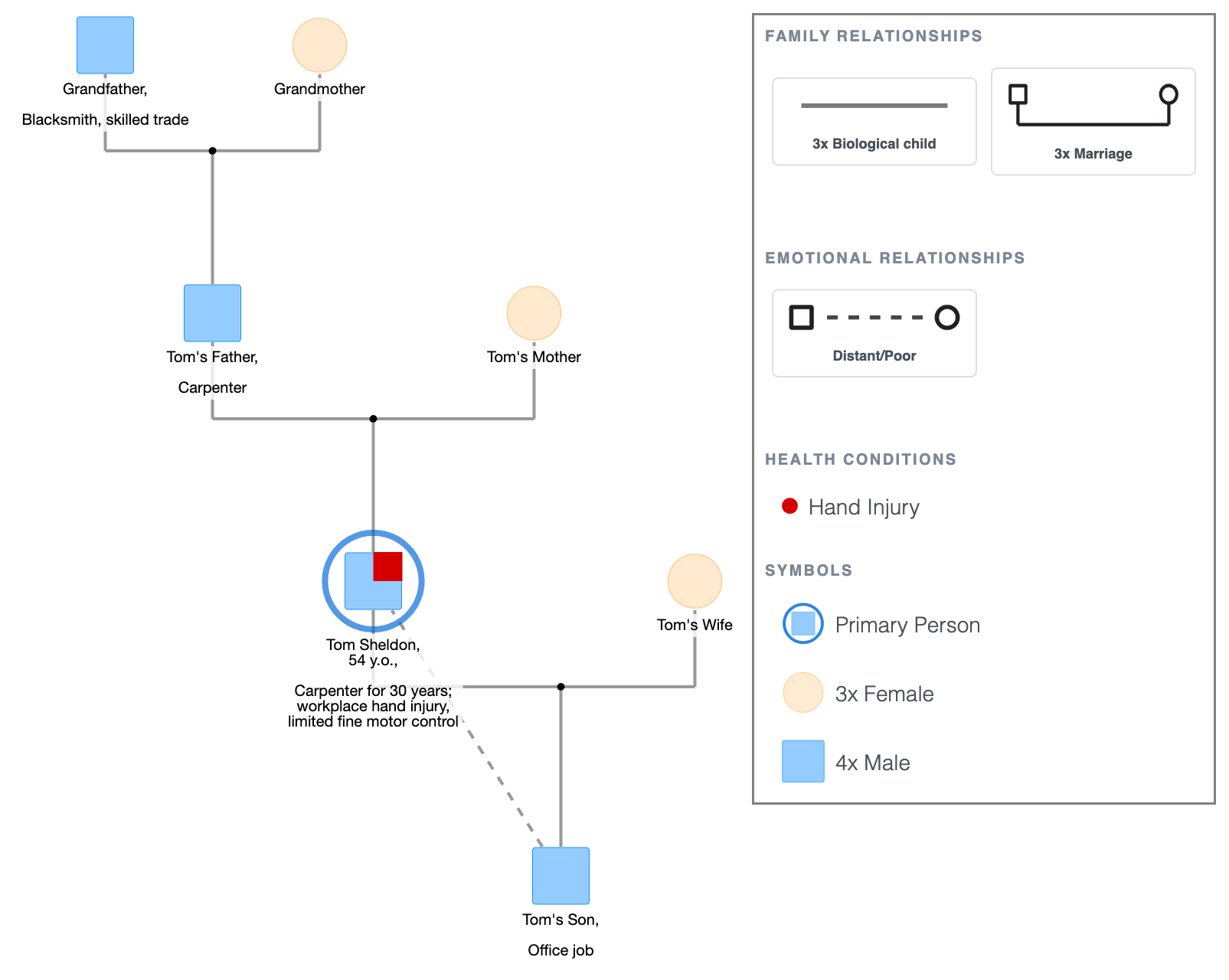
- Grandfather: blacksmith, notes on skilled manual trade identity.
- Father: carpenter, same occupational thread.
- Tom Sheldon: primary person, carpenter for 30 years, workplace hand injury.
- Tom's son: office job, notes: broke from the family trade pattern.
Tom Sheldon, 54, was referred to outpatient OT after a workplace accident left him with limited fine motor control in his dominant hand.
He'd spent thirty years as a carpenter, following his father into the trade.
His OT goals on paper looked straightforward; regain hand function, return to work.
His actual progress in sessions didn't match the straightforward version.
What the Genogram Revealed
Tom's grandfather was a blacksmith.
His father was a carpenter.
For three generations, the family's sense of what it meant to do meaningful work was built entirely around skilled manual labor, working with your hands, producing something tangible.
Tom's son broke from that pattern and took an office job, a choice that had nothing to do with Tom's injury but that Tom brought up unprompted more than once in sessions, usually with a note of something between pride and disappointment.
Once that pattern was visible on the genogram, Tom's resistance to adaptive equipment made more sense.
Using an adapted grip tool wasn't just a practical accommodation to him. It was, in the framework his family had operated in for three generations, an admission that he could no longer do real work.
His son, who'd built an identity around a different kind of work entirely, wasn't positioned to understand what that admission actually cost Tom, which is part of why Tom hadn't been able to talk to him about it directly.
Build One for an OT Assessment
During the initial occupational profile, ask about work and leisure across generations, not just the client's own history; what did your parents and grandparents do for work, what hobbies were valued in the family, who was seen as the hardest worker.
Add this information as notes on each person alongside the standard structure and health history.
Look for a pattern in what the family has defined as productive or meaningful, and note where the client's current limitation sits in relation to that pattern, since that's often where resistance to a treatment goal actually comes from.
For the full guide, see How to Make a Genogram.
Occupational Therapy Genogram Example
Explore this genogram and adapt it to your needs.
FAQ
How is an occupational genogram different from the standard OT genogram template?
Both use the same base structure. An occupational genogram specifically emphasizes work, leisure, and self-care patterns across generations, useful for cases where identity and motivation are central, like Tom's. A caregiving-focused OT genogram, like our Occupational Therapy Genogram Template on Qwoach, emphasizes health history and support networks instead, useful in cases like stroke rehabilitation.
Does every OT case need an occupational genogram?
No. It's most useful when a client's engagement or resistance seems disproportionate to the clinical picture, which often signals an identity or family-values factor worth mapping rather than a purely physical one.
What questions surface a family's occupational pattern?
Ask about work across generations directly: what did your parents and grandparents do, what was valued in the family as meaningful work, and who in the family was seen as especially hardworking or skilled. These questions often reveal more than a general family history intake would.
Can this approach work with pediatric OT clients?
Yes. Family routines, parenting styles, and what parents themselves were taught to value as productive activity all shape a child's occupational development, and a genogram can make those inherited expectations visible even when the child is too young to articulate them.
Do OT students need formal training to build one of these?
No special certification is required. Most accredited OT programs already cover genogram basics as part of family-centered assessment training; the occupational-transmission focus is simply a specific lens applied to the same tool.
Sources
- The Occupational Transmission Genogram: Exploring Family Occupational Legacies
- Genograms: Assessment and Intervention (4th ed.)