Appearance
Genogram for Military Families
A military family genogram marks deployment timelines and relocation history directly on the standard family structure, making visible a pattern of repeated disruption that a single conversation or intake form usually can't.
What a Military Family Genogram Maps
This one focuses on active-duty family life itself, deployment and relocation cycles, and what they do to the people who aren't deployed.
Standard genogram notation doesn't have a built-in way to show a parent's six-month deployment or a family's fourth move in five years.
Adding that information as dated notes turns a general "military family" label into a specific timeline:
- Deployment dates: when someone left and when they came back.
- Relocation count: how many times the household moved, and when.
- Constant relationships: which connections stayed steady through every move.
For an example focusing on multigenerational combat trauma and PTSD transmission across service members, see the Military Social Work Genogram Template.
The Whitlock Family
Genogram for Military Families
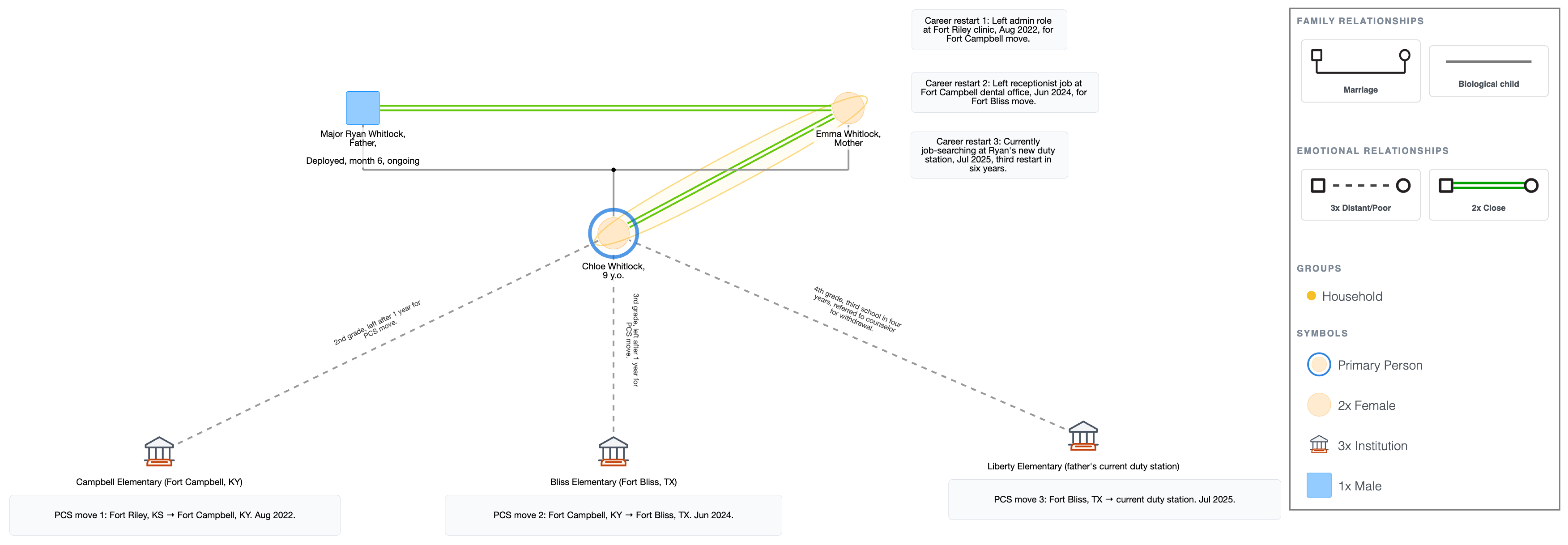
- Major Ryan Whitlock: Army deployment noted on his line (6 months, ongoing).
- Emma Whitlock: notes on career restarts tied to each PCS move.
- Chloe Whitlock: 9, primary person, Distant line to each successive school/community; Close line to Emma.
- PCS history noted: three moves in six years, current school being her third in four years.
Chloe Whitlock's teacher referred her to the school counselor after weeks of visible withdrawal; not participating in group activities, eating lunch alone, giving one-word answers when other kids tried to include her. Chloe is nine. Her father, Major Ryan Whitlock, is six months into a deployment. This is her third school in four years.
What the Genogram Revealed
Marking each PCS move on the family's genogram, with the date and the school connected to it, showed a pattern Chloe herself named almost matter-of-factly when asked directly; she'd stopped trying to make close friends because "we'll just move again."
Three moves in six years meant three times starting over, and by her third school, she'd developed what looked like disinterest but was actually a learned response to repeated loss.
Ryan's deployment dates, marked directly on his line, showed this wasn't just about moving.
Chloe's current withdrawal started roughly a month into her father's deployment, on top of a school transition that was already only a few months old. Two disruptions were stacking on each other. The one relationship with a Close line running through every part of the diagram was Emma, the one constant across every school, every deployment, every move.
How This Shaped the Counseling Plan
Naming the pattern directly, that Chloe's withdrawal made sense as a response to repeated disruption rather than a personality trait or a discipline problem, changed how the school approached her.
The counselor coordinated with Chloe's teacher on a gentler transition plan for whenever the next PCS move happened, rather than waiting for the next crisis to react to.
Sessions leaned on Emma's consistency deliberately, framing her as Chloe's stable anchor through every change rather than treating the family as uniformly unstable. And the plan didn't try to talk Chloe out of her caution about making friends.
It worked with it, focusing on lower-stakes connections she could build without needing them to survive another move.
Build One for a Military Family Case
Mark deployment start and end dates directly on the service member's line, and note each PCS move with its date and the school or community it is connected to for any children involved.
Use relationship lines like Close, Distant, etc., to show which connections held steady across the disruptions and which didn't.
Ask directly about how each family member experienced each move and each deployment separately, since the same event often lands very differently across a family.
For the full guide, see How to Make a Genogram.
Genogram for Military Families
Explore this genogram and adapt it to your needs.
FAQ
How do you create a family genogram that includes deployment history?
Add the deployment dates as notes directly on the service member's line, alongside the standard structure. Treat each deployment like a dated event, similar to how a placement date is noted on a foster care genogram, so the timeline is visible without needing a separate record.
What makes a family a "military family" for genogram purposes?
Any family with a current or former service member, whether the service history is single-generation or spans several. The Whitlock family's genogram in this article, for instance, focuses on Ryan's active-duty service and its current effects, not a multigenerational service tradition.
What is the 3-generation genogram, and does a military family genogram need three generations?
A 3-generation genogram maps grandparents, parents, and the current generation, the clinical standard for most family assessments. A military family genogram focused on active-duty relocation and deployment cycles, like Chloe's in this article, can be useful even with two generations if the goal is understanding a current family's disruption pattern rather than multigenerational service history.
What symbols are used for a military family genogram?
The same standard symbols as any genogram, squares, circles, relationship lines, plus dated notes for deployment periods and PCS moves. There's no separate symbol set specifically for military status; the service-specific information is added through notes.
Can a military family genogram help with a child's behavioral concerns even if there's no combat trauma involved?
Yes. As Chloe's case in this article shows, deployment and relocation alone, without any diagnosed trauma in the family, can produce behavioral patterns worth mapping. The genogram doesn't require a PTSD diagnosis to be useful.
Sources
- The Military Genogram: A Solution-Focused Approach for Resiliency Building in Service Members and Their Families
- Genograms: Assessment and Intervention (4th ed.)