Appearance
How to Analyze a Genogram: Step-by-Step Guide
After reading a genogram, analyzing it is the next step; actually working through it to find what matters. These are 3 steps on analyzing a genogram.
Step 1: Review the Structure
Before looking at any single relationship, scan the whole diagram:
- How many generations are represented?
- What structural events stand out; divorces, remarriages, adoptions, blended households?
- Where are the demographic basics, ages, birth and death years?
This gives you the shape of the family before you start looking for patterns inside it.
Step 2: Decode Relationship Patterns
Now look at how the relationship lines sit together:
- Where do close, distant, conflict, or cutoff lines cluster?
- Is there a triangle, closeness in one line paired with distance or conflict in another, all touching the same third person?
- Does one person connect to almost everyone on the diagram?
For the theory behind triangles and relationship clustering, see Genogram Interpretation.
Step 3: Look for Multigenerational Patterns and Gaps
Step back and look across the whole diagram at once:
- Anniversary reactions: events happening at a similar age across generations.
- Symptom concentration: a health or behavioral pattern clustering in one branch.
- Gaps: missing birth years, unnamed relatives, unexplained distance. Gaps are information too.
A Worked Walkthrough: The Hartley Family
The Hartley Family
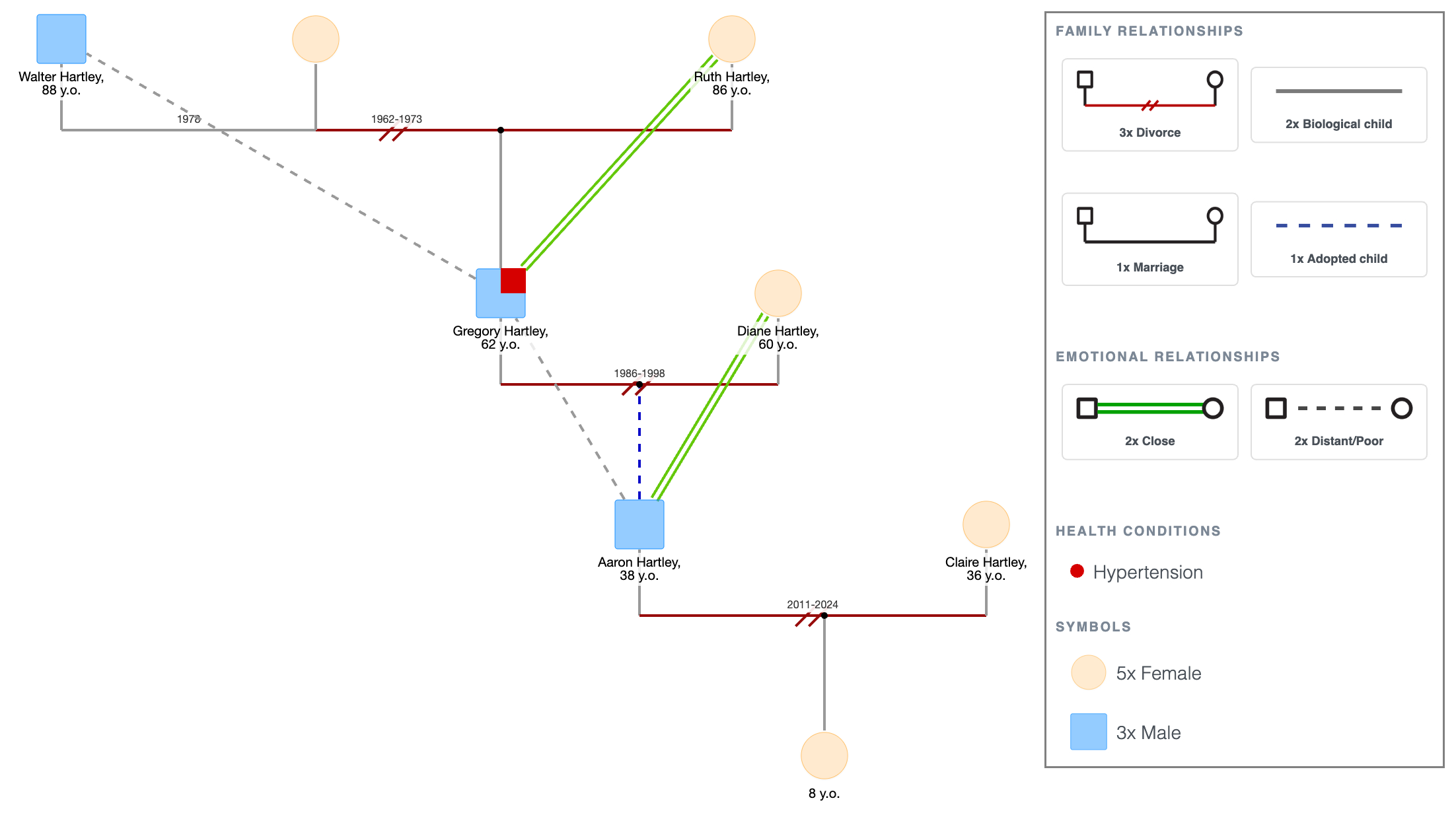
The family:
- Walter Hartley (b. 1938) married Ruth Hartley (b. 1940) in 1962. They divorced in 1973, when Walter was 35. Walter remarried in 1978.
- Their son, Gregory Hartley (b. 1964), has hypertension, noted in his shape. He's close to his mother, Ruth, and distant from Walter.
- Gregory married Diane Hartley (b. 1966) in 1986. They divorced in 1998, when Gregory was 34.
- Gregory and Diane adopted a son, Aaron Hartley (b. 1988), as an infant. He's close to Diane and distant from Gregory.
- Aaron married Claire Hartley (b. 1990) in 2011. They divorced in 2024, when Aaron was 36.
- Aaron and Claire have one daughter, born 2018, currently 8.
What you can now see:
- On a first pass, several things stand out on their own; Gregory's hypertension, the close/distant split repeating in two generations, Aaron's adoption.
- When you go back and check the year recorded on every couple line, not just read them once, that a repetition surfaces: Walter divorced at 35 (1973), Gregory at 34 (1998), Aaron at 36 (2024). Three divorces in three generations, with a two-year age window.
- This is the kind of pattern that is found by deliberately comparing one specific detail, age at a life event, across every generation, not just by reading the diagram once and moving on.
From Analysis to Action
A pattern you've found is a starting point rather than a conclusion. The Hartley pattern raises a question worth asking. Treat what you find as a hypothesis to explore further, not a verdict on the family.
The Hartley Family
Explore this genogram and adapt it to your needs.
FAQ
What's the first step in analyzing a genogram?
Start by reviewing the overall structure, generations, demographics, and major structural events, before looking at individual relationships. This gives you the shape of the family before you start finding patterns inside it.
What's the difference between analyzing and interpreting a genogram?
Analyzing is the step-by-step process of working through the diagram, structure, relationships, then patterns. Interpreting is the broader skill of making sense of what those patterns mean, covered in full on the Genogram Interpretation guide.
What are anniversary reactions in a genogram?
An anniversary reaction is a life event, a divorce, a diagnosis, a death, happening at a similar age or date across more than one generation. It's a pattern that only becomes visible once you compare generations directly.
Do gaps or missing information matter in analysis?
Yes. Missing birth years, unnamed relatives, or unexplained distance are worth noting on their own. Gaps often point to information the family hasn't shared yet, not information that doesn't exist.
Sources
- Reading and Interpreting Genograms: A Systematic Approach
- Genograms: Assessment and Intervention (3rd ed.)