Appearance
Family Patterns in a Genogram
In a genogram, patterns rarely show up as one fact sitting by itself. They are usually buried among a dozen other details on the diagram, health notes, relationship lines, structural events, all at once.
Here are the types of patterns worth knowing how to spot, and what it looks like when more than one shows up in the same family. The patterns below aren't mutually exclusive, most real families show more than one at once.
Relational Patterns
Roles and dynamics that repeat across generations:
- Triangles: two people managing tension by pulling in a third. A mother and son who are enmeshed, with the father drawn in only when their conflict needs defusing, is a classic example.
- Cutoff chains: the same estrangement pattern recurring between different pairs. A man who cut off his own father, followed by a son who later cuts him off, is the pattern of cutoff repeating rather than a coincidence.
- Family roles: positions that repeat regardless of who fills them. One well-documented framework for family roles comes from Sharon Wegscheider-Cruse's work on families organized around addiction; the Enabler, the Hero, the Scapegoat, and the Lost Child. Each role is a way a family member adapts to a stressor elsewhere in the system, and the roles often repeat in the next generation even when the original stressor is gone.
Health and Medical Patterns
The same condition, or a related one, clustering in one branch or generation:
- Symptom concentration, one diagnosis showing up repeatedly in the same family position. For instance, depression appearing in the eldest daughter of every generation, even across different marriages and different households, is the kind of repetition worth flagging.
- Hereditary risk, conditions with a genetic component appearing across multiple generations. For instance, breast cancer diagnosed in a grandmother, then her daughter, then her granddaughter, all before age 50, is the pattern a genogram makes visible.
Behavioral Patterns
Habits and conditions that show up in the same family position more than once:
- Addiction
- Eating disorders
- Anxiety or depression
None of these are automatically hereditary or automatically learned. The pattern itself is just the repetition, worth asking about, not assuming a cause for.
Structural and Life-Choice Patterns
Not everything that repeats is emotional:
- Family size, recurring only-children, or the reverse.
- Career paths repeating across generations.
- Age at marriage or first child staying consistent generation to generation.
A Worked Example: Patterns Overlapping in One Family
Patterns Overlapping in A Family Genogram
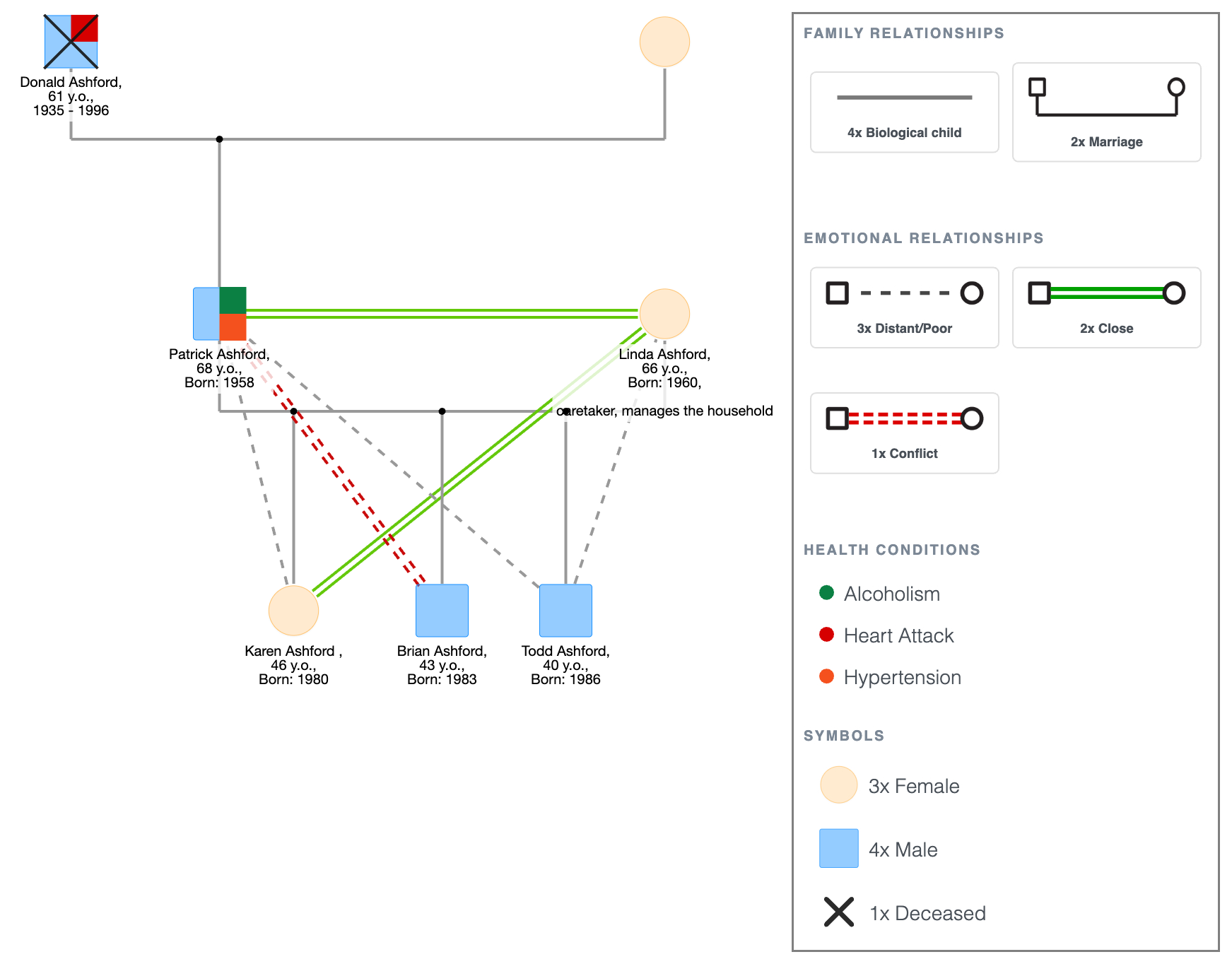
The family:
- Donald Ashford (b. 1935) had a heart attack and died at 61.
- His son, Patrick Ashford (b. 1958), struggles with alcoholism and has hypertension, noted in his shape.
- Patrick's wife, Linda Ashford (b. 1960), manages the household around his drinking. Close to Patrick.
- Their eldest daughter, Karen Ashford (b. 1980), is high-achieving and overfunctioning. Close to Linda, distant from Patrick.
- Their middle son, Brian Ashford (b. 1983), is in frequent conflict with Patrick and is often blamed when things go wrong in the family.
- Their youngest son, Todd Ashford (b. 1986), keeps to himself and is distant from both parents.
What you can now see:
- A health pattern: Donald's heart attack and Patrick's hypertension sit in the same generational line, a cardiovascular thread running down one branch.
- A relational pattern: Karen, Brian, and Todd occupy three distinct, well-documented roles around Patrick's drinking, the overfunctioning Hero, the blamed Scapegoat, and the withdrawn Lost Child.
These two patterns sit on the same diagram, in the same family, at the same time. Neither explains the other, but reading the family well means noticing both.
Spotting These in Your Own Genogram
Finding patterns like these means deliberately comparing one detail at a time across the whole diagram, not reading it once and moving on.
The full process is covered on How to Analyze a Genogram.
Patterns Overlapping in A Family Genogram
Explore this genogram and adapt it to your needs.
FAQ
What counts as a family pattern on a genogram?
Any relationship dynamic, health condition, behavior, or structural fact that repeats more than once, in a similar family position or generation. A single instance isn't a pattern on its own.
Can more than one pattern show up in the same family?
Yes, and it's common. A family can show a health pattern and a relational pattern at the same time, on the same diagram, without one causing the other.
Are family patterns always negative?
No. Patterns can be neutral or positive too, a family history of long marriages, a repeated career path, or a consistently close sibling relationship across generations are all patterns.
How many generations do you need to see a pattern?
Three generations is the usual minimum for a repeating pattern to become visible. Two generations only show the current household; three is where repetition starts to show up.
Sources
- Another Chance: Hope and Health for the Alcoholic Family. Science and Behavior Books
- Genograms: Assessment and Intervention (3rd ed.). W.W. Norton & Company