Appearance
Risk and Protective Factors in a Genogram
A genogram can show two kinds of information about a family; what threatens their stability, and what supports it. Risk factors are the threats. Protective factors are the supports. Most families show both at once.
What Counts as a Risk Factor
A risk factor is anything that threatens a family member's health, safety, or stability.
On a genogram, risk shows up as:
- Health or behavioral conditions: substance use, chronic illness, mental health diagnoses, noted on the relevant person.
- Institution history: CPS involvement, incarceration, court intervention, etc., using the Institution node.
- Strained relationship lines: conflict, hostile, abuse, or cutoff lines between family members.
- Displacement or instability: noted as text where a structural symbol doesn't fit.
What Counts as a Protective Factor
A protective factor is anything that buffers against those risks.
On a genogram, protective factors show up as:
- Stable attachment figures: a close or harmony line to a consistently present relative.
- Positive institution ties: school, church, a stable employer, or a recovery program, using the Institution node in a positive context.
- Community and cultural anchors: noted as text where relevant.
- Recovery or resilience history: a past pattern of coping successfully, noted beside the relevant person or event.
Reading Risk and Protective Factors Together
Many families show both at once, not one or the other.
A parent can have a substance use history and be actively in recovery.
A child can have an absent parent and a consistently present grandparent.
Read the whole diagram, not just the part that confirms the concern you walked in with.
A Worked Example: The Weller Family
The Weller Family
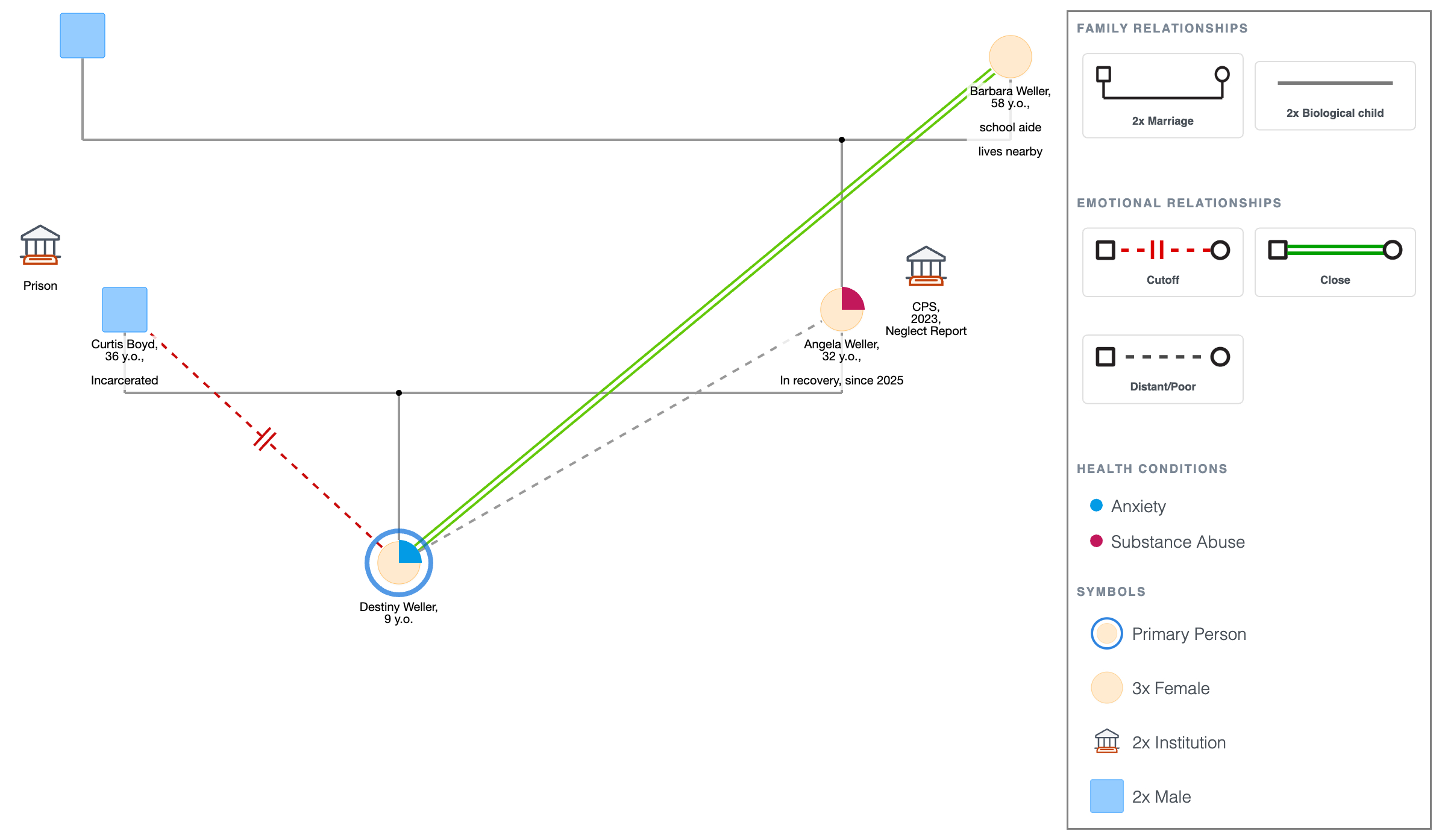
The family:
- Destiny Weller (b. 2017) is the primary person, currently 9.
- Her mother, Angela Weller (b. 1994), has a documented substance use history and an open CPS case, opened in 2023, following a neglect report.
- Angela entered a recovery program in 2025 and has been in active recovery for a year.
- Destiny's father, Curtis Boyd (b. 1990), is incarcerated. Destiny has no relationship with him. Cutoff line.
- Destiny's grandmother, Barbara Weller (b. 1968), lives nearby, works steadily as a school aide, and is close to Destiny. Close line.
- Destiny has documented anxiety, noted beside her shape.
- Destiny is currently distant from Angela. Distant line.
What you can now see:
- Risk factors cluster around Angela and Curtis; the open CPS case, Curtis' incarceration, the cutoff between Destiny and her father.
- Protective factors cluster around Barbara; her stable employment, her close relationship with Destiny, and her proximity.
- Angela's association with the recovery program sits alongside her CPS history on the same part of the diagram, both risk and protective information about the same person, at the same time.
- Barbara stands out as the strongest protective resource on the page, not because nothing negative touches her, but because she's the one consistent, stable connection Destiny has.
Where to Go Next
For full case-based genograms across child welfare, mental health, and elder care settings, see Genogram for Social Work Assessment.
For a child-welfare-specific template, see the CPS Genogram Template.
The Weller Family
Explore this genogram and adapt it to your needs.
FAQ
What's the difference between a risk factor and a protective factor in a genogram?
A risk factor is anything that threatens a family member's health, safety, or stability, such as health conditions, institution history, and strained relationships. A protective factor is anything that buffers against those risks, such as stable attachment figures, positive community ties, recovery history.
How do you show risk factors on a genogram?
Risk factors are shown through health or behavioral notations around a person's shape; the Institution node for CPS or legal history, and strained relationship lines like conflict, hostile, or cutoff.
How do you show protective factors on a genogram?
Protective factors are shown through close or harmony relationship lines, positive Institution node ties like a stable employer or recovery program, and notes on resilience or coping history.
Can a family have both risk and protective factors on the same genogram?
Yes, and many families do. It's common for the same person to carry both, a substance use history and active recovery, for example, at the same time.
What are the limitations of using a genogram for risk assessment?
A genogram reflects what's reported and known at the time it's built. It can miss information a family hasn't disclosed, and it should be treated as a starting point for further questions, not a complete or final assessment on its own.
Sources
- A Picture Is Worth a Thousand Words: Exploring the Use of Genograms in Social Work Practice