Appearance
Genogram for Child Welfare
A genogram for child welfare maps a child's household, extended family, and system involvement together, so a caseworker can see kinship options, risk factors, and protective relationships in one diagram instead of piecing them together from separate case notes.
Why Child Welfare Uses a Genogram
A case file records what's already documented. It doesn't reliably surface a relative nobody thought to ask about, especially when a parent, out of shame, distance, or simply not being asked directly, says there's no one else.
A genogram built through direct questions about both sides of a family, not just the household on file, is what tends to catch what the case notes miss.
The Fenwick Family
Genogram for Child Welfare
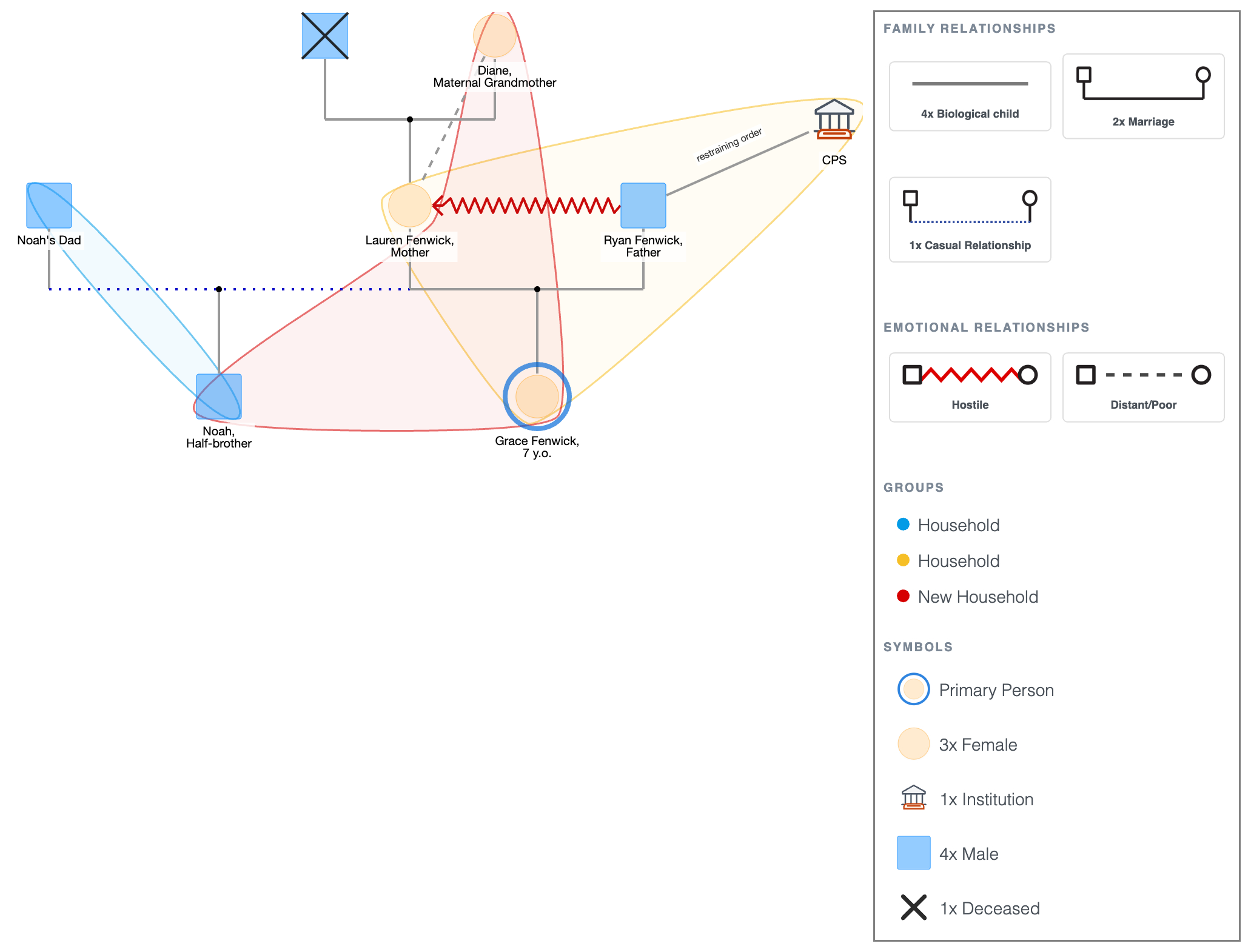
- Grace Fenwick, 7, primary person, removed following a domestic violence incident.
- Mother: Lauren Fenwick - no independent housing, agreed to a safety plan.
- Father: Ryan Fenwick - Hostile line to Lauren, restraining order noted via institution node.
- Maternal grandmother: Diane - estranged from Lauren, later identified as kinship placement.
- Half-brother: Noah, 14 (Lauren's son from a previous casual relationship).
- CPS/family court institution node connected to the household :::
Grace Fenwick, 7, was removed after a domestic violence incident between her parents led to a restraining order against her father, Ryan.
Her mother, Lauren, had no independent housing at the time and agreed to a safety plan while the agency worked out next steps.
When the caseworker first asked about extended family, Lauren said she didn't have anyone nearby who could help.
What the Genogram Revealed
The caseworker didn't stop at that answer. Working through the genogram interview systematically, asking about grandparents, aunts, uncles, and cousins on both sides rather than accepting the initial "no one," she learned that Lauren's mother, Diane, lived across town.
Lauren and Diane had been estranged since Lauren's teenage years, but Diane had been sending birthday cards to Grace for years and had reached out to Lauren a few times since Grace was born, unsure how to approach a reconciliation but clearly still present in the family's periphery.
The genogram also surfaced Grace's older half-brother, Noah, 14, from Lauren's previous relationship, currently in a separate household arrangement.
Keeping the two siblings together became part of the placement question once Noah was visible on the same diagram as Grace.
How This Shaped the Case Plan
Diane passed the kinship assessment, and Grace was placed with her rather than entering foster care, with Noah placed there as well so the siblings stayed together.
The restraining order against Ryan is documented directly on the genogram through the institution node, alongside the ongoing CPS involvement, giving anyone reviewing the case a single diagram that shows the safety concern, the placement, and the family structure at once.
As the case moves toward a permanency hearing, the same genogram gets updated rather than rebuilt, tracking Lauren's progress on her safety plan and Diane's ongoing role as kinship caregiver.
None of this changes what happened to Grace. It changed how quickly the agency found a placement that kept her connected to family instead of defaulting to foster care because the first answer was "no one."
Build One for a Case
Map at least three generations on both maternal and paternal sides, asking specifically about grandparents, aunts, uncles, and older cousins rather than relying on who the parent volunteers first.
Use foster or kinship placement lines to show where the child is actually living, and add an institution node for CPS or court involvement directly on the diagram.
Mark relationship quality, Close, Hostile, Distant, as it comes up, and document where information came from, since disputed or unconfirmed details matter in a case file.
Export as PDF for court reports and case reviews, and update it at every significant case event rather than treating it as a one-time document.
For the full guide, see How to Make a Genogram.
Genogram for Child Welfare
Explore this genogram and adapt it to your needs.
FAQ
How is a child welfare genogram different from a standard family genogram?
It adds child-protection-specific notation; foster and kinship placement lines showing where the child currently lives, institution nodes for CPS or court involvement, and risk and protective factors documented directly on relevant family members, alongside the standard three-generation structure.
What if a parent says there's no extended family who can help?
Ask about specific relationships, grandparents, aunts, uncles, older cousins, rather than accepting a general "no one." Shame, distance, or simply not being asked directly are common reasons a parent doesn't volunteer a relative who turns out to be a viable option.
Can a genogram be used in a court report?
Yes. Genograms are commonly included in care proceedings and permanency hearings to give a judge a clear visual summary of the family structure and placement history. Include a legend, a date, and note the source of any disputed information.
How do you show a restraining order or active court involvement on a genogram?
Use an institution node connected to the relevant household, noting the specific legal detail, like a restraining order, directly. This keeps the safety information visible on the same diagram as the family structure rather than buried in separate case notes.
How often should a child welfare genogram be updated?
At every significant case event such as a new placement, a reunification step, a court hearing, or a newly identified family member. Treating it as a living document rather than a one-time intake form is what keeps it useful across the life of the case.
Sources
- Diagrammatic assessment of family relationships
- Genograms: Assessment and Intervention (4th ed.)