Appearance
Foster Family Genogram Template
A foster family genogram template helps you show foster placements, birth parent connections, and the household the child is living in right now. Use it when a case needs clear foster-care notation instead of a generic family tree or a standard genogram that misses placement dynamics.
Foster Family Genogram Template
What This Template Shows
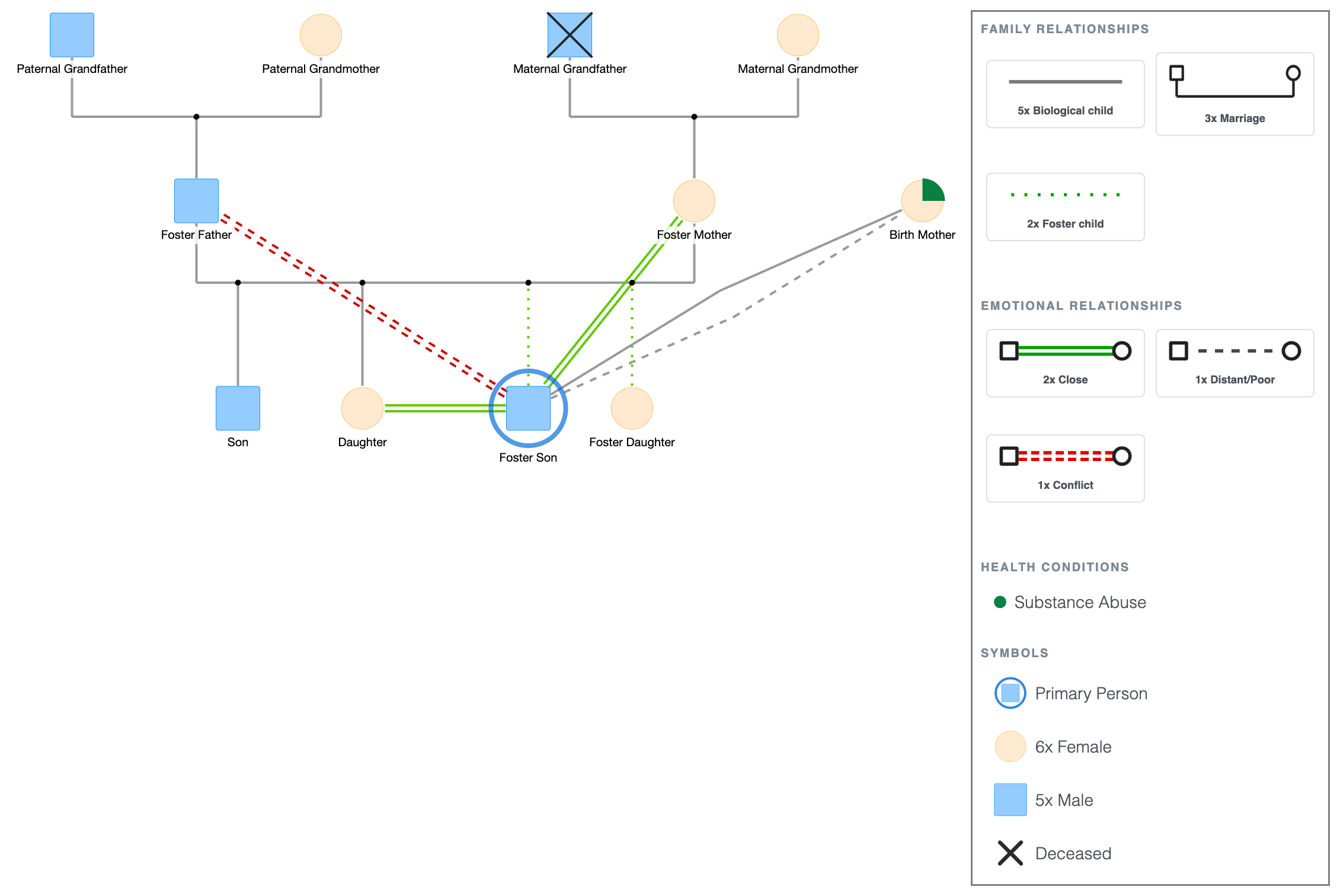
Three generations centered on a foster family household.
The foster parents have two biological children; a son and a daughter.
Two foster children are placed in their household, connected to the foster parents by dotted foster child lines.
The birth mother of the first foster child (the primary person) is shown separately in the diagram with a substance use marker.
The foster household picture is visible in the diagram: two placement children living alongside two biological children, the birth mother present in the family map but with a distant relationship with her son, and the relational dynamics inside the household showing both connection and tension. The foster child has a close relationship with the foster mother and the biological daughter, and a conflict line with the foster father.
The symbol legend is displayed below the diagram. For full definitions and clinical usage, see Genogram Symbols Explained.
When to Use This Template
- Foster family assessment and placement documentation: map the foster household composition, the placement children's connections to their birth families, and the relational dynamics within the household for case planning and review.
- Social work and child welfare case documentation: document the full family picture; foster parents, biological children, placement children, and birth parent connections in a single diagram for case records or court reports.
- Foster care training and support planning: use the template as a reference for foster carers and support workers learning how to map complex household configurations.
- Child welfare and MSW coursework: meets standard documentation requirements for foster care and child welfare tracks within BSW and MSW programs.
How to Use This Template
1. Download as-is
Click the PDF or PNG button under the embed to download immediately. Use as a case reference, supervision document, or teaching example for foster care notation.
2. Customize before downloading
Click "Use this genogram" to open the template in EasyGenogram. Replace the generic labels with real or fictional names, adjust the household configuration, and update the foster child lines, birth parent connections, and relationship lines to reflect the actual foster family.
Export as PDF or PNG when done, or share via link with a supervisor or case team.
Foster Family Genogram Template
Explore this genogram and adapt it to your needs.
FAQ
What is a foster family genogram template?
A foster family genogram template maps a household where foster parents care for one or more children placed by child welfare services alongside their own biological children. It shows the foster child's connection to their foster family using dotted foster child lines and documents the birth parents separately in the diagram, giving caseworkers and clinicians a complete picture of the child's legal, biological, and relational family system.
How do you show a foster child in a genogram?
A foster child is connected to their foster parents by a dotted vertical line; the standard foster placement notation in McGoldrick-Gerson-Petry clinical genograms. This distinguishes the placement relationship from a biological child line (solid) or an adoption line (dashed).
How is a foster family genogram different from an adoptive family genogram?
Both show non-biological parent-child relationships, but the notation and legal context differ. A foster child is connected to foster parents by a dotted line, indicating a temporary placement that has not been legally finalized. An adopted child is connected to adoptive parents by a dashed line, indicating a completed legal adoption.
Is this template free?
Yes. Open and customize it in EasyGenogram at no cost. Export requires a subscription for most users; students with a valid school email can export free.
Can I use this for a child welfare or MSW coursework assignment?
Yes. The template follows McGoldrick-Gerson-Petry standard notation and includes the foster child lines and birth parent notation required for foster care documentation. Open it in EasyGenogram, adjust the household configuration to match your assignment or case, and export as PDF for submission.